Quasilocalization under coupled mutation-selection dynamics
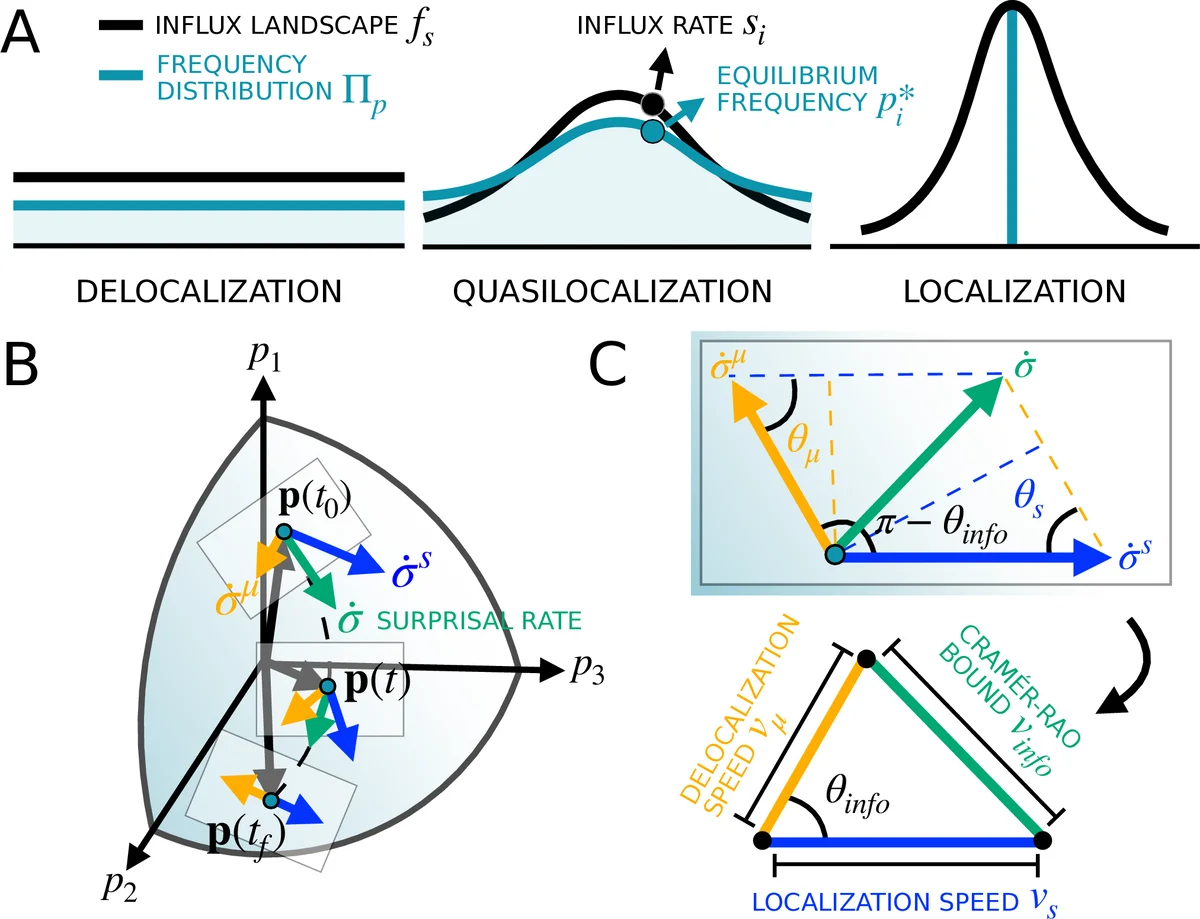
When mutations are rampant, quasispecies theory or Eigen’s model predicts that the fittest type in a population may not dominate. Beyond a critical mutation rate, the population may even be delocalized completely from the peak of the fitness landscape and the fittest is ironically lost. Extensive efforts have been made to understand this exceptional scenario. But in general, there is no simple prescription that predicts the eventual degree of localization for arbitrary fitness landscapes and mutation rates. Here, we derive a simple and general relation linking the quasispecies’ Hill numbers, which are diversity metrics in ecology, and the ratio of an effective fitness variance to the mean mutation rate squared. This ratio, which we call the localization factor, emerges from mean approximations of decomposed surprisal or stochastic entropy change rates. On the side of application, the relation we obtained here defines a combination of Hill numbers that may complement other complexity or diversity measures for real viral quasispecies. Its advantage being that there is an underlying biological interpretation under Eigen’s model.
💡 Research Summary
The paper tackles a long‑standing problem in quasispecies theory: how to predict the degree of localization of a population under arbitrary fitness landscapes and mutation rates. Classical Eigen’s model tells us that beyond a critical mutation rate the fittest genotype may be lost and the population can become completely delocalized, but it offers no simple, general metric for intermediate regimes. The authors introduce a new dimensionless quantity, the localization factor (L), defined as the ratio of an effective fitness variance (\sigma_{\text{eff}}^{2}) to the square of the mean mutation rate (\mu): \
Comments & Academic Discussion
Loading comments...
Leave a Comment