Beyond Attraction: A Novel Approach to Repulsive Casimir-Lifshitz Forces using heterogeneous off-stoichiometry in gapped metals
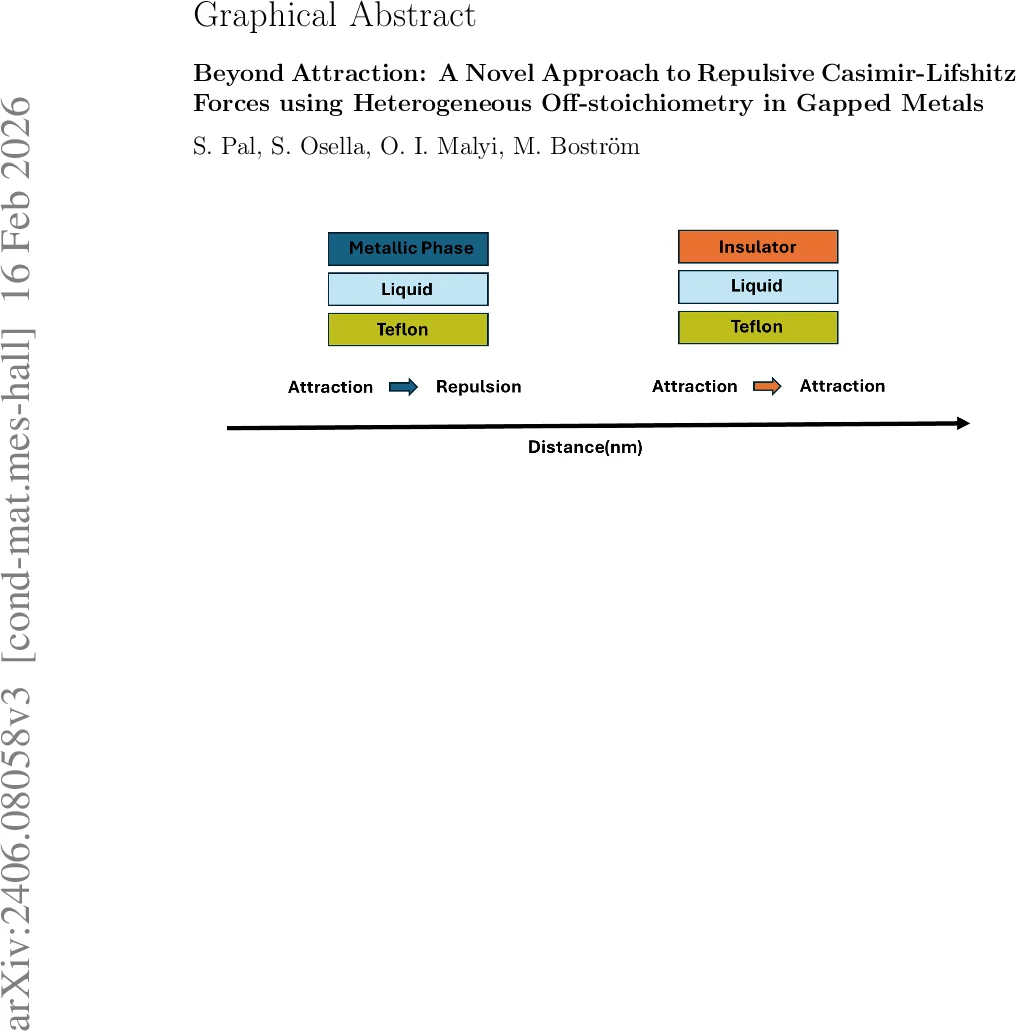
We uncover a novel physical mechanism that enables a switch between attractive and repulsive Casimir forces when a Teflon surface interacts with a new form of quantum material (i.e., gapped metal) surface across different liquid media. We demonstrate the discovery of a zero-frequency Casimir effect, which, for the first time, reveals the potential for quantum switching within nanometer distances-a scale previously thought to be unattainable. Hence, our results introduce a new method to induce phase (stoichiometry)-controlled attraction-repulsion transitions and achieving quantum levitation in a liquid medium by tuning the liquid environment. This study thus not only advances our understanding of quantum forces at the nanoscale via their correlation to dielectric properties of involved materials but also opens up exciting possibilities for their manipulation in novel ways, forming the basis towards innovative advancements in nanoscale technology.
💡 Research Summary
This paper presents a groundbreaking theoretical discovery in the field of quantum vacuum fluctuations and Casimir-Lifshitz forces. The authors propose a novel mechanism to actively switch the Casimir force between attractive and repulsive states at nanoscale separations, a feat with significant implications for nanotechnology.
The central innovation lies in the use of “gapped metals,” a unique class of quantum materials like Ca6-xAl7O16, whose electronic properties can be tuned between metallic and insulating phases by varying their stoichiometry (the ‘x’ value). This off-stoichiometry creates heterogeneous surfaces with patches of different optical properties. The study models a three-layer system consisting of a gapped metal substrate, an intervening liquid medium (e.g., methanol, bromobenzene), and a Teflon (PTFE) surface.
Through rigorous Lifshitz theory calculations, the authors demonstrate that for metallic phases of the gapped metal (e.g., Ca6Al7O16), the Casimir-Lifshitz interaction with PTFE across a methanol layer transitions from attractive to repulsive at remarkably short distances of approximately 2 nm and 5.9 nm, depending on the specific stoichiometry. This sign reversal is absent in the non-retarded (van der Waals) limit and is a direct consequence of including retardation effects at finite light speed.
A key and counterintuitive finding is the dominant role of the “zero-frequency term” (the m=0 Matsubara mode) at these ultra-small separations. Traditionally, this entropic contribution was considered significant only at much larger distances (>100 nm) or higher temperatures. Here, because the dielectric functions of the gapped metal and the liquid are similar at high frequencies but contrast sharply at zero frequency, the zero-frequency term becomes a major contributor even at 2-3 nm, enabling the force reversal. This redefines the understanding of thermal effects in nanoscale Casimir physics.
The switch can be controlled in two ways: (1) by chemically tuning the local stoichiometry (and hence the phase) of the gapped metal surface, creating a spatial pattern of attractive and repulsive zones, effectively acting as a “quantum switch”; and (2) by changing the liquid medium, which alters the dielectric contrast condition (ε_gapped metal > ε_liquid > ε_PTFE) required for repulsion.
The paper provides detailed spectral analysis, showing how retardation suppresses attractive high-frequency contributions and enhances repulsive low-frequency ones. It also contrasts the behavior of metallic vs. insulating phases, with the former showing long-range repulsion and the latter attraction. The work suggests potential applications in preventing stiction in NEMS, enabling quantum levitation of nanoscale components, and designing novel actuation systems, thereby opening a new avenue for manipulating quantum forces at the nanoscale for advanced technological applications. The authors note that future work should incorporate molecular-scale effects like fluid structure and surface roughness for a complete picture.
Comments & Academic Discussion
Loading comments...
Leave a Comment