A Huygens-Leibniz-Lange framework for classical mechanics
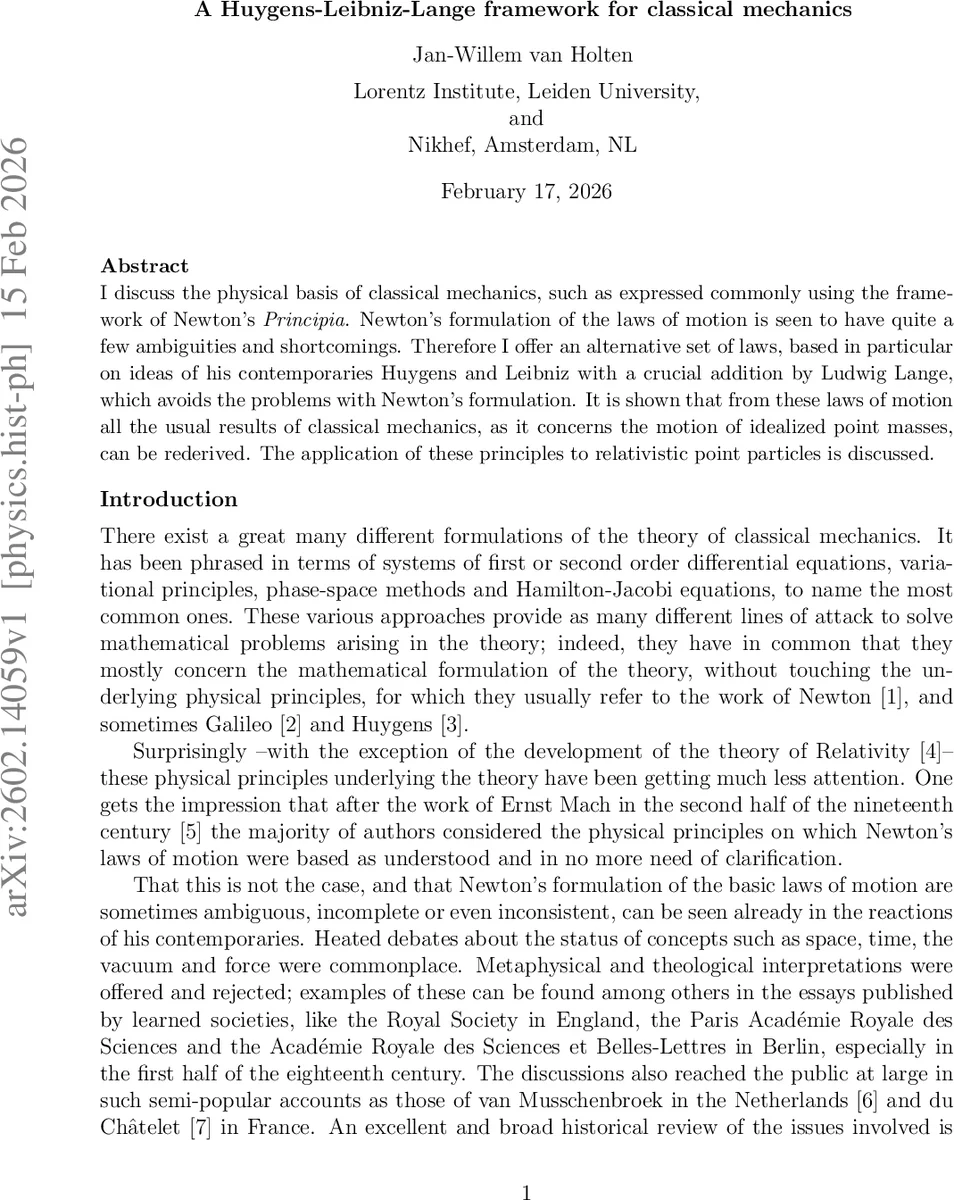
I discuss the physical basis of classical mechanics, such as expressed commonly using the framework of Newton’s Principia. Newton’s formulation of the laws of motion is seen to have quite a few ambiguities and shortcomings. Therefore I offer an alternative set of laws, based in particular on ideas of his contemporaries Huygens and Leibniz with a crucial addition by Ludwig Lange, which avoids the problems with Newton’s formulation. It is shown that from these laws of motion all the usual results of classical mechanics, as it concerns the motion of idealized point masses, can be rederived. The application of these principles to relativistic point particles is discussed.
💡 Research Summary
The paper begins by pointing out several ambiguities and logical gaps in Newton’s formulation of classical mechanics, especially the reliance on absolute space and time without a clear operational definition of an inertial frame. To remedy this, the author adopts Ludwig Lange’s 1885 construction of inertial frames: three force‑free particles moving uniformly in straight lines are used to define the coordinate axes, thereby making the principle of inertia independent of Newton’s second law.
Next, the author discards the notion of “force” as a fundamental entity and elevates the conservation of energy—specifically the vis‑viva or kinetic energy ½ mv²—into a primary postulate. This idea, originally advanced by Huygens and Leibniz, is shown to be sufficient for describing free‑fall, pendulum motion, and elastic collisions. By analysing collisions in a frame moving with arbitrary constant velocity u, the paper demonstrates that if kinetic energy is conserved in one frame, momentum conservation follows automatically, revealing a deep symmetry between the two quantities.
The treatment of mass is also revised. Instead of Newton’s density‑times‑volume definition, mass is defined experimentally through the ratio of observed velocity changes in binary collisions (Δv₁/Δv₂), echoing Ernst Mach’s proposal that inertia originates from the gravitational influence of distant masses. This operational definition eliminates the need for an a priori concept of inertial mass and links it directly to measurable quantities.
Newton’s third law (action–reaction) is reinterpreted as a consequence of the simultaneous conservation of energy and momentum, rather than as a separate axiom about forces. The paper shows that the equality and opposite direction of the interaction emerge naturally from the symmetry of the conservation laws.
Finally, the author extends the Huygens‑Leibniz‑Lange framework to relativistic point particles. By applying Lorentz transformations to the energy‑momentum conservation equations, the same structure replaces the Newtonian force‑acceleration relation, demonstrating compatibility with special relativity and reinforcing the central role of inertial frames.
In summary, the work argues that classical mechanics can be rebuilt on a foundation of directly observable kinematic quantities and conservation principles, without invoking an abstract force concept. This reconstruction clarifies the physical basis of the theory, aligns it more closely with modern physics, and offers a coherent bridge to relativistic dynamics.
Comments & Academic Discussion
Loading comments...
Leave a Comment