Strongly connected orientations and integer lattices
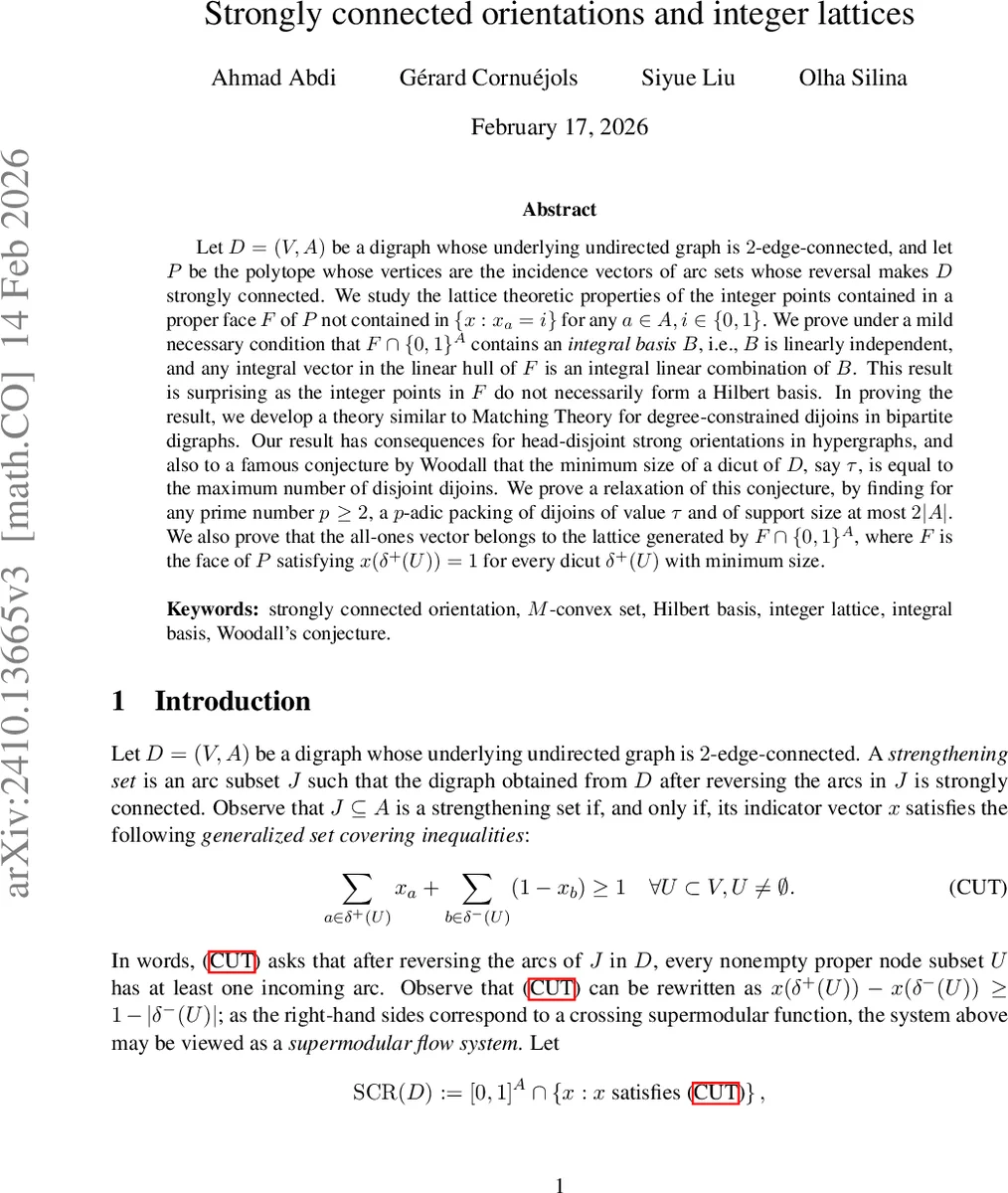
Let $D=(V,A)$ be a digraph whose underlying undirected graph is $2$-edge-connected, and let $P$ be the polytope whose vertices are the incidence vectors of arc sets whose reversal makes $D$ strongly connected. We study the lattice theoretic properties of the integer points contained in a proper face $F$ of $P$ not contained in ${x:x_a=i}$ for any $a\in A,i\in {0,1}$. We prove under a mild necessary condition that $F\cap {0,1}^A$ contains an integral basis $B$, i.e., $B$ is linearly independent, and any integral vector in the linear hull of $F$ is an integral linear combination of $B$. This result is surprising as the integer points in $F$ do not necessarily form a Hilbert basis. In proving the result, we develop a theory similar to Matching Theory for degree-constrained dijoins in bipartite digraphs. Our result has consequences for head-disjoint strong orientations in hypergraphs, and also to a famous conjecture by Woodall that the minimum size of a dicut of $D$, say $τ$, is equal to the maximum number of disjoint dijoins. We prove a relaxation of this conjecture, by finding for any prime number $p\geq 2$, a $p$-adic packing of dijoins of value $τ$ and of support size at most $2|A|$. We also prove that the all-ones vector belongs to the lattice generated by $F\cap {0,1}^A$, where $F$ is the face of $P$ satisfying $x(δ^+(U))=1$ for every dicut $δ^+(U)$ with minimum size.
💡 Research Summary
The paper studies the polytope SCR(D) consisting of all 0‑1 vectors that indicate a set of arcs whose reversal makes a given digraph D strongly connected. D is assumed to have a 2‑edge‑connected underlying undirected graph, which guarantees that SCR(D) is a non‑empty integral polytope. Its defining inequalities are the “CUT” constraints: for every non‑empty proper vertex subset U, the vector x must satisfy x(δ⁺(U)) – x(δ⁻(U)) ≥ 1 – |δ⁻(U)|. Vertices of SCR(D) correspond exactly to strengthening sets (sets of arcs whose reversal yields strong connectivity).
The main focus is on a proper face F of SCR(D) that is not fixed by any variable x_a = 0 or 1. Such a face is described by a family ℱ of vertex subsets; for each U∈ℱ the equality x(δ⁺(U)) – x(δ⁻(U)) = 1 – |δ⁻(U)| holds. The authors prove a lattice‑theoretic result (Theorem 1.1): if the greatest common divisor of the integers {1 – |δ⁻(U)| : U∈ℱ} equals 1, then the set of 0‑1 points in F contains an integral basis for the linear hull lin(F). In other words, there exists a linearly independent subset B⊆F∩{0,1}^A such that every integer vector in lin(F) can be expressed as an integer linear combination of vectors in B. The GCD condition is shown to be necessary; without it an integral basis may not exist.
The proof does not rely on the usual Hilbert‑basis arguments—indeed the integer points of F need not form a Hilbert basis— but instead develops a theory reminiscent of matching theory for degree‑constrained dijoins in bipartite digraphs. The authors introduce the notion of a “digraft”: a pair (D,ℱ) where D is a bipartite digraph (every vertex is either a source or a sink), its underlying graph is 2‑edge‑connected, and ℱ satisfies natural closure properties. For a digraft they consider the dijoin polyhedron DIJ(D) and the face defined by the equalities x(δ⁺(U)) = 1 for all U∈ℱ. By analysing minimal dijoins and exploiting the bipartite structure, they establish the existence of the integral basis in the general (non‑bipartite) setting of SCR(D).
Three significant applications are presented:
-
Relaxation of Woodall’s conjecture. Woodall conjectured that the maximum number of pairwise disjoint dijoins equals the minimum size τ of a dicut. Theorem 1.3 shows that for any digraph whose minimum dicut size is τ, one can assign integer weights λ_J to strengthening sets J such that each minimum dicut is intersected exactly once, the total weight sums to τ, and the collection of weighted characteristic vectors forms an integral basis of their linear span. This replaces the conjectured non‑negative integer weights with unrestricted integer weights, providing a strong partial result. The authors also discuss why the stronger statement fails in the presence of capacity constraints.
-
p‑adic packing of dijoins. For any prime p≥2, the dual linear program (D) associated with the dijoin packing problem admits a p‑adic optimal solution with at most 2|A| non‑zero entries (Theorem 1.4). This improves the Carathéodory bound (|A| non‑zeros) by only a factor of two while guaranteeing a representation in the p‑adic number system, which is valuable for exact computation. The result does not extend to the capacitated version, although recent work shows dyadic (2‑adic) solutions always exist.
-
Head‑disjoint strong orientations of hypergraphs. For a τ‑uniform hypergraph H satisfying d_H(X)≥τ for every non‑empty proper X⊂V (where d_H(X) counts the sum of |X∩E| over hyperedges separated by X), Theorem 1.6 constructs integer weights λ_O for strongly connected orientations O such that each hyperedge contributes exactly one unit of weight to each of its vertices, and the number of orientations with zero weight is bounded by (τ−1)|E|+1. This is a relaxation of a conjecture by Bérczi and Chandrasekaran, which would require non‑negative weights.
The paper also clarifies the limits of the main theorem. It does not hold for faces that involve both the CUT constraints and explicit 0‑1 bounds, nor does it survive when additional capacity constraints are imposed on the primal problem. Counterexamples and a discussion of these boundaries appear in §6.7, along with conjectures for possible extensions.
In summary, the authors reveal a surprising lattice structure in faces of the strong‑connectivity orientation polytope, develop new combinatorial tools for bipartite digraphs, and apply the theory to longstanding open problems in digraph packing, p‑adic optimization, and hypergraph orientation. The work opens several avenues for further research, including extending the integral‑basis result to more general faces and strengthening the connection to Woodall’s conjecture.
Comments & Academic Discussion
Loading comments...
Leave a Comment