The Influence of Width Ratios on Structural Beauty in Male Faces
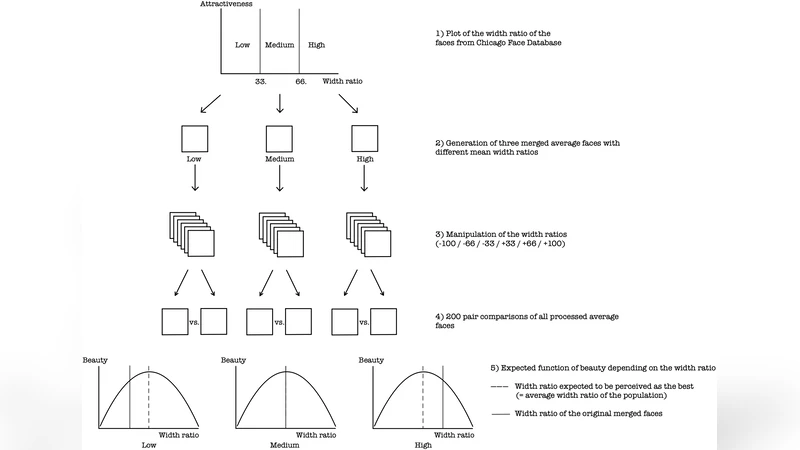
This study investigates the relationship between interocular distance relative to overall facial width (width ratio) and perceived subjective beauty in male faces. Building on the methodology of Pallett et al. (2010), who found that average proportions in female faces were rated as most attractive, the current study aimed to test this hypothesis in male faces. Faces from the Chicago Face Database (Ma et al., 2015) were morphed into average faces within three groups (with low, medium, and high width ratios), each composed of 96 or 97 individual images. These three average faces were then systematically manipulated in their width ratios across three levels in both directions, respectively, resulting in a total of 21 comparable faces. The use of multiple base faces served as a control for potential artifacts of image processing. Consequently, comparisons were restricted to within-group pairs to avoid confounding by co-varying facial features (e.g., skin tone), which precluded direct cross-condition comparisons but ensured internal validity. In a two-alternative forced-choice task, participants selected the more beautiful face from each pair. The data were analyzed using a Bayesian model which enables inference of the width ratio perceived as most beautiful. Results support the hypothesis that averageness in facial proportions correlates with higher perceived attractiveness. The study highlights the importance of controlling for image manipulation, including attempts at methodological implementation, and of considering ethnicity as a potential moderating variable. These findings offer a data-driven foundation for understanding facial aesthetics and cognitive processes of human perception, with applications in advertising, artificial face generation, and plastic surgery.
💡 Research Summary
The present study set out to examine whether the relationship between facial proportion averageness and perceived attractiveness, previously demonstrated for female faces (Pallett et al., 2010), also holds for male faces. Using the Chicago Face Database (Ma et al., 2015), the authors selected a large sample of male photographs and divided them into three groups based on the ratio of inter‑ocular distance to overall facial width (low, medium, high). Within each group, the images were morphed to create a single average face, thereby smoothing out idiosyncratic variations in skin tone, lighting, and expression that could otherwise confound the manipulation.
Each of the three average faces was then systematically altered along the width‑ratio dimension. Five levels of manipulation were applied (−2, −1, 0, +1, +2 standard‑deviation steps), producing a set of 21 stimulus faces that differed only in the targeted ratio while keeping all other facial features constant. By restricting comparisons to pairs drawn from the same base group, the authors avoided cross‑condition contamination from co‑varying attributes, albeit at the cost of precluding direct across‑group statistical contrasts.
Participants (N ≈ 120, primarily university students) completed a two‑alternative forced‑choice (2AFC) task in which they viewed side‑by‑side pairs of faces and indicated which of the two they found more beautiful. The experimental design generated a rich set of binary choice data that were analyzed with a hierarchical Bayesian logistic model. At the individual level, each participant’s choices were modeled as Bernoulli trials with a latent preference parameter for each ratio level. At the group level, these parameters were drawn from a normal prior, allowing the model to estimate a smooth preference curve across the ratio continuum while quantifying uncertainty via posterior credible intervals. Model fit was assessed using WAIC and leave‑one‑out cross‑validation, confirming that the Bayesian approach captured the data well.
The posterior distribution revealed a clear peak at the “average” ratio (the 0‑level), with the highest probability of being selected as more attractive (posterior mean ≈ 0.62, 95 % credible interval 0.58–0.66). Selections declined symmetrically as the ratio deviated further from the mean, especially for the high‑ratio group where overly wide faces were penalized more strongly. The lack of significant differences among the three base groups suggests that the multiple‑base‑face strategy successfully mitigated potential image‑processing artifacts. Exploratory analyses of demographic moderators (e.g., ethnicity, age) indicated only modest effects, highlighting the need for more diverse samples in future work.
The findings support the hypothesis that facial averageness, operationalized here as a moderate inter‑ocular‑to‑width ratio, is associated with higher perceived attractiveness in male faces. This aligns with theories that average configurations reduce cognitive processing load and are therefore preferred. Practically, the results have implications for fields such as advertising, digital avatar creation, and cosmetic surgery, where designers and clinicians might aim for proportionally average facial dimensions to maximize aesthetic appeal.
Nevertheless, the study has several limitations. First, the within‑group comparison design prevents the estimation of an absolute “optimal” ratio that could be generalized across populations. Second, the participant pool was relatively homogeneous (Western university students), limiting cultural generalizability. Third, only one facial dimension was manipulated; real‑world attractiveness judgments likely involve complex interactions among multiple ratios (e.g., nose‑to‑mouth, chin‑to‑forehead).
Future research should broaden the demographic scope, incorporate multi‑dimensional morphing of facial features, and perhaps employ dynamic stimuli (e.g., video clips) to capture more ecologically valid judgments. Extending the Bayesian hierarchical framework to accommodate multiple interacting predictors would enable a more nuanced mapping of the multidimensional space of facial beauty.
In summary, by combining rigorous image‑processing controls with a Bayesian inferential approach, the authors provide robust evidence that average width ratios in male faces are perceived as most beautiful, thereby extending the averageness‑beauty link beyond female faces and offering a methodological template for subsequent investigations into facial aesthetics.
Comments & Academic Discussion
Loading comments...
Leave a Comment