Preparing Quantum Backflow States by Large Momentum Transfer
A quantum backflow state refers to a quantum state exhibiting negative probability density flux albeit a completely positive momentum spectrum. Extending earlier work that uses single laser pulse to prepare quantum backflow state in an ultracold atomic BEC [1], we theoretical investigated flexible quantum backflow state preparation via large momentum transfer technique, which to our knowledge, has not been studied before. By combining atom interferometry theory and non-interacting BEC wave function, we solve for the evolution of a BEC wavepacket under atom interferometry sequence. Simulation results show a highly tunable backflow flux and critical density under our scheme, and can be manipulated to go beyond existing numbers.
💡 Research Summary
The manuscript presents a comprehensive theoretical proposal for generating and controlling quantum backflow states in an ultracold atomic Bose‑Einstein condensate (BEC) by exploiting large‑momentum‑transfer (LMT) techniques within an atom‑interferometry framework. Quantum backflow is a counter‑intuitive quantum‑mechanical effect whereby a particle with an entirely positive momentum distribution can exhibit a locally negative probability‑current density. Although the phenomenon has been rigorously studied theoretically, it has never been observed experimentally.
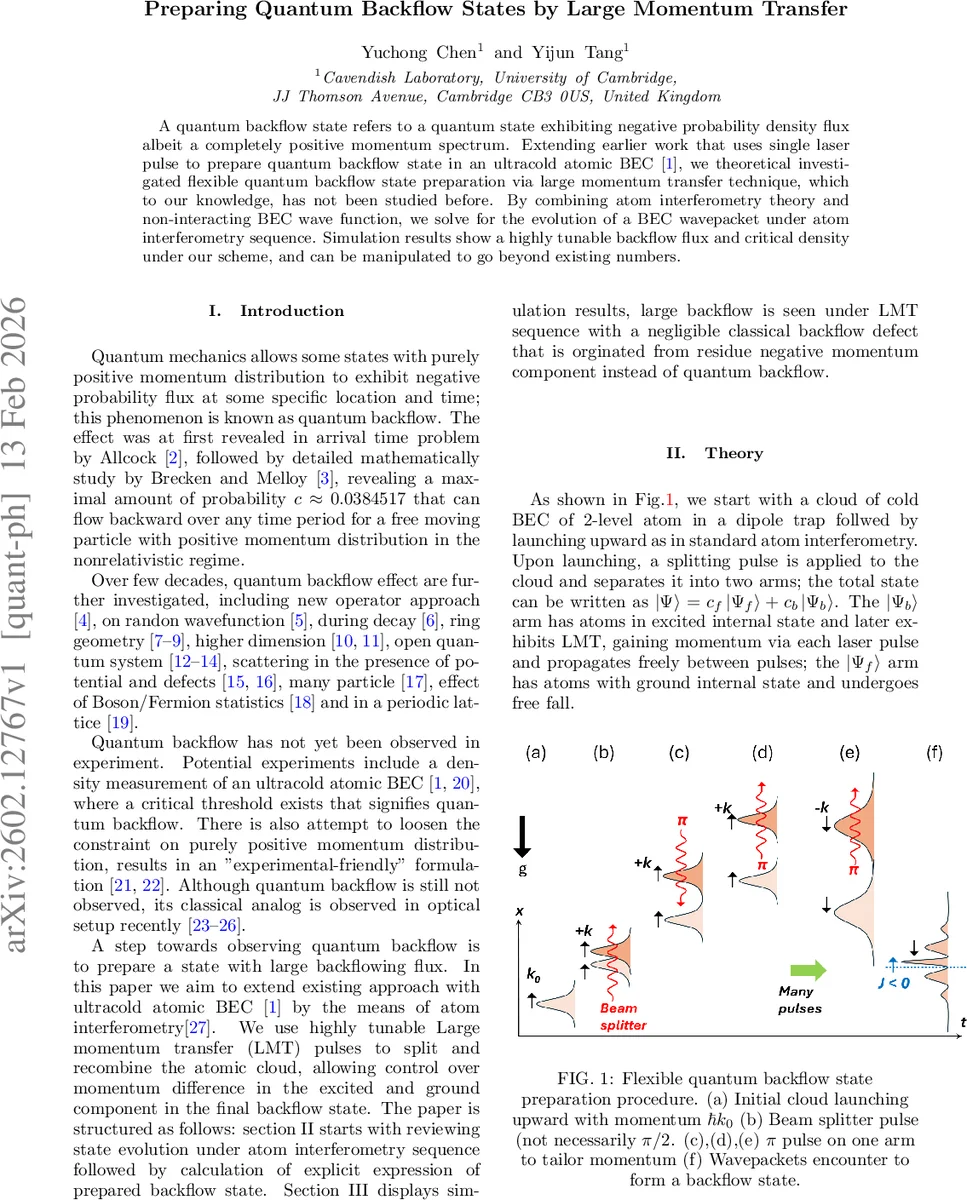
The authors extend the earlier single‑pulse scheme (which used a modest momentum kick) by introducing a sequence of π‑pulses that impart tens to over a hundred photon recoils (ℏk) to one arm of a Mach‑Zehnder‑type interferometer while the other arm evolves freely. The key steps are:
-
Modeling of free evolution – Using a Galilean transformation operator, the center‑of‑mass (COM) motion of a non‑interacting BEC is separated from its internal state. The COM wavefunction remains Gaussian, with a time‑dependent width b(t) and position x_c(t).
-
Laser‑pulse interaction – In the short‑pulse limit the atom‑light coupling is described by a two‑level Rabi matrix. A general pulse of area Ωτ yields coefficients Λ_c = cos(Ωτ/2) and Λ_s = sin(Ωτ/2). A π‑pulse (Ωτ = π) swaps the internal state and adds a momentum kick ±ℏk, while an arbitrary splitting pulse (not necessarily π/2) determines the complex amplitudes c_f and c_b of the two interferometer arms.
-
State after the interferometer – The free arm |Ψ_f⟩ is obtained analytically from the Gaussian solution; the LMT arm |Ψ_b⟩ accumulates a series of momentum kicks and phase factors from each π‑pulse. At the final recombination time T_f the total wavefunction is a coherent sum
\
Comments & Academic Discussion
Loading comments...
Leave a Comment