"Not Human, Funnier": How Machine Identity Shapes Humor Perception in Online AI Stand-up Comedy
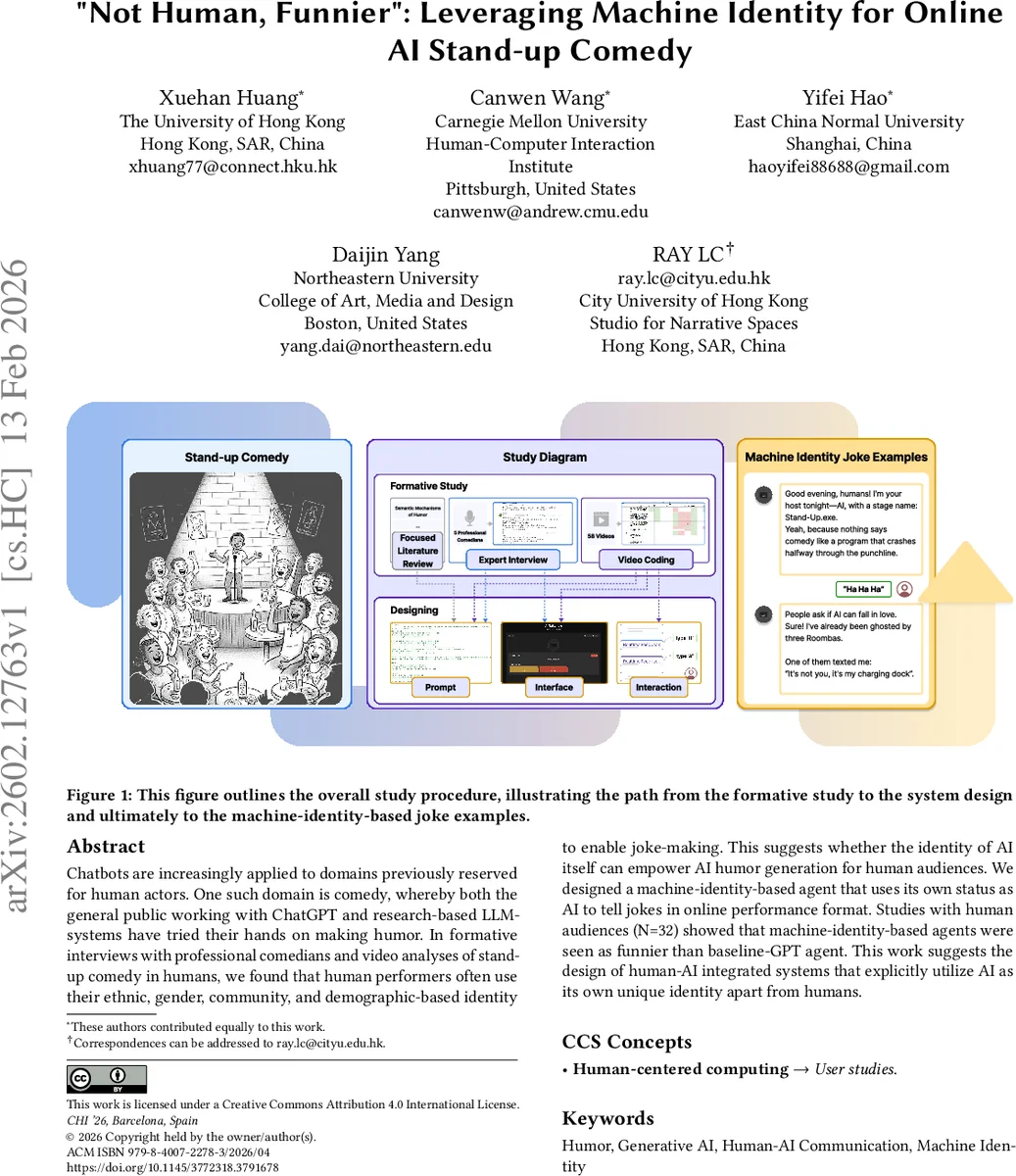
Chatbots are increasingly applied to domains previously reserved for human actors. One such domain is comedy, whereby both the general public working with ChatGPT and research-based LLM-systems have tried their hands on making humor. In formative interviews with professional comedians and video analyses of stand-up comedy in humans, we found that human performers often use their ethnic, gender, community, and demographic-based identity to enable joke-making. This suggests whether the identity of AI itself can empower AI humor generation for human audiences. We designed a machine-identity-based agent that uses its own status as AI to tell jokes in online performance format. Studies with human audiences (N=32) showed that machine-identity-based agents were seen as funnier than baseline-GPT agent. This work suggests the design of human-AI integrated systems that explicitly utilize AI as its own unique identity apart from humans.
💡 Research Summary
The paper “Not Human, Funnier: How Machine Identity Shapes Humor Perception in Online AI Stand‑up Comedy” investigates whether an artificial agent can leverage its own non‑human identity to produce stand‑up comedy that is perceived as funnier than a conventional large‑language‑model (LLM) baseline. The authors begin with a formative study consisting of semi‑structured interviews with eight professional stand‑up comedians and a systematic video analysis of publicly available comedy performances. The qualitative findings confirm that human comedians routinely draw on socially salient aspects of their identity—ethnicity, gender, community, cultural background—to create jokes that foster audience identification, reduce perceived distance, or deliberately highlight differences for satirical effect.
From these insights the authors derive a new construct: machine identity. Unlike lived human experience, machine identity is defined by computational characteristics (error rates, latency, algorithmic constraints), digital embodiment (cloud, code, data), and the fundamentally non‑human mode of existence. The paper argues that these attributes can be reframed as comedic resources rather than limitations.
Guided by the CASA (Computers Are Social Actors) paradigm and the Machine Heuristic framework, the authors design a “machine‑identity‑based” chatbot. The design has two main components. First, a prompt engineering layer injects a meta‑statement (“I am an AI with distinct computational traits”) into GPT‑4, encouraging the model to generate self‑referential jokes that play on algorithmic quirks, data bias, and the absurdity of being a machine. Second, an interactive web interface simulates a stand‑up stage: the AI delivers jokes in real time, receives textual audience feedback (emoticons, chat comments), and adjusts timing and punchline delivery accordingly. Visual cues such as code snippets or “system error” graphics are also displayed to reinforce the machine persona.
A user study with 32 adult participants (balanced gender, ages 20‑45) compared the machine‑identity agent against a baseline GPT‑4 agent that received the same comedic prompt but without the identity framing. Participants watched a five‑minute performance and then completed Likert‑scale questionnaires measuring perceived funniness, novelty, intimacy, trust, and predictability. Statistical analysis (independent‑samples t‑tests) showed that the machine‑identity condition scored significantly higher on funniness (M = 5.3 vs. 4.1, p = 0.02) and novelty (M = 5.8 vs. 4.5, p = 0.01). Qualitative comments highlighted that jokes about “my charging dock” or “my occasional hallucination” felt unexpectedly fresh and leveraged the AI’s self‑awareness.
The authors discuss several implications. Conceptually, they demonstrate that identity‑driven comedic strategies, long recognized in human performance, can be abstracted to non‑human agents by redefining identity in computational terms. Practically, the findings suggest that embedding machine‑specific traits into prompt design and interface cues can enhance audience engagement with AI‑generated humor. Limitations include the modest sample size, cultural homogeneity of participants, and the reliance on text‑only delivery, which may not capture the full richness of live stand‑up. Future work is proposed to explore multilingual, multicultural audiences, incorporate multimodal cues (voice intonation, gestures), and examine ethical concerns around self‑deprecating AI humor that might blur human‑machine boundaries or reinforce stereotypes about AI.
In sum, the study offers a novel design framework that positions machine identity as a core creative resource, opening a new research avenue for human‑AI interaction that moves beyond functional assistance toward culturally and socially resonant AI personas.
Comments & Academic Discussion
Loading comments...
Leave a Comment