Nonlinear methods for tensors: determinantal equations for secant varieties beyond cactus
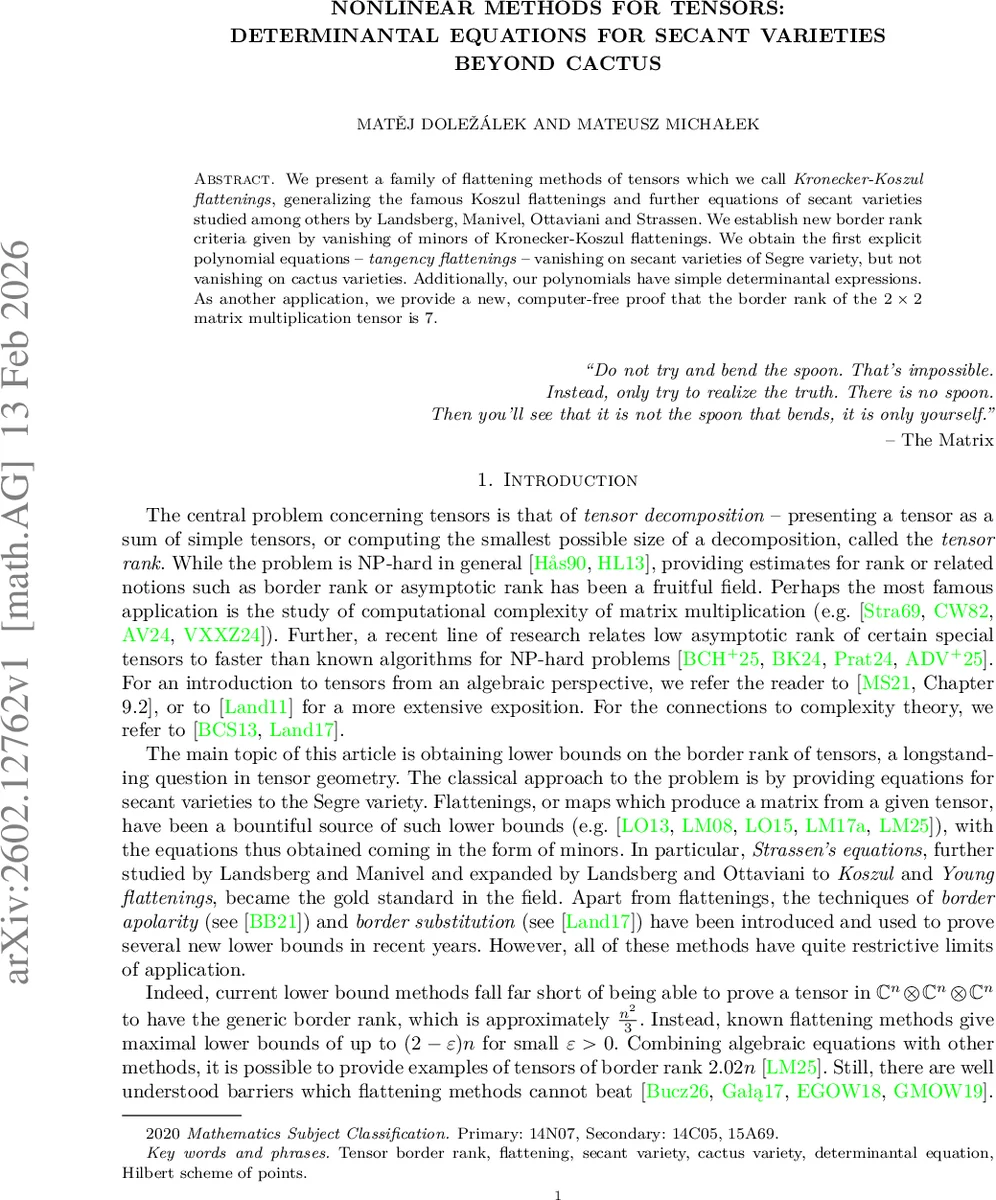
We present a family of flattening methods of tensors which we call Kronecker-Koszul flattenings, generalizing the famous Koszul flattenings and further equations of secant varieties studied among others by Landsberg, Manivel, Ottaviani and Strassen. We establish new border rank criteria given by vanishing of minors of Kronecker-Koszul flattenings. We obtain the first explicit polynomial equations – tangency flattenings – vanishing on secant varieties of Segre variety, but not vanishing on cactus varieties. Additionally, our polynomials have simple determinantal expressions. As another application, we provide a new, computer-free proof that the border rank of the $2\times2$ matrix multiplication tensor is $7$.
💡 Research Summary
The paper introduces a novel family of tensor flattenings called Kronecker‑Koszul flattenings, which extend the classical Koszul flattenings by incorporating a nonlinear map from the tensor space to a matrix space. The construction proceeds by first taking a k‑th tensor power of a given tensor T, then tensoring with auxiliary identity tensors J that encode exterior powers determined by a collection of partitions λ_{i,j} and integers d_{i,j}. A polynomial map π is then applied to the resulting tensor ˜T = T^{⊗k} ⊗ J, producing the Kronecker‑Koszul tensor T_π. Classical flattenings are applied to T_π, yielding matrices whose minors provide rank constraints.
The central result (Theorem 1.1) shows that for a specific quadratic instance of this construction, called the “tangency flattening,” all minors of size n·pⁿ⁻¹·q·pⁿ⁻²·q + 1 vanish on the n‑th secant variety σ_n of the Segre variety, yet they do not vanish generically on the n‑th cactus variety κ_n. Consequently, these minors give explicit determinantal equations that separate secant from cactus varieties—something previously thought impossible for any determinantal expression derived from flattenings. An explicit example for n = 14 is provided: the relevant minors are degree‑4370 polynomials in 2744 variables, yet their vanishing can be tested efficiently.
Using these tangency flattenings, the authors give a completely elementary, computer‑free proof that the border rank of the 2 × 2 matrix multiplication tensor ⟨2,2,2⟩ equals 7. The proof hinges on showing that the minors vanish for any decomposition of rank ≤ 7 but fail for rank ≤ 6, thereby establishing the exact border rank.
The paper also revisits Koszul flattenings in Section 4, applying them to structure tensors of finite‑dimensional commutative algebras. While Koszul flattenings often give trivial bounds for such tensors (because they produce spaces of commuting matrices), the authors demonstrate that even with Koszul flattenings one can obtain cactus‑rank lower bounds exceeding the algebra’s degree. Moreover, under mild hypotheses, certain quadratic Kronecker‑Koszul flattenings improve upon Koszul flattenings for border‑rank estimates.
The authors discuss the combinatorial factor F(p,q) that counts compatible colorings of a graph built from the partitions λ_{i,j}; this factor appears in the general rank bound of Theorem 3.3, linking the rank of T_π to the rank of the original tensor T.
In addition to the main technical contributions, the paper proposes Conjecture 6.1, suggesting a deeper connection between tangency flattenings and tangent spaces of Hilbert schemes of points, hinting at a geometric interpretation of the new equations.
Overall, the work delivers four major advances: (1) the conceptual shift to nonlinear flattenings, (2) explicit determinantal equations that distinguish secant from cactus varieties, (3) practical border‑rank criteria via minors of tangency flattenings, and (4) a new, elementary proof of the border rank of the 2 × 2 matrix multiplication tensor. These results open fresh avenues for both algebraic geometry of tensors and complexity‑theoretic applications.
Comments & Academic Discussion
Loading comments...
Leave a Comment