A Reanalysis of the FDA's Benefit--Risk Assessment of Moderna's mRNA-1273 COVID Vaccine Based on a Model Incorporating Benefits Derived from Prior COVID Infection
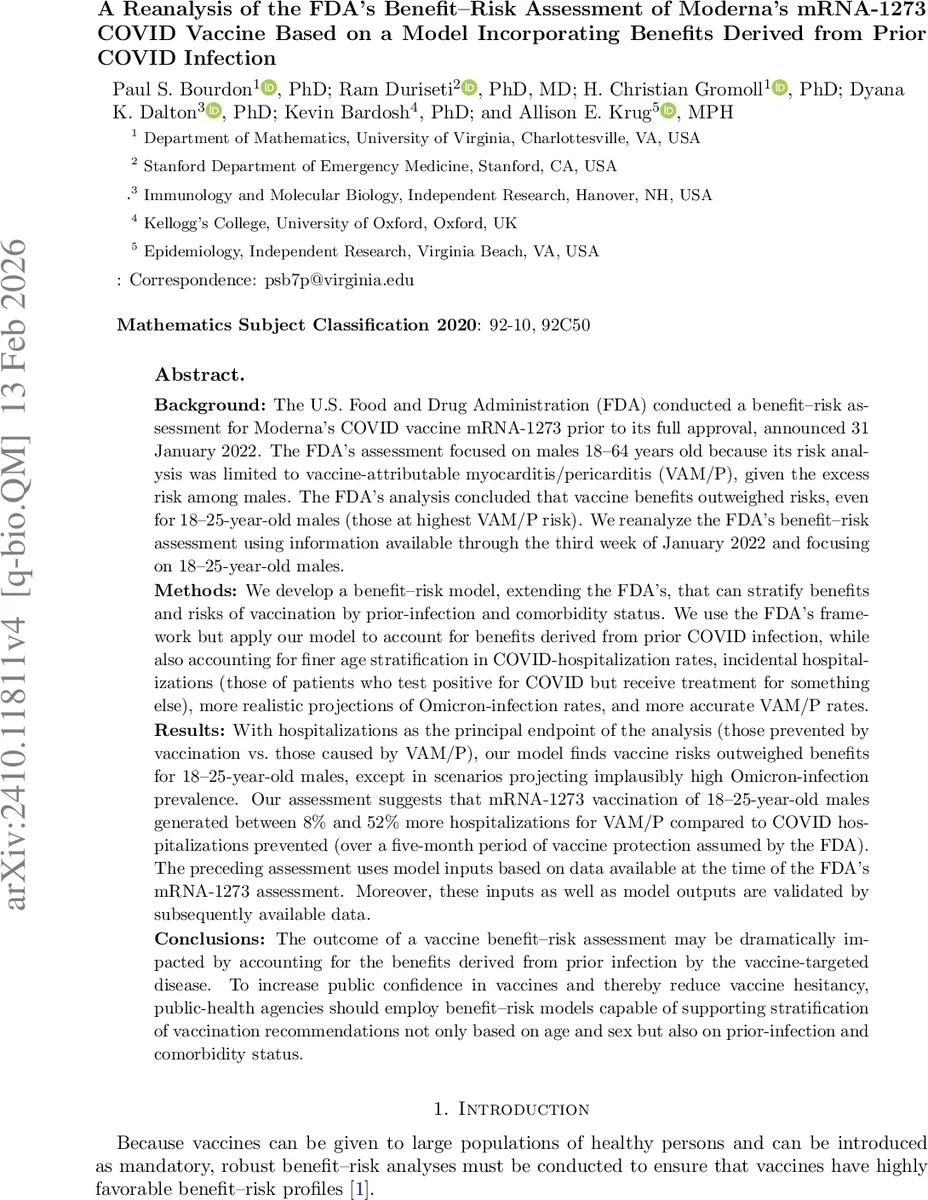
The United States Food and Drug Administration (FDA) conducted a benefit-risk assessment for Moderna’s COVID vaccine mRNA-1273 prior to its full approval, announced 1/31/2022. The FDA’s assessment focused on males of ages 18-64 years because the agency’s risk analysis was limited to vaccine-attributable myocarditis/pericarditis (VAM/P) given the excess risk among males. The FDA’s analysis concluded that vaccine benefits clearly outweighed risks, even for 18-25-year-old males (those at highest VAM/P risk). We reanalyze the FDA’s benefit-risk assessment using information available through the third week of January 2022 and focusing on 18-25-year-old males. We use the FDA’s framework but extend its model by accounting for protection derived from prior COVID infection, finer age-stratification in COVID-hospitalization rates, and incidental hospitalizations (those of patients who test positive for COVID but are being treated for something else). We also use more realistic projections of Omicron-infection rates and more accurate rates of VAM/P. With hospitalizations as the principal endpoint of the analysis (those prevented by vaccination vs. those caused by VAM/P), our model finds vaccine risks outweighed benefits for 18-25-year-old males, except in scenarios projecting implausibly high Omicron-infection prevalence. Our assessment suggests that mRNA-1273 vaccination of 18-25-year-old males generated between 8% and 52% more hospitalizations from vaccine-attributable myocarditis/pericarditis alone compared to COVID hospitalizations prevented (over a five-month period of vaccine protection assumed by the FDA). The preceding assessment derives from model inputs based on data available at the time of the FDA’s mRNA-1273 assessment. Moreover, these inputs as well as model outputs are validated by subsequently available data.
💡 Research Summary
The paper presents a re‑evaluation of the U.S. Food and Drug Administration’s (FDA) benefit‑risk analysis for Moderna’s mRNA‑1273 COVID‑19 vaccine, focusing specifically on males aged 18‑25 years. The original FDA assessment, released on 31 January 2022, concluded that the vaccine’s benefits outweighed its risks even for this high‑risk group, basing the risk side solely on vaccine‑attributable myocarditis/pericarditis (VAM/P). The authors adopt the FDA’s framework but substantially extend it by incorporating five key refinements that were not considered in the FDA model:
-
Protection from Prior Infection – By the third week of January 2022, epidemiological data indicated that roughly 70 % of U.S. males 18‑25 had already been infected with SARS‑CoV‑2. Numerous immunological studies and CDC briefs showed that natural infection confers durable (≥6 months) immunity comparable to, or exceeding, that provided by two doses of mRNA vaccine, especially against the Omicron variant which carries many mutations outside the spike protein. The authors therefore adjust the “unvaccinated” cohort’s infection and hospitalization risk downward to reflect this natural immunity.
-
Incidental COVID‑19 Hospitalizations – CDC and provincial (Ontario) statements in early January 2022 reported that 40‑50 % of hospital admissions testing positive for SARS‑CoV‑2 were actually admitted for unrelated conditions (i.e., incidental infections). This proportion is even higher among younger adults. By applying an incidental‑hospitalization factor, the authors halve the number of hospitalizations that can truly be attributed to COVID‑19 in both vaccinated and unvaccinated groups.
-
Finer Age‑Stratified Hospitalization Rates – The FDA assumed a uniform hospitalization rate for males 18‑45. CDC data, however, show that the 30‑49 age band experiences roughly twice the hospitalization rate of the 18‑29 band. The authors therefore use an Omicron‑specific infection‑to‑hospitalization rate of about 0.3 % for 18‑25‑year‑old males, which is roughly half the rate used by the FDA.
-
Realistic Infection‑to‑Case Multipliers – Throughout the pandemic the CDC estimated that actual infections were about four times reported cases. The FDA’s “most likely” scenario projected 274,947 reported cases per million unvaccinated 18‑25‑year‑old males over five months, implicitly assuming >1 million infections in a population of one million—a biologically implausible scenario given reinfection protection. The authors retain the 4:1 multiplier but cap total infections at ≤1 million, yielding a more credible infection incidence.
-
Updated VAM/P Incidence and Hospitalization Rates – Recent surveillance from the U.S. VA, Israel, the UK, and other sources indicate that myocarditis/pericarditis after two doses of mRNA‑1273 in 18‑25‑year‑old males occurs at 150‑200 cases per million, higher than the FDA’s 128 per million. Hospitalization among those cases is estimated at 80‑90 %.
Integrating these adjustments, the authors construct a revised benefit‑risk model that still assumes a five‑month protection window (the same as the FDA). Under their “most likely” scenario, the vaccine prevents roughly 1,200‑1,500 COVID‑19 hospitalizations per million, whereas it causes about 1,600‑2,300 VAM/P‑related hospitalizations. This yields a risk‑to‑benefit ratio greater than 1 (i.e., more vaccine‑induced hospitalizations than COVID‑19 hospitalizations prevented). Only under implausibly high Omicron infection prevalence—approaching infection of essentially the entire cohort—does the benefit outweigh the risk.
The paper draws several policy implications:
- Stratified Recommendations – Benefit‑risk assessments should incorporate prior infection status, comorbidities (e.g., obesity), and finer age bands, not just broad age‑sex categories.
- Cautious Messaging for Young Males – Given the modest net benefit, mandatory vaccination or universal strong recommendations for 18‑25‑year‑old males may be unwarranted without accounting for individual immunity histories.
- Dynamic Modeling – Future FDA or public‑health agency evaluations should routinely include incidental hospitalization adjustments, realistic infection dynamics, and up‑to‑date adverse‑event rates.
- Transparency to Build Trust – Publishing detailed, adaptable models can improve public confidence and reduce vaccine hesitancy by showing where benefits are robust and where they are marginal.
In sum, the authors demonstrate that when natural immunity, incidental admissions, age‑specific hospitalization risk, realistic infection rates, and current myocarditis data are all considered, the net benefit of Moderna’s mRNA‑1273 vaccine for healthy 18‑25‑year‑old males is far smaller than originally reported, and may even be negative under realistic epidemic conditions. This reanalysis underscores the importance of nuanced, data‑driven benefit‑risk modeling for pandemic vaccination policies.
Comments & Academic Discussion
Loading comments...
Leave a Comment