Legitimate Overrides in Decentralized Protocols
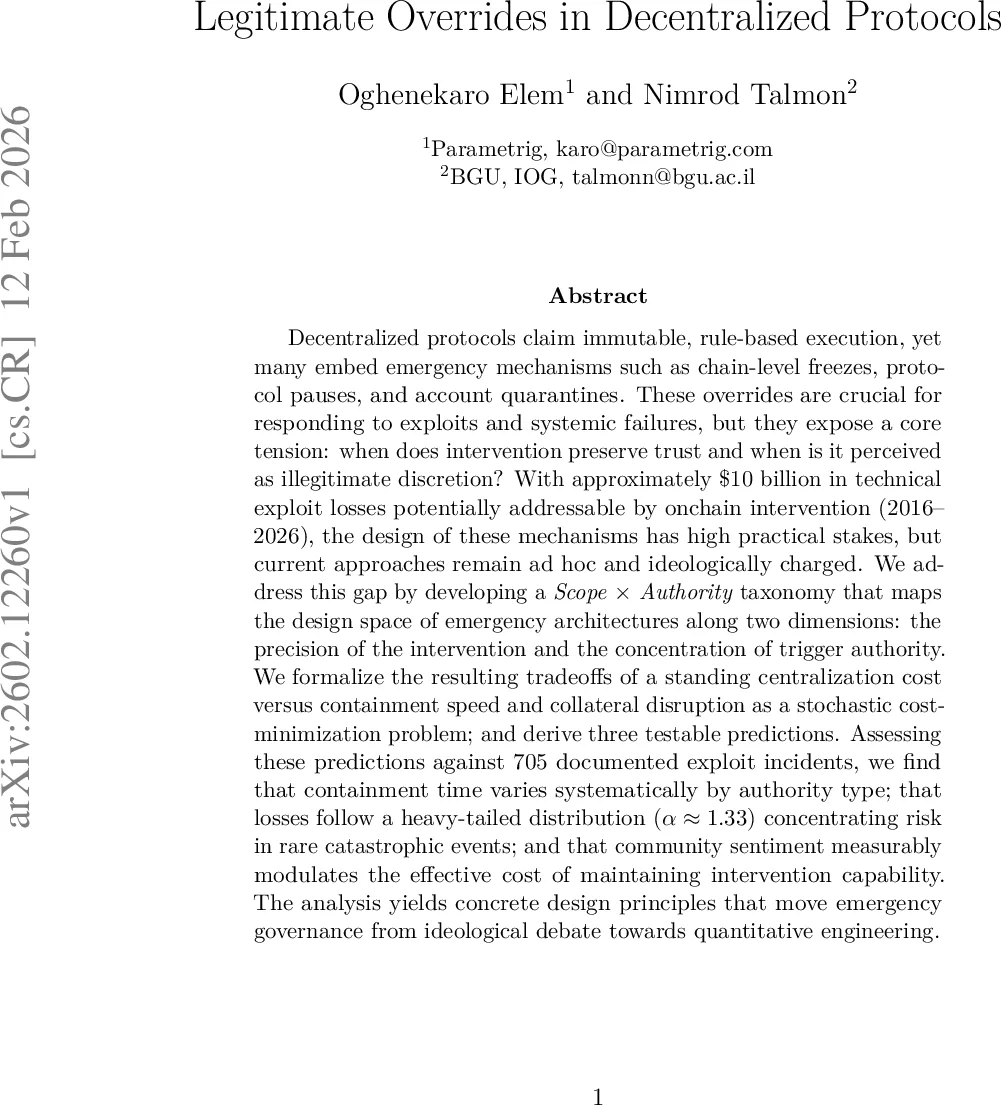
Decentralized protocols claim immutable, rule-based execution, yet many embed emergency mechanisms such as chain-level freezes, protocol pauses, and account quarantines. These overrides are crucial for responding to exploits and systemic failures, but they expose a core tension: when does intervention preserve trust and when is it perceived as illegitimate discretion? With approximately $10$ billion in technical exploit losses potentially addressable by onchain intervention (2016–2026), the design of these mechanisms has high practical stakes, but current approaches remain ad hoc and ideologically charged. We address this gap by developing a Scope $\times$ Authority taxonomy that maps the design space of emergency architectures along two dimensions: the precision of the intervention and the concentration of trigger authority. We formalize the resulting tradeoffs of a standing centralization cost versus containment speed and collateral disruption as a stochastic cost-minimization problem; and derive three testable predictions. Assessing these predictions against 705 documented exploit incidents, we find that containment time varies systematically by authority type; that losses follow a heavy-tailed distribution ($α\approx 1.33$) concentrating risk in rare catastrophic events; and that community sentiment measurably modulates the effective cost of maintaining intervention capability. The analysis yields concrete design principles that move emergency governance from ideological debate towards quantitative engineering.
💡 Research Summary
The paper “Legitimate Overrides in Decentralized Protocols” tackles a paradox that lies at the heart of modern blockchain and DeFi systems: while the technology promises immutable, rule‑based execution, real‑world incidents repeatedly force communities to intervene through emergency mechanisms such as chain‑wide freezes, protocol pauses, asset blacklists, and account quarantines. These “legitimate overrides” can dramatically limit financial loss during a crisis, yet they also introduce a new source of centralization and legitimacy risk because the mere existence of privileged discretion can erode trust in the system’s trust‑less promise.
To bring order to a field that has been dominated by ad‑hoc engineering and ideological debate, the authors construct a two‑dimensional taxonomy called Scope × Authority. Scope captures the precision of an intervention and is discretized into five hierarchical levels: network (chain‑wide), asset (all holders of a token), protocol (all contracts of a specific application), module (a particular feature within a protocol), and account (individual addresses). Authority captures who can trigger the mechanism and is divided into three tiers: a fixed signer set (e.g., a 1‑of‑n or m‑of‑n multisig), a delegated body (a council or committee with bounded emergency powers), and a full governance process (formal token‑holder voting or community coordination). The taxonomy therefore yields a 5 × 3 matrix that maps every known emergency design onto a point in design space.
The authors then formalize the trade‑off between standing centralization cost, containment speed, and collateral disruption as a stochastic cost‑minimization problem. They model the arrival of attacks as a Poisson process and the distribution of loss sizes as a Pareto tail with exponent α ≈ 1.33, reflecting the empirical observation that a small number of catastrophic exploits account for the majority of total loss (≈ $10 billion of technically addressable damage from 2016‑2026). The total expected cost C is expressed as:
C = c₁·CentralizationWeight(Authority) + c₂·ExpectedContainmentTime(Scope) + c₃·CollateralLoss(Scope),
where c₁, c₂, c₃ are policy‑level parameters reflecting how much the community values decentralization, speed of response, and minimizing disruption to honest users. Using stochastic dynamic programming, the authors derive optimal Scope‑Authority pairings for different risk regimes. In high‑risk, high‑loss scenarios, a network‑level intervention triggered by a small signer set (fast, low‑latency multisig) minimizes expected loss despite higher centralization cost. In low‑risk, low‑loss regimes, a protocol‑level or module‑level intervention governed by a full community vote is cheaper in the long run because it preserves legitimacy and reduces the “stickiness” of emergency powers.
To validate the model, the paper assembles a dataset of 705 documented exploit incidents spanning multiple chains, assets, and governance structures. Each incident is coded into the taxonomy, and the authors extract three key metrics: (i) containment time (time from detection to successful mitigation), (ii) financial loss, and (iii) community sentiment measured via social‑media sentiment analysis. The empirical results confirm the model’s predictions: containment time is shortest for signer‑set authority (average ≈ 1.8 h), longer for delegated bodies (≈ 5.4 h), and longest for governance processes (≈ 12.3 h). However, sentiment‑adjusted cost shows that interventions requiring broad governance incur lower legitimacy penalties, especially when the community’s sentiment is positive. Moreover, sentiment scores are positively correlated with the perceived cost of maintaining an emergency capability, indicating that community mood can be used as a dynamic input to the cost parameters.
The paper concludes with four practical design principles for protocol engineers:
- Pre‑define a Scope‑Authority matrix based on the protocol’s risk profile, ensuring that the most severe emergencies have a fast, low‑latency trigger while routine issues use more decentralized processes.
- Limit privileged trigger sets to minimal multisig configurations, augmenting them with time‑locks, threshold signatures, or hardware‑based key management to reduce the centralization penalty (c₁).
- Codify post‑intervention recovery (automatic rollback, state reconciliation, or “liveness” restoration) to mitigate the impact on normal operation after a safety‑oriented pause.
- Integrate real‑time community sentiment monitoring into governance dashboards, allowing the cost parameters (c₁, c₂, c₃) to be adjusted dynamically as public perception shifts.
By moving the discussion of emergency governance from abstract ideology to a quantitative engineering framework, the authors provide a roadmap for building decentralized systems that can both protect users in crises and preserve the core promise of trust‑less, decentralized operation.
Comments & Academic Discussion
Loading comments...
Leave a Comment