Generalizing the Clunie--Hayman construction in an Erdős maximum-term problem
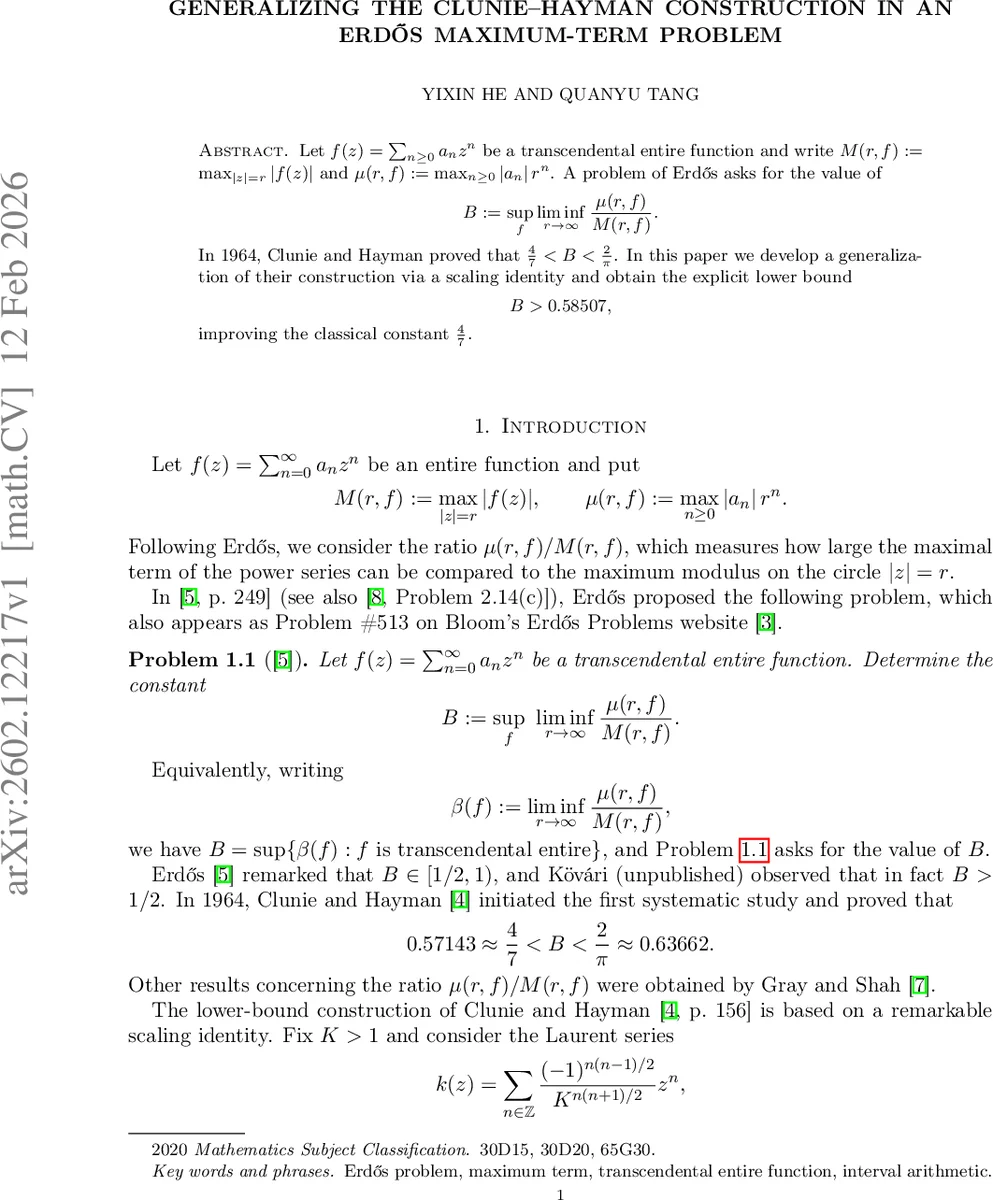
Let $f(z)=\sum_{n\ge0}a_n z^n$ be a transcendental entire function and write $M(r,f):=\max_{|z|=r}|f(z)|$ and $μ(r,f):=\max_{n\ge0}|a_n|,r^n$. A problem of Erdős asks for the value of $$ B:=\sup_f \liminf_{r\to\infty}\frac{μ(r,f)}{M(r,f)}. $$ In 1964, Clunie and Hayman proved that $\frac{4}{7}<B<\frac{2}π$. In this paper we develop a generalization of their construction via a scaling identity and obtain the explicit lower bound $$ B>0.58507, $$ improving the classical constant $\frac{4}{7}$.
💡 Research Summary
The paper addresses a long‑standing problem posed by Erdős concerning the asymptotic ratio between the maximal term of a power series and its maximum modulus on circles. For an entire function f(z)=∑{n≥0}a_n z^n, define μ(r,f)=max_n|a_n|r^n (the maximal term) and M(r,f)=max{|z|=r}|f(z)| (the maximum modulus). Erdős asked for the supremum B of the limit inferior of μ(r,f)/M(r,f) as r→∞, taken over all transcendental entire functions. Earlier work by Clunie and Hayman (1964) gave the bounds 4/7 < B < 2/π, and no substantial improvement of the lower bound had been achieved since.
The authors revisit the Clunie–Hayman construction, which is based on a remarkable scaling identity for a Laurent series k(z) that satisfies k(Kz)=z·k(εz) for a fixed scaling factor K>1 and a unimodular phase ε (|ε|=1). They generalize this by introducing two free parameters (K,ε) and define k_{K,ε}(z)=∑{n∈ℤ} ε^{n(n−1)/2} K^{-n(n+1)/2} z^n, f{K,ε}(z)=∑{n≥0} ε^{n(n−1)/2} K^{-n(n+1)/2} z^n, the latter being the entire function obtained by discarding the negative‑index part of k. The scaling identity yields an explicit formula for the maximum modulus on the geometric radii r_m=K^m: M(K^m, k{K,ε}) = K^{m(m−1)/2}·A(K,ε), where A(K,ε)=max_{|z|=1}|k_{K,ε}(z)|. Simultaneously, the maximal term at the same radii is exactly μ(K^m, f_{K,ε}) = K^{m(m−1)/2}. The difference between f and k is O(1/|z|), so M(K^m, f_{K,ε}) and M(K^m, k_{K,ε}) have the same leading term. Consequently, β(f_{K,ε}) = liminf_{r→∞} μ(r,f)/M(r,f) = 1/A(K,ε).
Thus the Erdős constant satisfies B ≥ 1/A(K,ε) for any admissible (K,ε). The problem of improving the lower bound reduces to minimizing A(K,ε). The authors identify k_{K,ε} with Ramanujan’s general theta function: k_{K,ε}(z) = Φ(qz, εz−1), q = K^{-1}, and parametrize the unit circle by z = ε e^{2iθ}. This yields the real‑valued representation |k_{K,ε}(z)| = 2∑{n≥0} K^{-T_n} cos((2n+1)θ), with triangular numbers T_n = n(n+1)/2. Hence A(K,ε) = max{θ∈
Comments & Academic Discussion
Loading comments...
Leave a Comment