Global solutions and large time stabilization in a model for thermoacoustics in a standard linear solid
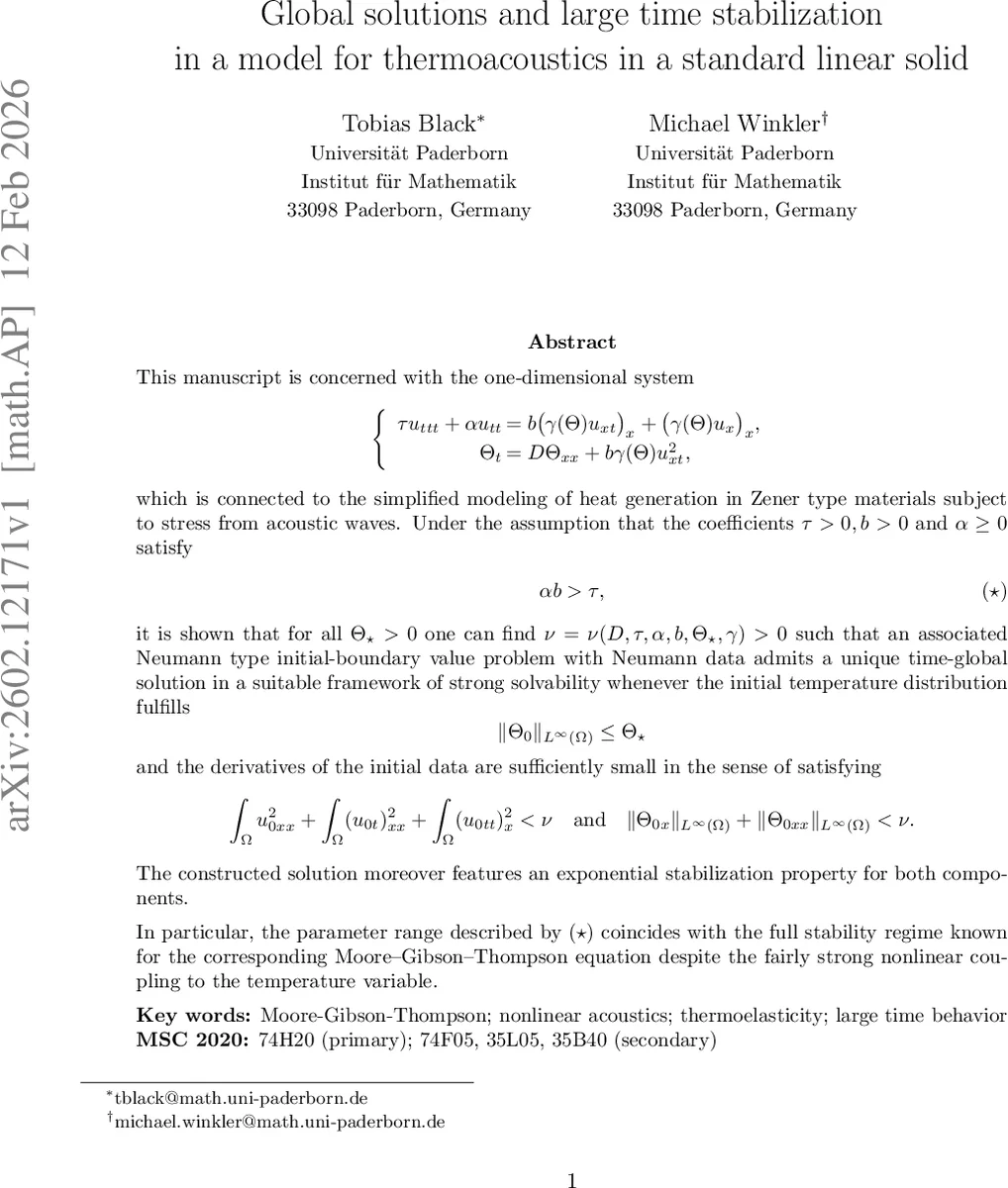
This manuscript is concerned with the one-dimensional system [ \begin{array}{l} τu_{ttt} + αu_{tt} = b \big(γ(Θ) u_{xt}\big)x + \big( γ(Θ) u_x\big)x, \[1mm] Θ_t = D Θ{xx} + bγ(Θ) u{xt}^2, \end{array} ] which is connected to the simplified modeling of heat generation in Zener type materials subject to stress from acoustic waves. Under the assumption that the coefficients $τ>0, b>0$ and $α\geq0$ satisfy \begin{align}\tag{$\star$} αb >τ, \end{align} it is shown that for all $Θ_\star>0$ one can find $ν=ν(D,τ,α,b,Θ_\star,γ)>0$ such that an associated Neumann type initial-boundary value problem with Neumann data admits a unique time-global solution in a suitable framework of strong solvability whenever the initial temperature distribution fulfills $$|Θ_0|{L^\infty(Ω)}\leq Θ\star$$ and the derivatives of the initial data are sufficiently small in the sense of satisfying $$\int_Ωu_{0xx}^2 + \int_Ω(u_{0t}){xx}^2 + \int_Ω(u{0tt})x^2 < ν\quad\text{and}\quad |Θ{0x}|{L^\infty(Ω)} + |Θ{0xx}|_{L^\infty(Ω)} < ν.$$ The constructed solution moreover features an exponential stabilization property for both components. In particular, the parameter range described by ($\star$) coincides with the full stability regime known for the corresponding Moore–Gibson–Thompson equation despite the fairly strong nonlinear coupling to the temperature variable.
💡 Research Summary
The paper investigates a one‑dimensional thermo‑acoustic system that couples a third‑order in time displacement equation with a heat equation. The displacement u satisfies
τ uₜₜₜ + α uₜₜ = b (γ(Θ) uₓₜ)ₓ + (γ(Θ) uₓ)ₓ,
while the temperature Θ obeys
Θₜ = D Θₓₓ + b γ(Θ) uₓₜ².
Here τ>0, b>0, α≥0, D>0, and γ∈C²(
Comments & Academic Discussion
Loading comments...
Leave a Comment