Deterministic Generation of Arbitrary Fock States via Resonant Subspace Engineering
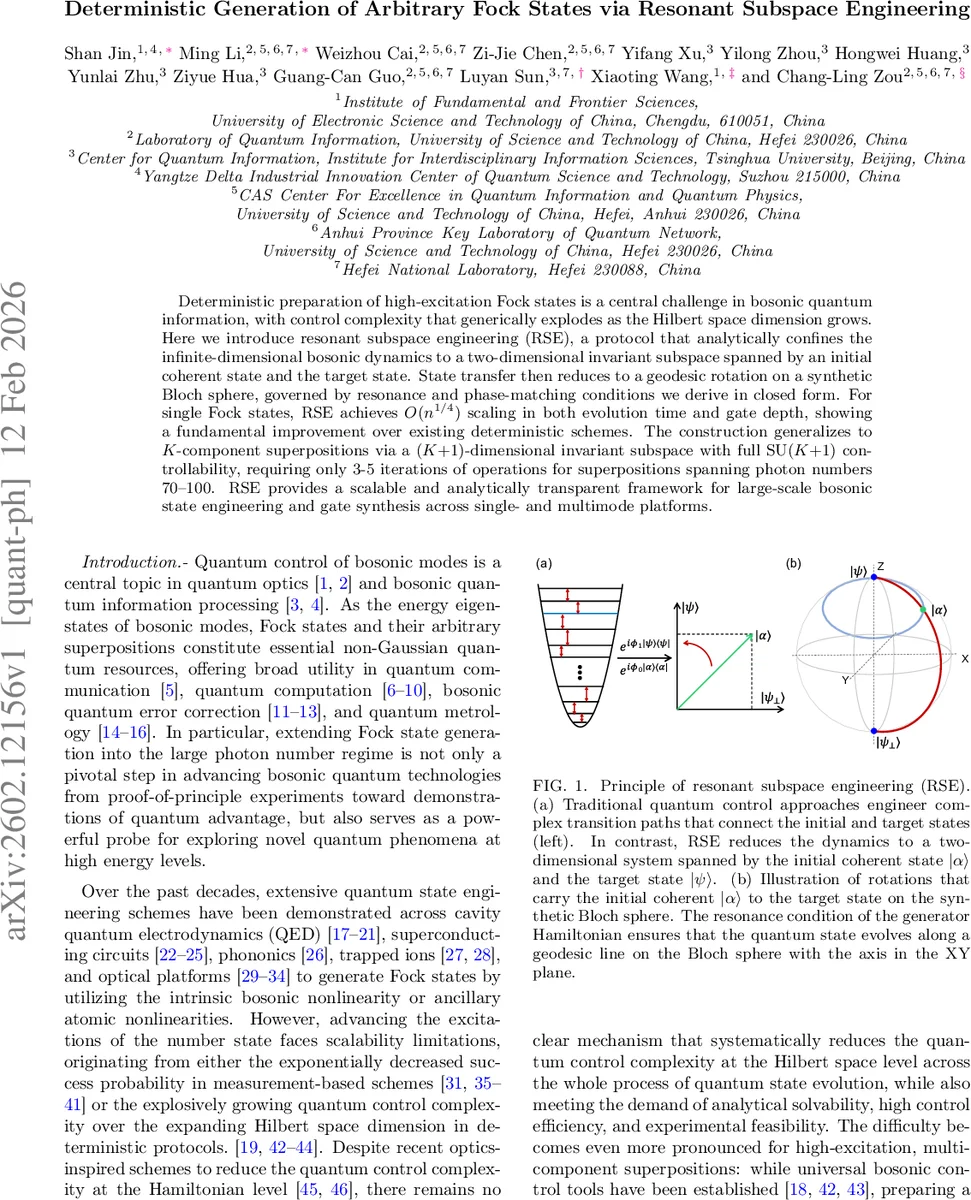
Deterministic preparation of high-excitation Fock states is a central challenge in bosonic quantum information, with control complexity that generically explodes as the Hilbert space dimension grows. Here we introduce resonant subspace engineering (RSE), a protocol that analytically confines the infinite-dimensional bosonic dynamics to a two-dimensional invariant subspace spanned by an initial coherent state and the target state. State transfer then reduces to a geodesic rotation on a synthetic Bloch sphere, governed by resonance and phase-matching conditions we derive in closed form. For single Fock states, RSE achieves $O(n^{1/4})$ scaling in both evolution time and gate depth, showing a fundamental improvement over existing deterministic schemes. The construction generalizes to $K$-component superpositions via a $(K{+}1)$-dimensional invariant subspace with full $\mathrm{SU}(K{+}1)$ controllability, requiring only 3-5 iterations of operations for superpositions spanning photon numbers 70–100. RSE provides a scalable and analytically transparent framework for large-scale bosonic state engineering and gate synthesis across single- and multimode platforms.
💡 Research Summary
The paper introduces a novel protocol called Resonant Subspace Engineering (RSE) for the deterministic preparation of high‑excitation Fock states and arbitrary superpositions in bosonic quantum systems. Traditional approaches—measurement‑based probabilistic schemes or global optimal control techniques such as GRAPE—suffer from exponential growth in control complexity as the Hilbert space dimension increases, making large‑n Fock‑state generation impractical.
RSE circumvents this by analytically restricting the infinite‑dimensional dynamics to a two‑dimensional invariant subspace (S=\text{span}{|\alpha\rangle,|\psi\rangle}) spanned by an initial coherent state (|\alpha\rangle) and the desired target state (|\psi\rangle). The restriction is achieved through alternating applications of two “generalized oracle operations” (GOOs):
(O(|\alpha\rangle,\phi_0)=e^{-i\phi_0|\alpha\rangle\langle\alpha|}) and (O(|\psi\rangle,\phi_1)=e^{-i\phi_1|\psi\rangle\langle\psi|}).
Using a Trotter‑Suzuki expansion, the effective Hamiltonian becomes
(H_{\text{eff}}\propto \phi_0|\alpha\rangle\langle\alpha|+\phi_1|\psi\rangle\langle\psi|),
which acts non‑trivially only within (S). Projected onto the orthogonal basis ({|\psi\rangle,|\psi^\perp\rangle}), the Hamiltonian is a 2×2 matrix that generates rotations on a synthetic Bloch sphere.
Two analytic conditions guarantee that the rotation follows the geodesic (shortest) path from (|\alpha\rangle) to (|\psi\rangle):
- Resonance condition – the diagonal elements must be equal, (H_{11}=H_{22}), eliminating any (\sigma_z) component and leaving a pure transverse coupling.
- Phase‑matching condition – the phase of the off‑diagonal element must match the relative phase (\theta) of the overlap (\mu=\langle\psi|\alpha\rangle=|\mu|e^{i\theta}), i.e. (\arg(H_{12})=\theta+\pi/2) (mod 2π).
When both are satisfied, the evolution time to reach the target is
(T=\arccos(|\mu|)/|H_{12}|).
For the specific case of a single Fock state (|n\rangle), the overlap is (\mu=\alpha^n e^{-|\alpha|^2/2}/\sqrt{n!}). Choosing (\alpha=\sqrt{n}) maximizes (|\mu|). The resonance condition fixes the effective frequency shift on the Fock level, (\omega_n=\Omega(1-2|\mu|^2)). A pre‑rotation by a (\pi/2) phase (a Pauli‑Z gate) aligns the initial state with the rotation axis. The resulting Rabi‑type oscillation yields a transfer time bounded by
(T\le\pi/(2\Omega|\mu|)=O(n^{1/4})).
Numerical simulations confirm the scaling: preparing (|n=100\rangle) from (|\alpha=10\rangle) reaches >99.9 % fidelity at (T\approx7.9) (in units where (\Omega=1)). Even (|n=380\rangle) requires only 4–5 GOO iterations. By contrast, mismatched Hamiltonian parameters (detuned case) lead to rapid, low‑fidelity oscillations, underscoring the necessity of the resonance condition.
The framework naturally extends to superpositions of (K) orthogonal Fock states. Introducing (K) GOOs for the target components together with a reference GOO for (|\alpha\rangle) yields an effective Hamiltonian confined to a ((K+1))-dimensional subspace. Full SU((K+1)) controllability is achieved, allowing arbitrary unitary synthesis within that subspace. The authors demonstrate preparation of three representative superpositions (e.g., (\sqrt{0.3}|70\rangle+\sqrt{0.7}|100\rangle)) from (|\alpha=\sqrt{88}\rangle) with only 3–5 iterations, achieving fidelities above 0.98.
Experimentally, the GOOs are realized in circuit QED using the dispersive interaction (H_{\text{disp}}=-\chi a^\dagger a|e\rangle\langle e|). This interaction makes the qubit transition frequency photon‑number dependent, enabling photon‑number‑selective phase shifts (SNAP gates). Combining SNAP with displacement operations (D(\alpha)) implements the required GOO for both coherent and Fock states. Hence the entire RSE protocol can be executed with existing superconducting‑circuit hardware, requiring only SNAP and displacement pulses—no complex multi‑tone drives or high‑depth optimal‑control pulses.
Beyond state preparation, the authors point out that RSE can directly implement logical gates on bosonic error‑correcting codes (e.g., cat codes) whose logical basis consists of coherent‑state superpositions. For large coherent amplitudes the basis states become nearly orthogonal, and a high‑dimensional RSE (with (2d) coherent‑state GOOs and a reference Fock GOO) can enact arbitrary logical operations efficiently.
In summary, RSE provides a transparent, analytically solvable method to compress infinite‑dimensional bosonic dynamics into a low‑dimensional controllable subspace, achieve geodesic state transfer with (O(n^{1/4})) scaling, and implement both single‑Fock and multi‑component superposition preparation using only SNAP and displacement gates. This represents a substantial advance in scalable bosonic quantum information processing, with immediate applicability to superconducting circuits, optical cavities, trapped‑ion phonon modes, and any platform supporting photon‑number‑dependent control.
Comments & Academic Discussion
Loading comments...
Leave a Comment