Matrix bordering structure of the Faddeev-Jackiw algorithm: Schur complement regularization and symbolic automation
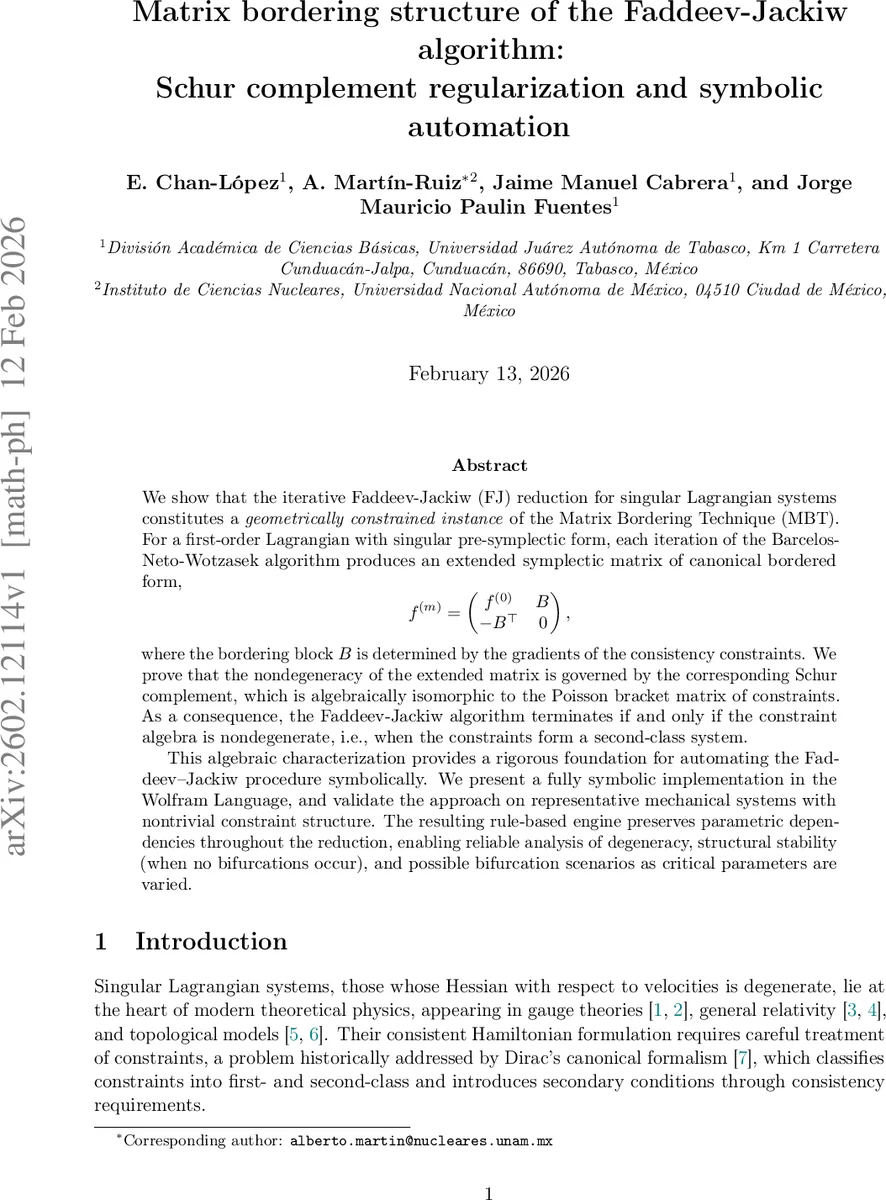
We show that the iterative Faddeev-Jackiw (FJ) reduction for singular Lagrangian systems constitutes a geometrically constrained instance of the Matrix Bordering Technique (MBT). For a first-order Lagrangian with singular pre-symplectic form, each iteration of the Barcelos-Neto-Wotzasek algorithm produces an extended symplectic matrix of canonical bordered form, \begin{eqnarray} f^{(m)} = \left( \begin{matrix} f^{(0)} & B \ -B^{\mathsf{T}} & 0 \end{matrix} \right) \end{eqnarray} where the bordering block $B$ is determined by the gradients of the consistency constraints. We prove that the nondegeneracy of the extended matrix is governed by the corresponding Schur complement, which is algebraically isomorphic to the Poisson bracket matrix of constraints. As a consequence, the Faddeev-Jackiw algorithm terminates if and only if the constraint algebra is nondegenerate, i.e., when the constraints form a second-class system. This algebraic characterization provides a rigorous foundation for automating the Faddeev-Jackiw procedure symbolically. We present a fully symbolic implementation in the Wolfram Language, and validate the approach on representative mechanical systems with nontrivial constraint structure. The resulting rule-based engine preserves parametric dependencies throughout the reduction, enabling reliable analysis of degeneracy, structural stability (when no bifurcations occur), and possible bifurcation scenarios as critical parameters are varied.
💡 Research Summary
The paper establishes a rigorous connection between the iterative Faddeev‑Jackiw (FJ) reduction for singular Lagrangian systems and the Matrix Bordering Technique (MBT), showing that each iteration of the Barcelos‑Neto‑Wotzasek algorithm corresponds to a structured matrix augmentation. Starting from a first‑order Lagrangian L = a_i(ξ) · ẋ_i – V(ξ), the pre‑symplectic two‑form f^{(0)}_{ij}=∂_i a_j – ∂j a_i may be singular. Consistency conditions generate constraints Ω_α(ξ); their gradients B{jα}=∂_j Ω_α are used to build the extended symplectic matrix
f^{(m)} = \begin{pmatrix} f^{(0)} & B \ -B^{\mathsf T} & 0 \end{pmatrix}.
The authors prove that the non‑degeneracy of f^{(m)} is governed by its Schur complement, which is algebraically identical to the Poisson‑bracket matrix C_{αβ}={Ω_α,Ω_β}. Consequently, the FJ algorithm terminates precisely when the constraints form a second‑class system (det C≠0); otherwise further bordering steps are required or a gauge symmetry is revealed.
Building on this algebraic insight, the paper presents a fully symbolic implementation in the Wolfram Language. The engine treats the physical state as an immutable symbolic object S={ξ, L, f, V} and applies deterministic rewriting rules that perform matrix bordering, null‑space extraction, and inversion while preserving all symbolic parameters (e.g., coupling constants, geometric lengths). This parametric preservation enables direct detection of bifurcation points and structural stability analysis without premature numerical simplifications.
The implementation is validated on three representative mechanical models: (1) a singular system with a non‑canonical kinetic term, resolved in a single bordering step yielding a 4×4 inverse matrix and confirming a purely second‑class constraint set; (2) a four‑mass system linked by rigid rods, where an 8×8 extended matrix is constructed and inverted, reproducing the correct coupling between positions, momenta, and Lagrange multipliers; (3) three masses constrained to a ring and coupled by springs, requiring two bordering iterations and producing a 6×6 inverse matrix that explicitly displays sinusoidal dependencies on the angular variables and the spring constant. In each case the symbolic engine retains the full parameter dependence, allowing the user to explore how critical values of k, R, etc., affect the rank of the constraint matrix and trigger bifurcations.
The authors emphasize that their approach constitutes a “structural” regularization rather than a numerical one: the rank of the symplectic matrix is increased not by artificial perturbations but by the intrinsic geometry of the constraints. This property makes the method especially suitable for theories with rich gauge structures, such as non‑abelian gauge fields or general relativity, where constraint algebras can be highly parameter‑dependent.
In summary, the paper provides (i) a theorem linking FJ reduction to a geometrically constrained MBT, (ii) a proof that the Schur complement equals the Poisson‑bracket matrix of constraints, (iii) a deterministic, rule‑based symbolic engine that automates the entire reduction while preserving parametric information, and (iv) concrete examples demonstrating its effectiveness in detecting second‑class versus gauge constraints and in analyzing bifurcation scenarios. This work bridges a gap between formal constrained dynamics and practical symbolic computation, offering a powerful tool for both theoretical investigations and computational applications.
Comments & Academic Discussion
Loading comments...
Leave a Comment