Hierarchy of saturation conditions for multiparameter quantum metrology bounds
The quantum Cramér-Rao (QCR) bound sets the ultimate local precision limit for unbiased multiparameter estimation. Yet, unlike in the single-parameter case, its saturability is not generally guaranteed and is often assessed through commutativity-based conditions. Here, we resolve the logical hierarchy of these commutativity conditions for unitary parameter-encoding transformations. We identify strict gaps between them, uncover previously assumed but missing implications, and construct explicit counterexamples to characterize the boundaries between distinct classes. In particular, we show that commutativity of the parameter-encoding generators alone does not ensure the saturability of the QCR bound once realistic noise produces mixed probe states. Our results provide a systematic classification of saturability conditions in multiparameter quantum metrology and clarify fundamental precision limits in noisy distributed quantum sensing beyond idealized pure-state settings.
💡 Research Summary
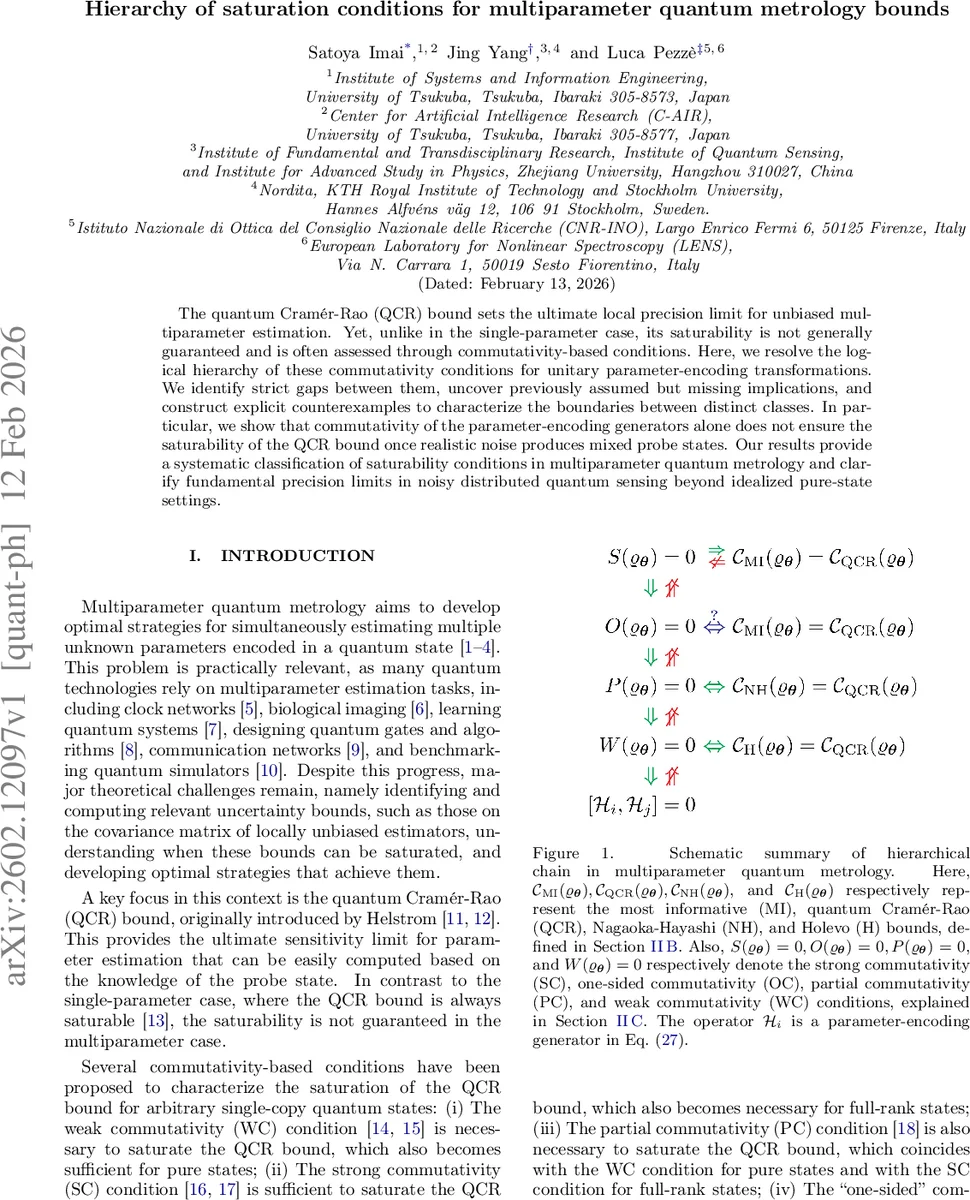
The paper “Hierarchy of saturation conditions for multiparameter quantum metrology bounds” addresses a central problem in quantum metrology: under what circumstances can the quantum Cramér‑Rao (QCR) bound be saturated when estimating several parameters simultaneously? While the QCR bound is always attainable in the single‑parameter case, its saturability in the multiparameter regime is far from guaranteed. The authors focus on unitary parameter‑encoding maps generated by a set of Hamiltonians {H_i} and investigate a family of commutativity‑based conditions that have been proposed to guarantee saturation.
First, the authors review the standard hierarchy of precision bounds: the classical Cramér‑Rao (CCR) bound, the most informative (MI) bound, the Nagaoka‑Hayashi (NH) bound, the Holevo (H) bound, and finally the QCR bound. Each bound depends only on the probe state (or its copies) and a weight matrix M that encodes the relative importance of the parameters. The MI bound is the ultimate achievable limit but is generally intractable; the Holevo and QCR bounds are additive and easier to compute, with the Holevo bound always tighter than the QCR bound.
The paper then introduces four commutativity conditions that involve the symmetric logarithmic derivative (SLD) operators L_i associated with the parameters:
- Weak commutativity (WC) – the expectation value of the commutator vanishes, i.e., Tr
Comments & Academic Discussion
Loading comments...
Leave a Comment