Contention Resolution, With and Without a Global Clock
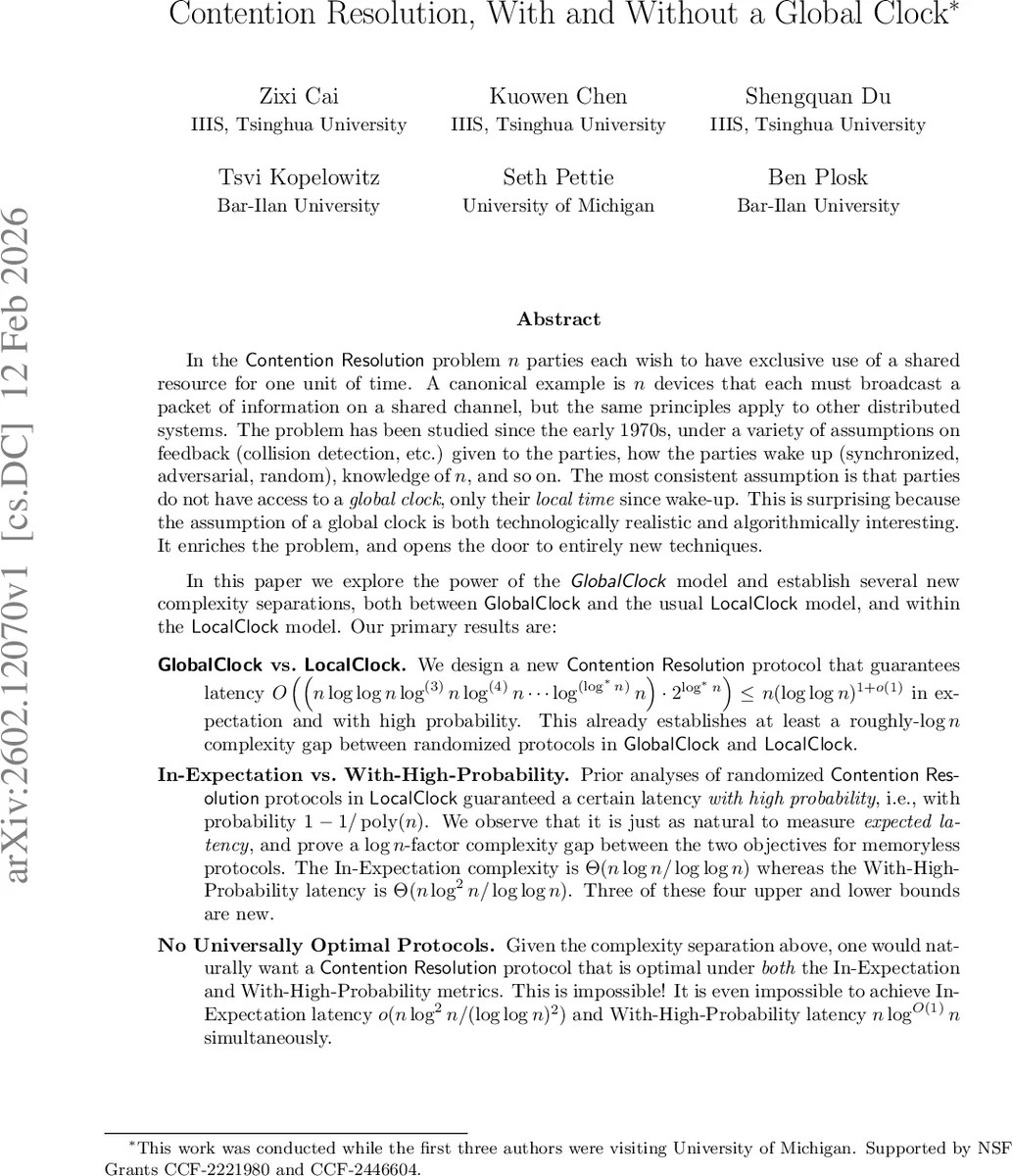
In the Contention Resolution problem $n$ parties each wish to have exclusive use of a shared resource for one unit of time. The problem has been studied since the early 1970s, under a variety of assumptions on feedback given to the parties, how the parties wake up, knowledge of $n$, and so on. The most consistent assumption is that parties do not have access to a global clock, only their local time since wake-up. This is surprising because the assumption of a global clock is both technologically realistic and algorithmically interesting. It enriches the problem, and opens the door to entirely new techniques. Our primary results are: [1] We design a new Contention Resolution protocol that guarantees latency $$O\left(\left(n\log\log n\log^{(3)} n\log^{(4)} n\cdots \log^{(\log^* n)} n\right)\cdot 2^{\log^* n}\right) \le n(\log\log n)^{1+o(1)}$$ in expectation and with high probability. This already establishes at least a roughly $\log n$ complexity gap between randomized protocols in GlobalClock and LocalClock. [2] Prior analyses of randomized ContentionResolution protocols in LocalClock guaranteed a certain latency with high probability, i.e., with probability $1-1/\text{poly}(n)$. We observe that it is just as natural to measure expected latency, and prove a $\log n$-factor complexity gap between the two objectives for memoryless protocols. The In-Expectation complexity is $Θ(n \log n/\log\log n)$ whereas the With-High-Probability latency is $Θ(n\log^2 n/\log\log n)$. Three of these four upper and lower bounds are new. [3] Given the complexity separation above, one would naturally want a ContentionResolution protocol that is optimal under both the In-Expectation and With-High-Probability metrics. This is impossible! It is even impossible to achieve In-Expectation latency $o(n\log^2 n/(\log\log n)^2)$ and With-High-Probability latency $n\log^{O(1)} n$ simultaneously.
💡 Research Summary
The paper studies the classic contention‑resolution problem, where n anonymous parties each wish to obtain exclusive access to a shared resource for one time unit. The authors focus on acknowledgment‑based, memoryless protocols—i.e., parties receive feedback only when they succeed, and their behavior depends solely on clock information, not on past actions. Two timing models are considered. In the LocalClock model each party knows only its own elapsed time since wake‑up; in the GlobalClock model parties additionally know the absolute global time.
GlobalClock results. By exploiting the extra global‑time information the authors devise a novel randomized protocol. The key idea is to encode a multiplicative back‑off factor in the binary representation of the global time using Elias’s ω‑code. At any moment the protocol interprets a suffix of the global clock as an integer a(t) and applies a back‑off factor that cycles through all integers with periods given by the ζ‑function (product of doubly‑exponential terms). This schedule guarantees that, with high probability, the contention level stays within a constant factor of the optimal for a long stretch of time. Consequently the latency (the gap between a party’s wake‑up and its successful grab) is bounded by
O (n·ζ(4 log log n)) = n·(log log n)^{1+o(1)}
both in expectation and with high probability. This establishes a clear separation from the LocalClock model, where any memoryless protocol must incur latency Ω(n log n/(log log n)²) w.h.p. (as shown by prior work). The authors conjecture that, with the global clock, linear latency O(n) (or constant throughput in the unbounded setting) should be achievable even against an adaptive adversary.
LocalClock results – expectation vs. high‑probability. In the more traditional LocalClock setting the paper investigates two natural performance metrics. First, the expected latency of a party; second, the latency guaranteed with probability 1 – 1/poly(n). For memoryless acknowledgment‑based protocols the authors prove tight bounds:
- Expected latency Θ(n log n/ log log n).
- High‑probability latency Θ(n log² n/ log log n).
The upper bounds are obtained by a “counter‑game” analysis that reduces the protocol’s dynamics to a simple stochastic process with an obvious optimal strategy. The lower bounds use a sophisticated layered adversary construction. Roughly, the adversary first forces a long phase of low contention (layer 0), then releases the remaining parties in a carefully timed fashion (layer 1) so that any protocol must accumulate enough attempts to overcome the induced collisions. By telescoping the required number of attempts across layers, the authors derive the Ω((log n/ log log n)²) total attempts, which translates into the stated latency lower bounds.
Impossibility of simultaneous optimality. A striking contribution is Theorem 1.5, which shows that no memoryless protocol in the LocalClock model can simultaneously achieve the optimal expected latency O(n log n/ log log n) and the optimal high‑probability latency O(n log^{O(1)} n). In fact, achieving expected latency o(n log² n/(log log n)²) forces the high‑probability latency to be super‑polylogarithmic, and vice‑versa. This rules out the naïve idea of interleaving two optimal protocols, a technique that works in many other algorithmic settings but fails here because the two metrics cannot be satisfied by the same memoryless schedule.
Technical innovations.
- The use of Elias ω‑coding to generate a deterministic, globally synchronized back‑off schedule is novel and may inspire other distributed algorithms that have access to a global clock.
- The “counter game” abstraction provides a clean way to analyze upper bounds against adaptive adversaries.
- The layered adversary technique extends previous lower‑bound constructions (DS17, DKS22b) and yields the first tight separation between expectation and high‑probability performance for memoryless contention‑resolution.
Open problems. The authors pose two conjectures: (1) a global‑clock protocol achieving O(n) latency w.h.p. against an adaptive adversary, and (2) a global‑clock protocol attaining constant throughput in the unbounded arrival model. They also suggest extending the analysis beyond memoryless protocols to understand whether the expectation/high‑probability gap persists for more general strategies.
In summary, the paper demonstrates that a global clock dramatically reduces the fundamental latency of contention resolution, while in the local‑clock world there is an inherent logarithmic gap between expected and high‑probability performance, and no single protocol can be optimal for both. These findings deepen our theoretical understanding of distributed contention management and point to new directions for algorithm design in systems where global time information is (or is not) available.
Comments & Academic Discussion
Loading comments...
Leave a Comment