Local boundedness for solutions to parabolic $p,q$-problems with degenerate coefficients
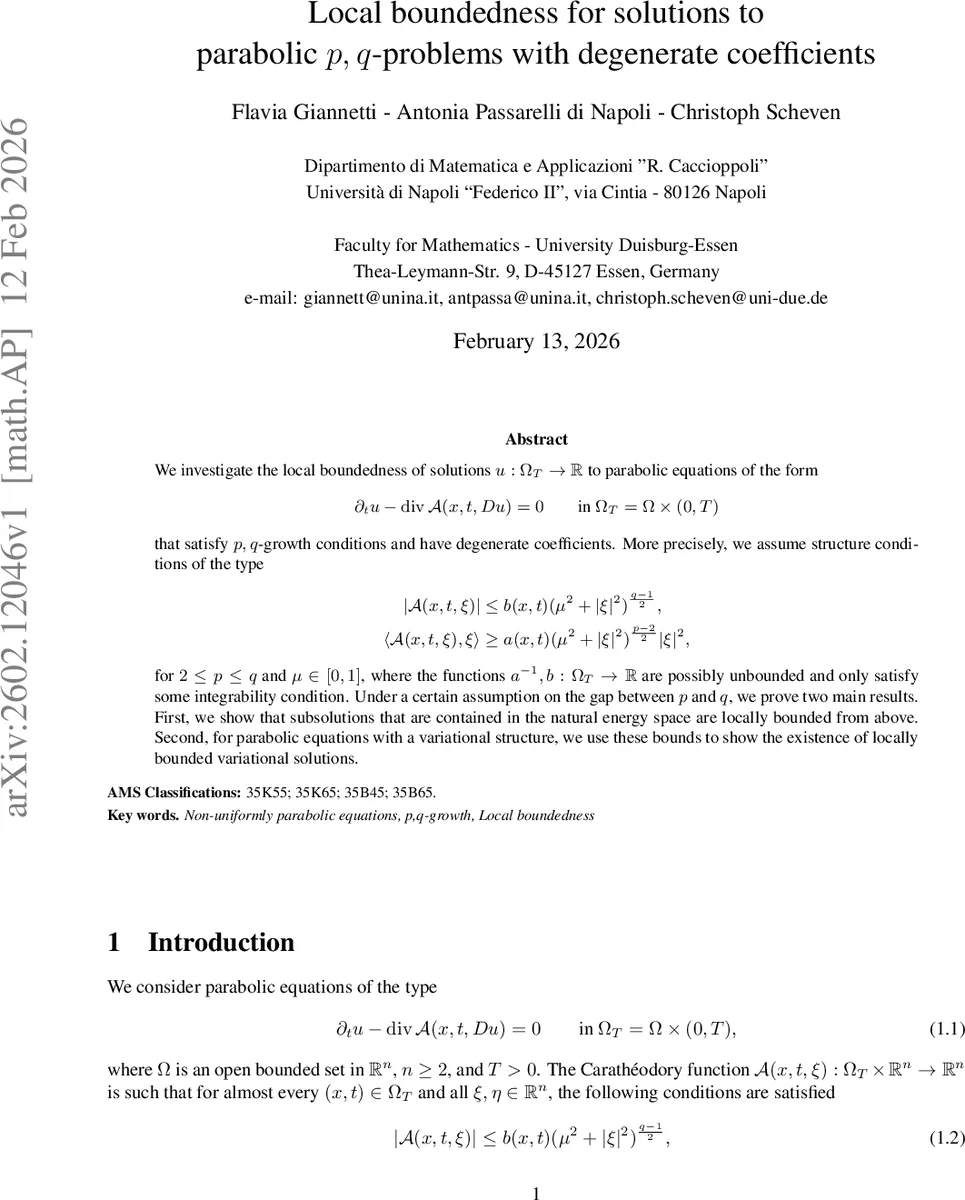
We investigate the local boundedness of solutions $u:Ω_T\to\mathbb{R}$ to parabolic equations of the form \begin{equation*} \partial_tu-\mathrm{div},\mathcal{A}(x,t,Du)=0 \qquad\mbox{in }Ω_T=Ω\times(0,T) \end{equation*} that satisfy $p,q$-growth conditions and have degenerate coefficients. More precisely, we assume structure conditions of the type \begin{align*} |\mathcal{A}(x,t,ξ)|&\le b(x,t)(μ^2+|ξ|^2)^{\frac{q-1}{2}},\ \langle \mathcal{A}(x,t,ξ),ξ\rangle&\ge a(x,t)(μ^2+|ξ|^2)^{\frac {p-2}{2}}|ξ|^2, \end{align*} for $2\le p\le q$ and $μ\in[0,1]$, where the functions $a^{-1}, b:Ω_T\to\mathbb{R}$ are possibly unbounded and only satisfy some integrability condition. Under a certain assumption on the gap between $p$ and $q$, we prove two main results. First, we show that subsolutions that are contained in the natural energy space are locally bounded from above. Second, for parabolic equations with a variational structure, we use these bounds to show the existence of locally bounded variational solutions.
💡 Research Summary
The paper addresses the regularity of solutions to a class of non‑uniformly parabolic equations with p‑q growth and possibly degenerate coefficients. The model problem is
\
Comments & Academic Discussion
Loading comments...
Leave a Comment