Thermodynamic Stability and Hydrogen Bonds in Mixed Halide Perovskites
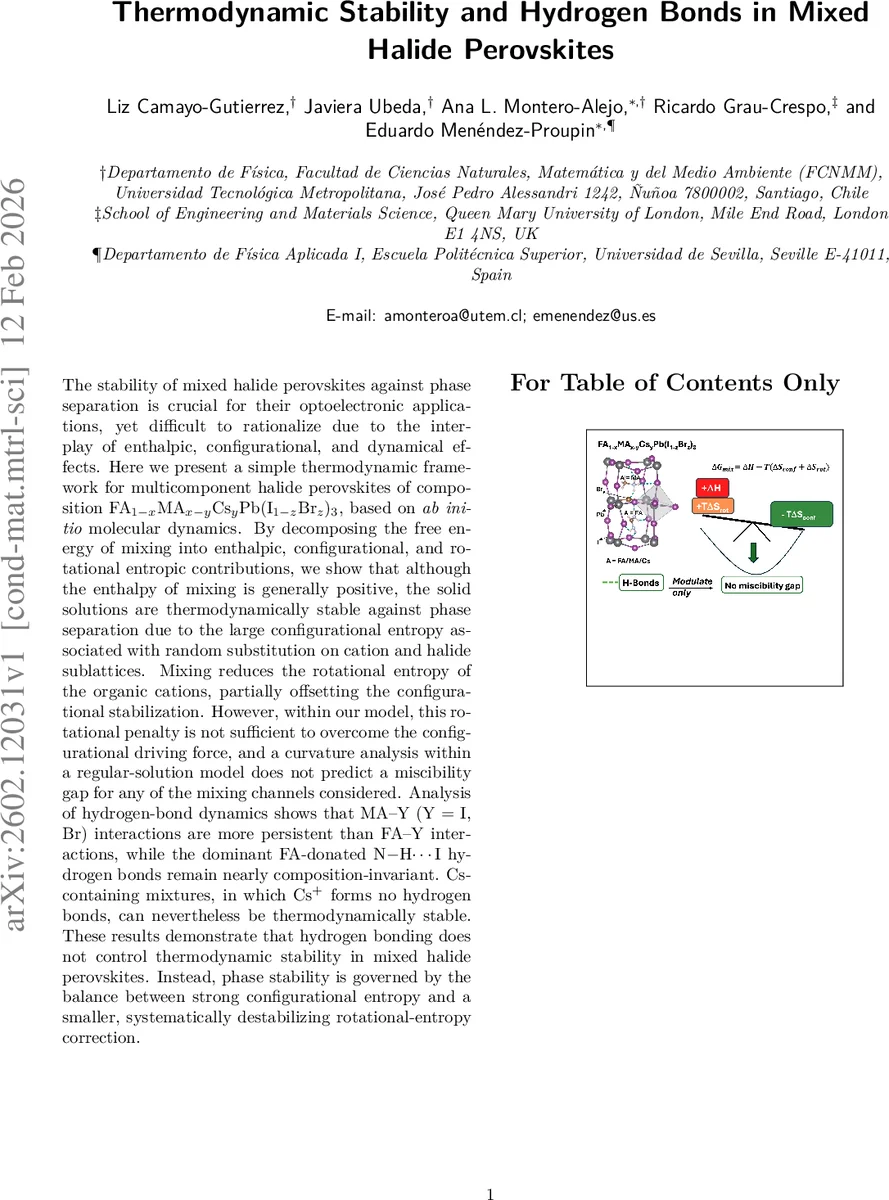
The stability of mixed halide perovskites against phase separation is crucial for their optoelectronic applications, yet difficult to rationalize due to the interplay of enthalpic, configurational, and dynamical effects. Here we present a simple thermodynamic framework for multicomponent halide perovskites of composition FA${1-x}$MA${x-y}$Cs$y$Pb(I${1-z}$Br$_z$)$_3$, based on \textit{ab initio} molecular dynamics. By decomposing the free energy of mixing into enthalpic, configurational, and rotational entropic contributions, we show that although the enthalpy of mixing is generally positive, the solid solutions are thermodynamically stable against phase separation due to the large configurational entropy associated with random substitution on cation and halide sublattices. Mixing reduces the rotational entropy of the organic cations, partially offsetting the configurational stabilization. However, within our model, this rotational penalty is not sufficient to overcome the configurational driving force, and a curvature analysis within a regular-solution model does not predict a miscibility gap for any of the mixing channels considered. Analysis of hydrogen-bond dynamics shows that MA–Y (Y = I, Br) interactions are more persistent than FA–Y interactions, while the dominant FA-donated N$-$H$\cdots$I hydrogen bonds remain nearly composition-invariant. Cs-containing mixtures, in which Cs$^{+}$ forms no hydrogen bonds, can nevertheless be thermodynamically stable. These results demonstrate that hydrogen bonding does not control thermodynamic stability in mixed halide perovskites. Instead, phase stability is governed by the balance between strong configurational entropy and a smaller, systematically destabilizing rotational-entropy correction.
💡 Research Summary
This paper presents a comprehensive thermodynamic analysis of mixed‑halide perovskites of the general composition FA₁₋ₓMAₓ₋ᵧCsᵧPb(I₁₋𝓏Br𝓏)₃, focusing on the interplay between enthalpic, configurational, and rotational contributions to the free energy of mixing. Using ab‑initio molecular dynamics (AIMD) at 350 K, the authors simulated four distinct mixing scenarios at a fixed substitution level of x = 1/8 (12.5 %): (i) A‑site mixing of FA and MA, (ii) Y‑site mixing of I and Br, (iii) simultaneous A‑ and Y‑site mixing (FA/MA with I/Br), and (iv) A‑site mixing of FA with Cs combined with Y‑site mixing of I/Br. All simulations employed a 4 × 4 × 4 supercell (64 ABX₃ formula units) and special quasirandom structures (SQS) to mimic near‑random short‑range order on the mixed sublattices. Production trajectories of 18 ps were used to extract average total energies, from which the mixing enthalpy ΔH_mix was calculated. Statistical uncertainties were estimated via effective independent sample counts, ensuring reliable error bars.
The configurational entropy of mixing, ΔS_conf_mix, was evaluated within the ideal solution approximation: ΔS_conf_mix = −n_s k_B
Comments & Academic Discussion
Loading comments...
Leave a Comment