Labor Supply under Temporary Wage Increases: Evidence from a Randomized Field Experiment
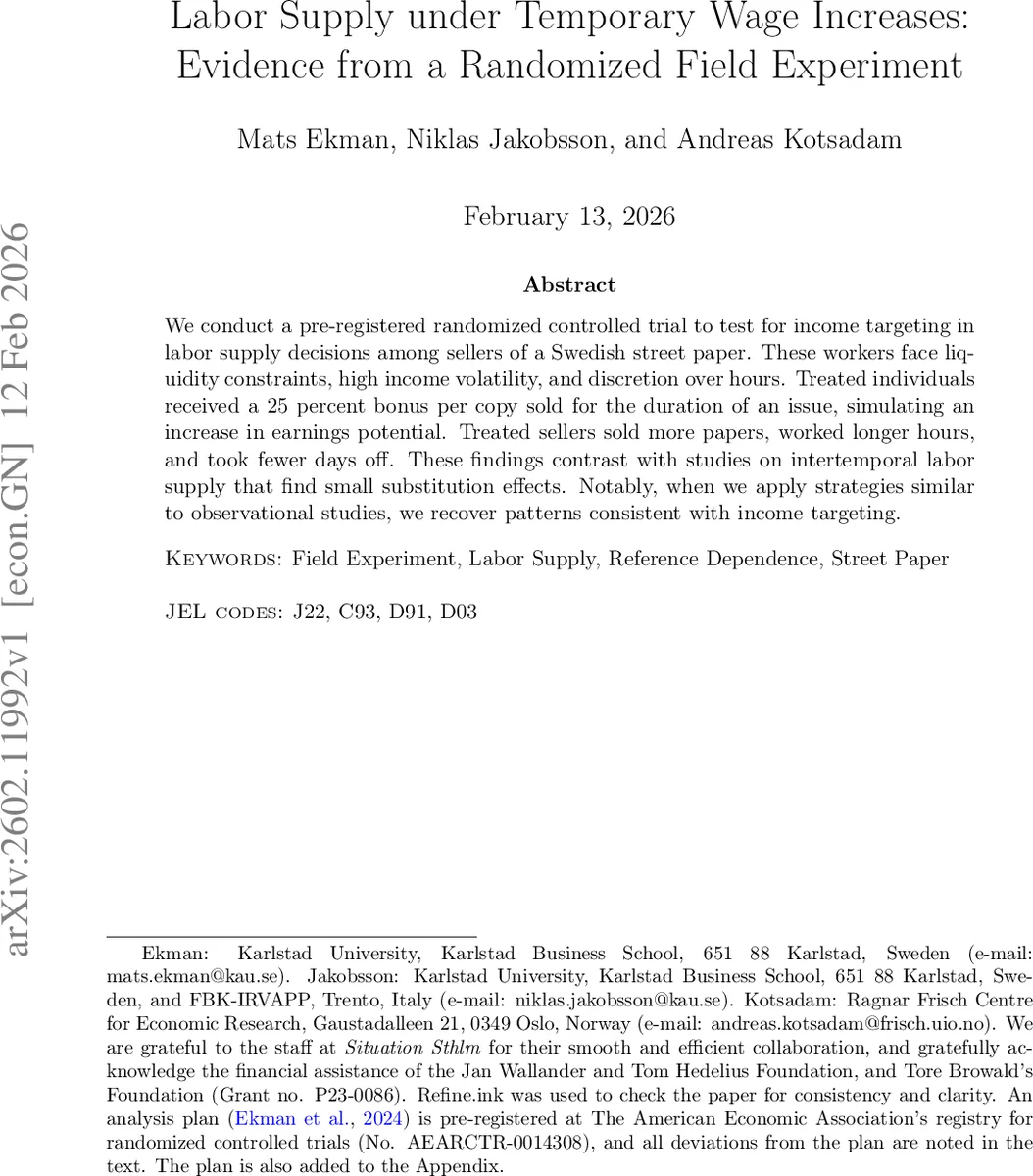
We conduct a pre-registered randomized controlled trial to test for income targeting in labor supply decisions among sellers of a Swedish street paper. These workers face liquidity constraints, high income volatility, and discretion over hours. Treated individuals received a 25 percent bonus per copy sold for the duration of an issue, simulating an increase in earnings potential. Treated sellers sold more papers, worked longer hours, and took fewer days off. These findings contrast with studies on intertemporal labor supply that find small substitution effects. Notably, when we apply strategies similar to observational studies, we recover patterns consistent with income targeting.
💡 Research Summary
This paper presents a pre‑registered randomized field experiment that investigates how a temporary wage increase affects labor supply among sellers of a Swedish street newspaper, Situation Sthlm. The authors recruited 109 sellers (average age 56, 34 % women) who work on commission, buying each copy for 40 SEK and reselling it for 80 SEK. To simulate a transitory earnings boost, 53 sellers were randomly assigned to receive a 10 SEK bonus per copy sold (a 25 % increase) on electronic Swish payments for the October issue, while 56 sellers served as controls and received the bonus on the subsequent November issue. The randomization was conducted via a coin flip in front of participants, creating a wait‑list control design.
The primary outcome is the total number of copies sold for the October issue (Sales). The authors also examine electronic sales (Electronic), cash sales (Cash), hours worked (Hours), and days worked (Days). Baseline covariates include age, gender, and twelve lags of the outcome variable. Because baseline sales were modestly lower in the treatment group, the authors employ a post‑double LASSO procedure (Belloni et al., 2014) to select controls that predict both treatment assignment and outcomes, thereby improving precision and addressing any residual imbalance. All regressions use heteroskedasticity‑robust standard errors.
The main findings are striking. The bonus raises average sales by 23.25 copies, a 21 % increase relative to the control group mean of 110.68 copies. The effect is driven almost entirely by electronic sales, consistent with the design that the bonus applies only to Swish transactions. Treated sellers also work longer: they log roughly 6.8 additional hours per month and work about two extra days, while taking fewer days off. These results directly contradict the “backward‑bending” labor‑supply curve often cited in theory, which would predict reduced labor supply when wages rise temporarily. Instead, the experiment reveals a positive labor‑supply elasticity for a low‑income, liquidity‑constrained population.
To contextualize the contribution, the authors compare their experimental estimates with patterns that emerge from observational analyses of the same data. When they apply the same regression specifications used in many observational studies, the data appear to exhibit “income‑targeting” behavior—workers reduce effort after reaching a certain earnings threshold. This contrast underscores how selection bias, measurement error, and omitted‑variable confounding can generate spurious evidence of income targeting in non‑experimental settings.
Robustness checks include adding pre‑treatment sales as controls, using alternative dependent variables (log‑sales, electronic vs. cash sales), and testing for heterogeneous effects by age and gender (none found). The authors acknowledge the modest sample size (N = 109) and the fact that the bonus applies only to electronic sales, which may limit external validity. Nevertheless, the use of administrative sales records, the pre‑registered analysis plan, and the LASSO‑based covariate selection strengthen causal identification.
The paper contributes to three strands of literature. First, it provides rare experimental evidence on intertemporal labor‑supply responses, complementing the few existing RCTs (Fehr & Goette, 2007; Andersen et al., 2025). Second, it challenges the prevailing narrative from taxi‑driver and gig‑economy studies that suggest strong reference‑dependent or income‑targeting behavior. Third, it highlights the importance of experimental designs for policy evaluation: short‑term wage subsidies or bonuses can indeed increase labor participation among vulnerable workers, contrary to what observational studies might imply.
In conclusion, a modest, temporary 25 % earnings boost leads to higher sales, longer working hours, and fewer days off among street‑newspaper sellers. This finding suggests that temporary wage incentives can be an effective tool for increasing labor supply in low‑skill, liquidity‑constrained populations, and it cautions researchers and policymakers against inferring behavioral mechanisms solely from observational data. Future work should explore larger samples, different occupations, and longer‑run dynamics of temporary wage interventions.
Comments & Academic Discussion
Loading comments...
Leave a Comment