UPDA: Unsupervised Progressive Domain Adaptation for No-Reference Point Cloud Quality Assessment
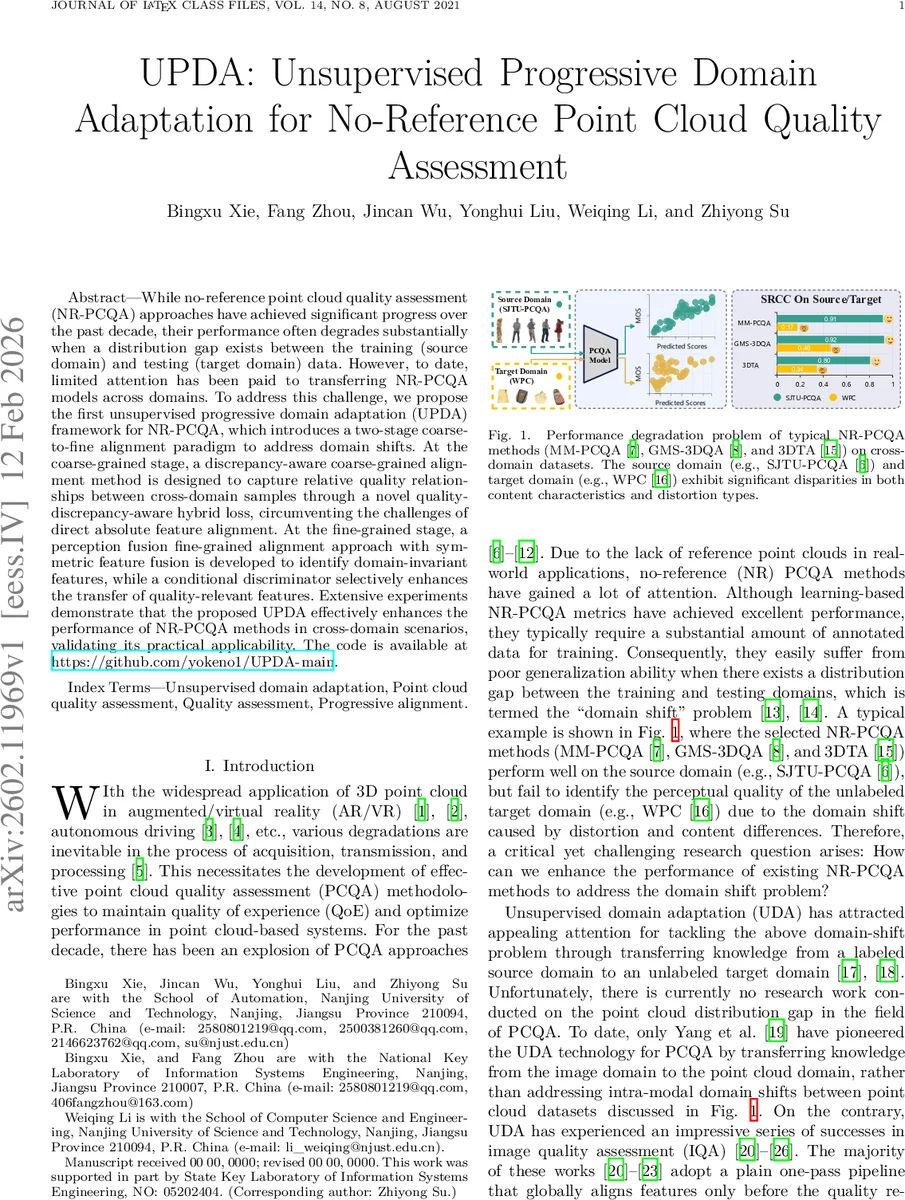
While no-reference point cloud quality assessment (NR-PCQA) approaches have achieved significant progress over the past decade, their performance often degrades substantially when a distribution gap exists between the training (source domain) and testing (target domain) data. However, to date, limited attention has been paid to transferring NR-PCQA models across domains. To address this challenge, we propose the first unsupervised progressive domain adaptation (UPDA) framework for NR-PCQA, which introduces a two-stage coarse-to-fine alignment paradigm to address domain shifts. At the coarse-grained stage, a discrepancy-aware coarse-grained alignment method is designed to capture relative quality relationships between cross-domain samples through a novel quality-discrepancy-aware hybrid loss, circumventing the challenges of direct absolute feature alignment. At the fine-grained stage, a perception fusion fine-grained alignment approach with symmetric feature fusion is developed to identify domain-invariant features, while a conditional discriminator selectively enhances the transfer of quality-relevant features. Extensive experiments demonstrate that the proposed UPDA effectively enhances the performance of NR-PCQA methods in cross-domain scenarios, validating its practical applicability. The code is available at https://github.com/yokeno1/UPDA-main.
💡 Research Summary
The paper addresses the critical problem of domain shift in no‑reference point‑cloud quality assessment (NR‑PCQA), where models trained on a labeled source dataset often fail when applied to an unlabeled target dataset with different content and distortion characteristics. While unsupervised domain adaptation (UDA) has been extensively studied for 2‑D image quality assessment, its application to 3‑D point clouds remains largely unexplored due to the non‑Euclidean geometry, sparsity, and diverse distortion types of point clouds.
To bridge this gap, the authors propose UPDA (Unsupervised Progressive Domain Adaptation), the first UDA framework specifically designed for NR‑PCQA. UPDA follows a biologically inspired, coarse‑to‑fine alignment strategy that mirrors the human visual system’s two‑stage quality perception: an initial coarse categorization followed by fine‑grained scoring. The framework consists of two sequential modules:
-
Discrepancy‑aware Coarse‑grained Alignment (DACA) – This stage introduces a quality‑discrepancy‑aware hybrid loss that combines a pair‑wise ranking loss with a Maximum Mean Discrepancy (MMD) loss. By weighting sample pairs according to their MOS differences, DACA forces the feature extractor to learn reliable relative quality relationships even when absolute feature alignment is difficult. The MMD component simultaneously reduces the overall distribution gap between source and target domains.
-
Perception Fusion Fine‑grained Alignment (PFFA) – Building on the coarse alignment, PFFA refines the model’s ability to predict absolute scores. A symmetric feature‑fusion module merges source and target representations, emphasizing domain‑invariant, quality‑sensitive cues. A conditional discriminator then adversarially aligns these fused features, but only for those aspects that are predictive of quality; the discriminator receives both the feature vector and the current quality prediction as conditioning information, thereby filtering out quality‑irrelevant noise that would otherwise be forced into alignment by a vanilla global discriminator.
The overall training objective is:
L = L_Q (source regression) + λ₁·L_MMD + λ₂·L_rank + λ₃·L_conditional,
where λ’s balance the contributions of each term. Importantly, the adaptation occurs solely during training; the original NR‑PCQA architecture remains unchanged at inference time, preserving deployment efficiency.
Experiments were conducted on three state‑of‑the‑art NR‑PCQA models (MM‑PCQA, GMS‑3DQA, 3DTA) using the SJTU‑PCQA dataset as the source and the WPC dataset as the unlabeled target. Evaluation metrics (PLCC and SRCC) show consistent improvements of 0.10–0.18 across all baselines after applying UPDA. Ablation studies confirm that both the discrepancy‑aware ranking loss in DACA and the symmetric fusion plus conditional discriminator in PFFA contribute independently to performance gains. Sensitivity analysis on the λ hyper‑parameters demonstrates the robustness of the method when reasonable weights are chosen.
Key contributions of the work are:
- Introduction of the first unsupervised progressive domain adaptation framework for point‑cloud quality assessment.
- A novel coarse‑grained alignment that leverages relative quality information to guide feature learning across domains.
- A fine‑grained alignment that isolates and transfers quality‑relevant features via symmetric fusion and conditional adversarial training.
- Demonstration that existing NR‑PCQA models can be enhanced without architectural changes, facilitating practical adoption.
The authors release their code and preprocessing scripts, ensuring reproducibility and encouraging future research on cross‑domain PCQA and related 3‑D perception tasks.
Comments & Academic Discussion
Loading comments...
Leave a Comment