Towards a Sustainable Age of Information Metric: Carbon Footprint of Real-Time Status Updates
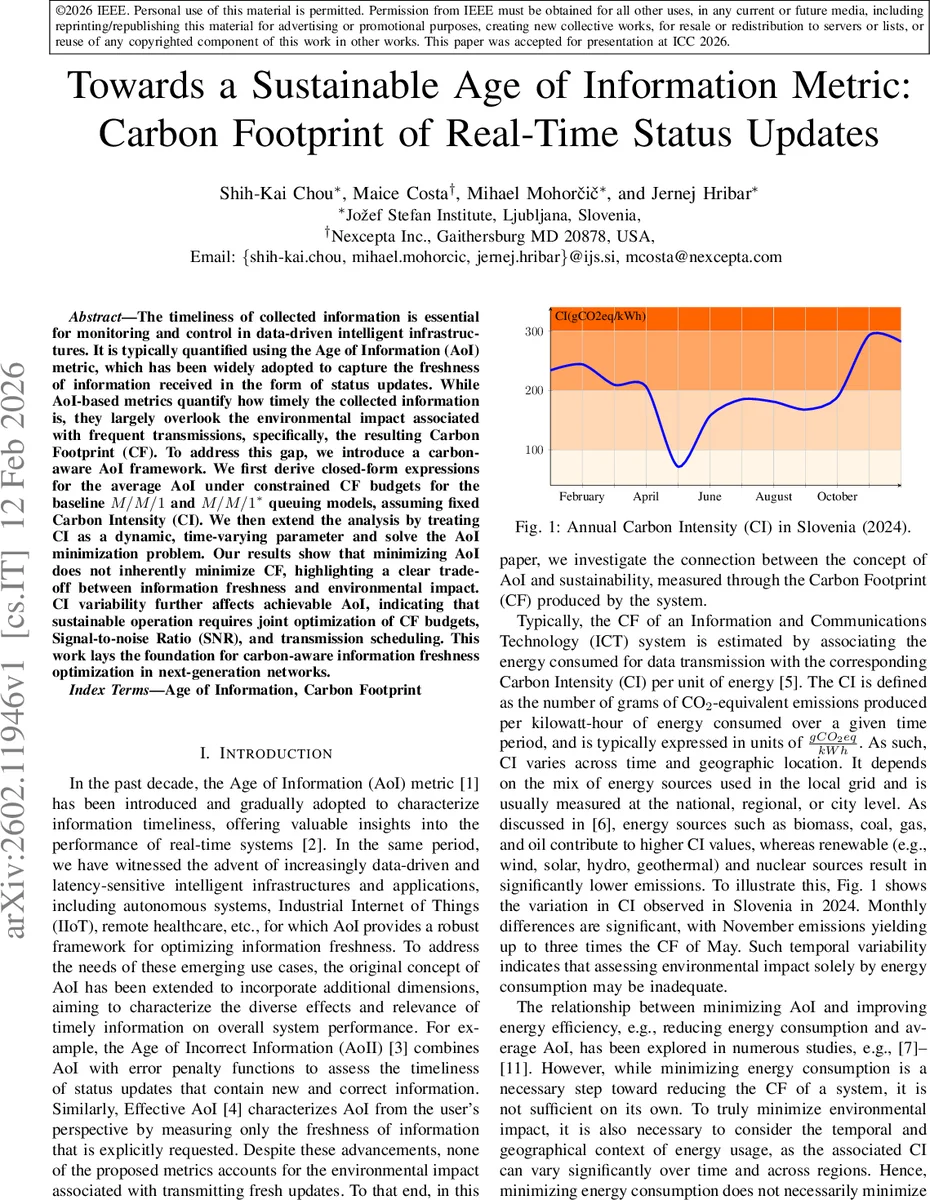
The timeliness of collected information is essential for monitoring and control in data-driven intelligent infrastructures. It is typically quantified using the Age of Information (AoI) metric, which has been widely adopted to capture the freshness of information received in the form of status updates. While AoI-based metrics quantify how timely the collected information is, they largely overlook the environmental impact associated with frequent transmissions, specifically, the resulting Carbon Footprint (CF). To address this gap, we introduce a carbon-aware AoI framework. We first derive closed-form expressions for the average AoI under constrained CF budgets for the baseline $M/M/1$ and $M/M/1^*$ queuing models, assuming fixed Carbon Intensity (CI). We then extend the analysis by treating CI as a dynamic, time-varying parameter and solve the AoI minimization problem. Our results show that minimizing AoI does not inherently minimize CF, highlighting a clear trade-off between information freshness and environmental impact. CI variability further affects achievable AoI, indicating that sustainable operation requires joint optimization of CF budgets, Signal-to-noise Ratio (SNR), and transmission scheduling. This work lays the foundation for carbon-aware information freshness optimization in next-generation networks.
💡 Research Summary
The paper introduces a carbon‑aware Age of Information (AoI) framework that jointly considers information freshness and the environmental impact of status‑update transmissions. Recognizing that traditional AoI metrics ignore the carbon footprint (CF) generated by frequent communications, the authors model the system’s carbon intensity (CI) and incorporate it into the AoI optimization problem.
A basic wireless system is considered: a single source generates updates at rate λ, each update is served by a server with rate μ, and the monitor measures the AoI Δ(t)=t−u_i(t). The average AoI Δ is the long‑term time average of Δ(t). The instantaneous carbon footprint is defined as the product of the time‑varying carbon intensity ξ(τ) (grams CO₂‑eq per kWh) and the instantaneous power consumption P(τ). The cumulative CF κ(T)=∫₀^T ξ(τ)P(τ)dτ and its long‑term average κ are used as the environmental metric.
Two queuing models are examined: (i) an M/M/1 queue (FCFS) with average AoI Δ=1/μ·
Comments & Academic Discussion
Loading comments...
Leave a Comment