The Cylinder Simplicial DG Ring
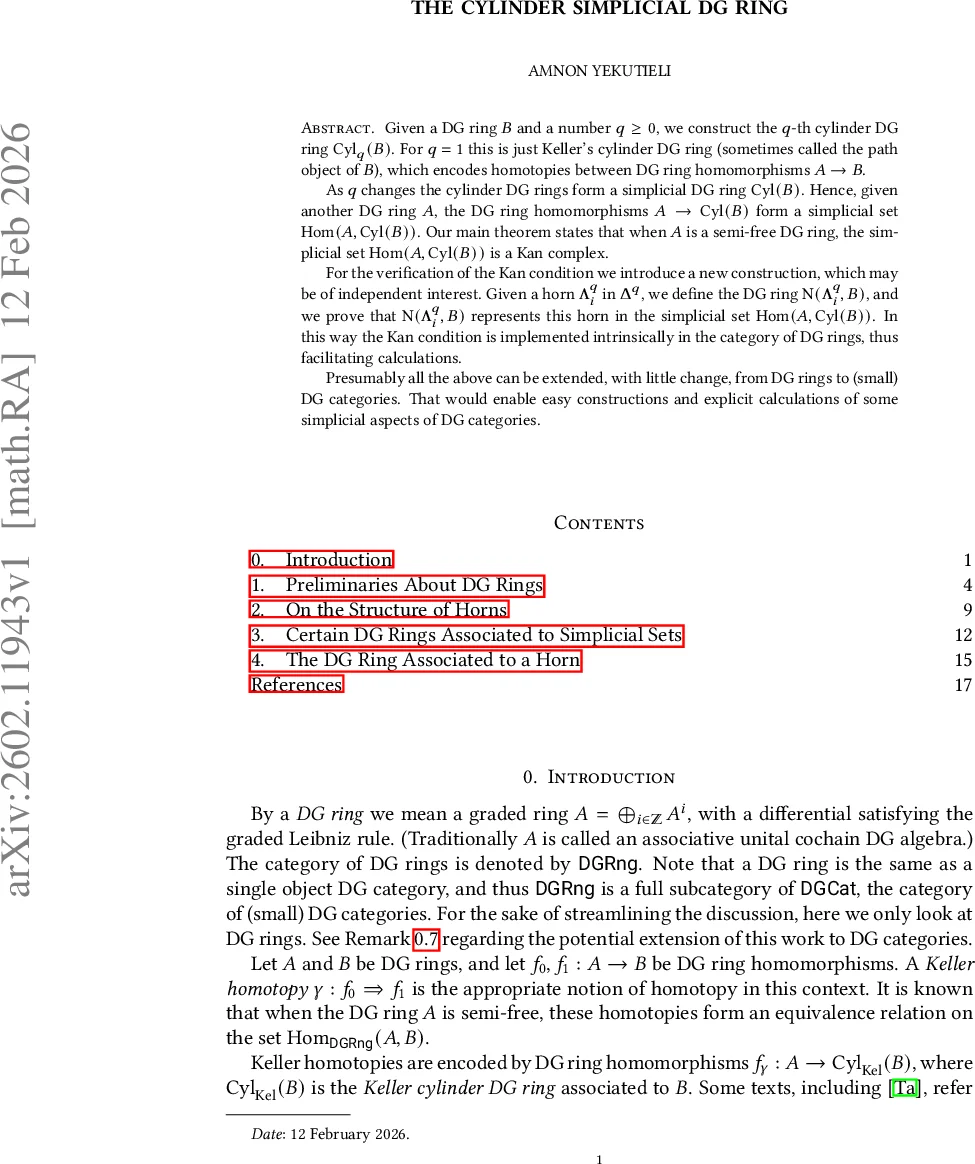
Given a DG ring $B$ and an integer $q \geq 0$, we construct the $q$-th cylinder DG ring $Cyl_q(B)$. For $q = 1$ this is just Keller’s cylinder DG ring, sometimes called the path object of $B$, which encodes homotopies between DG ring homomorphisms $A \to B$. As $q$ changes the cylinder DG rings form a simplicial DG ring $Cyl(B)$. Hence, given another DG ring $A$, the DG ring homomorphisms $A \to Cyl(B)$ form a simplicial set $Hom(A,Cyl(B))$. Our main theorem states that when $A$ is a semi-free DG ring, the simplicial set $Hom(A,Cyl(B))$ is a Kan complex. For the verification of the Kan condition we introduce a new construction, which may be of independent interest. Given a horn $Y$, we define the DG ring $N(Y,B)$, and we prove that $N(Y,B)$ represents this horn in the simplicial set $Hom(A,Cyl(B))$. In this way the Kan condition is implemented intrinsically in the category of DG rings, thus facilitating calculations. Presumably all the above can be extended, with little change, from DG rings to (small) DG categories. That would enable easy constructions and explicit calculations of some simplicial aspects of DG categories.
💡 Research Summary
The paper introduces a systematic construction of higher‑dimensional cylinder differential graded (DG) rings. For a given DG ring B and each integer q ≥ 0 the authors define a q‑th cylinder DG ring Cyl₍q₎(B). When q = 1 this recovers Keller’s classical cylinder (often called the path object) which encodes homotopies between DG‑ring maps. The key observation is that the collection {Cyl₍q₎(B)}₍q₎ can be assembled into a simplicial DG ring Cyl(B) by using the standard simplices Δ⁽q⁾ as a cosimplicial indexing object. Consequently, for any DG ring A the set of DG‑ring homomorphisms A → Cyl(B) becomes a simplicial set Hom_DGRng(A, Cyl(B)).
The main theorem (Theorem 0.2) states that if A is semi‑free (i.e. built from a filtered set of free generators) then the simplicial set Hom_DGRng(A, Cyl(B)) satisfies the Kan lifting condition; in other words it is a Kan complex. This result provides a concrete, algebraic model for the ∞‑categorical hom‑space between A and B when A is semi‑free.
To prove the Kan condition the authors develop a new auxiliary construction. For any simplicial set X they define a DG ring N(X, B). When X = Δ⁽q⁾ this recovers the cylinder DG ring Cyl₍q₎(B). For a horn Λ⁽q⁾ᵢ ⊂ Δ⁽q⁾ they consider the DG ring N(Λ⁽q⁾ᵢ, B) and prove (Theorem 0.4) that there is a natural bijection
Hom_SSet(Λ⁽q⁾ᵢ, Hom_DGRng(A, Cyl(B))) ≅ Hom_DGRng(A, N(Λ⁽q⁾ᵢ, B)).
Thus horns in the simplicial hom‑space are represented internally by DG‑ring maps into N(Λ⁽q⁾ᵢ, B). Moreover the inclusion Λ⁽q⁾ᵢ → Δ⁽q⁾ induces a surjective quasi‑isomorphism Cyl₍q₎(B) → N(Λ⁽q⁾ᵢ, B). Because semi‑free DG rings enjoy a lifting property (Theorem 1.7), any map A → N(Λ⁽q⁾ᵢ, B) can be lifted to a map A → Cyl₍q₎(B), which exactly furnishes the required filler for the horn. Hence the Kan condition is verified purely inside the category of DG rings, without recourse to model‑category arguments.
The paper also sketches how the whole construction extends to small DG categories. By tensoring the universal cylinder over ℤ, Cyl₍q₎(ℤ) = N(Δ⁽q⁾, ℤ), with a DG category B, one obtains a simplicial DG category Cyl₍q₎(B). The authors conjecture that the analogue of Theorem 0.2 holds for semi‑free DG categories, and that the same horn‑representing DG categories N(Λ⁽q⁾ᵢ, B) would provide the necessary fillers.
Finally, the authors compare their approach with existing literature. Tabuada’s path object P(B) coincides with our q=1 cylinder; Faonte’s simplicial enrichment via the DG nerve of A∞‑functor categories is shown to be weakly equivalent to Tabuada’s construction, though a direct relationship to the present higher cylinders is unclear. Holstein’s simplicial resolution B· is more elaborate; its first level agrees with Tabuada’s path object, suggesting possible compatibility with the present Cyl(B) construction, but the details remain to be verified.
In summary, the work supplies a concrete algebraic model for higher homotopies between DG rings (and potentially DG categories) by building a simplicial cylinder object and representing horns internally as DG rings. This yields a transparent proof that Hom_DGRng(A, Cyl(B)) is a Kan complex for semi‑free A, and opens the door to explicit calculations in ∞‑categorical contexts, as well as to future development of a full simplicial enrichment of the DG‑ring (or DG‑category) world.
Comments & Academic Discussion
Loading comments...
Leave a Comment