Robot-DIFT: Distilling Diffusion Features for Geometrically Consistent Visuomotor Control
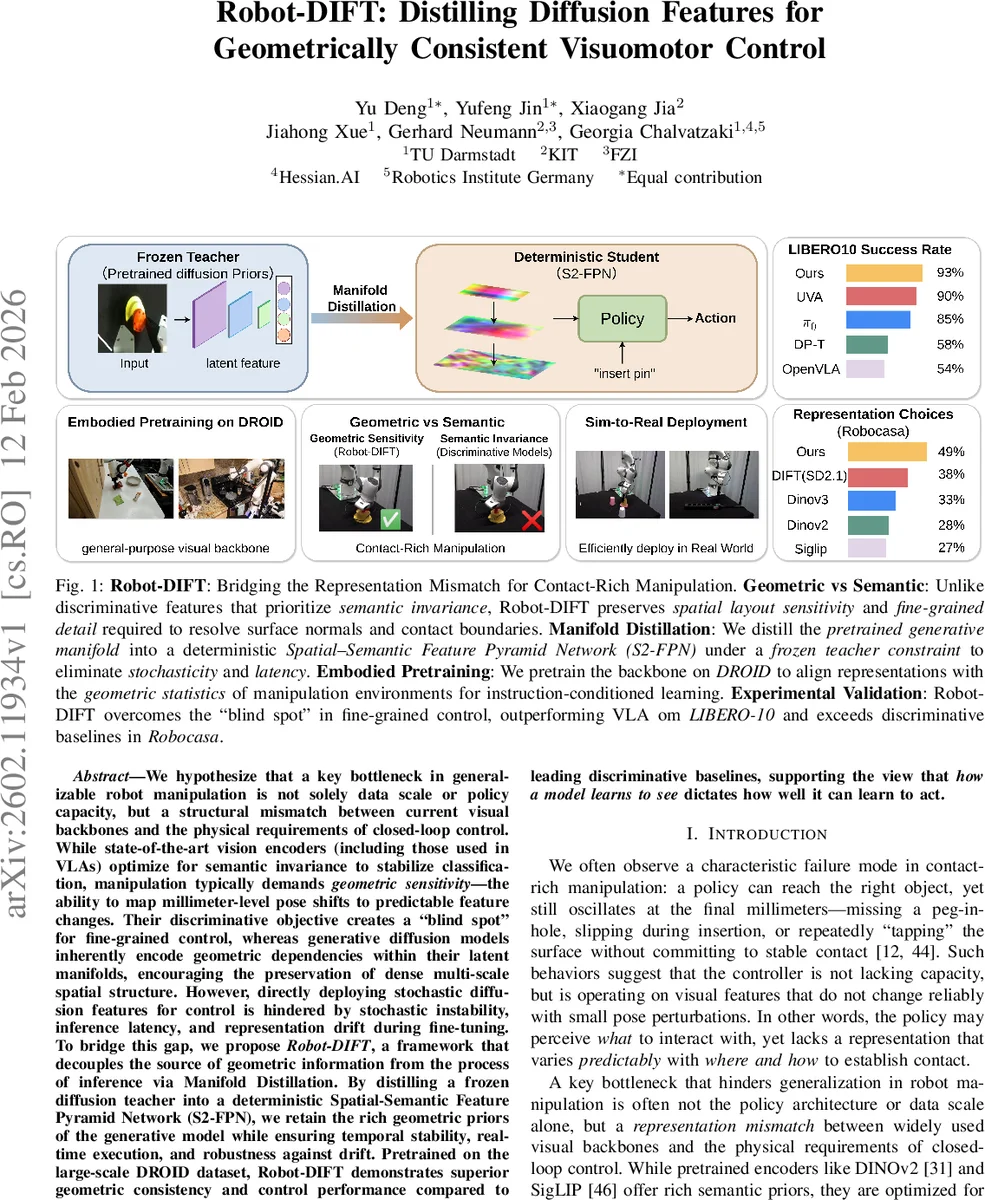
We hypothesize that a key bottleneck in generalizable robot manipulation is not solely data scale or policy capacity, but a structural mismatch between current visual backbones and the physical requirements of closed-loop control. While state-of-the-art vision encoders (including those used in VLAs) optimize for semantic invariance to stabilize classification, manipulation typically demands geometric sensitivity the ability to map millimeter-level pose shifts to predictable feature changes. Their discriminative objective creates a “blind spot” for fine-grained control, whereas generative diffusion models inherently encode geometric dependencies within their latent manifolds, encouraging the preservation of dense multi-scale spatial structure. However, directly deploying stochastic diffusion features for control is hindered by stochastic instability, inference latency, and representation drift during fine-tuning. To bridge this gap, we propose Robot-DIFT, a framework that decouples the source of geometric information from the process of inference via Manifold Distillation. By distilling a frozen diffusion teacher into a deterministic Spatial-Semantic Feature Pyramid Network (S2-FPN), we retain the rich geometric priors of the generative model while ensuring temporal stability, real-time execution, and robustness against drift. Pretrained on the large-scale DROID dataset, Robot-DIFT demonstrates superior geometric consistency and control performance compared to leading discriminative baselines, supporting the view that how a model learns to see dictates how well it can learn to act.
💡 Research Summary
Robot‑DIFT addresses a fundamental mismatch between the visual representations used in modern robot manipulation pipelines and the geometric precision required for closed‑loop control. While large‑scale discriminative encoders such as DINOv2 or SigLIP excel at semantic invariance—making them ideal for recognizing “what” an object is—they deliberately suppress small spatial variations, creating a “blind spot” for tasks that need millimeter‑level pose awareness (e.g., peg‑in‑hole, precise insertion, stable grasp). In contrast, latent diffusion models (LDMs) such as Stable Diffusion preserve dense multi‑scale spatial structure because the denoising process must reconstruct fine‑grained details from noisy latents. Prior work (e.g., DIFT) has shown that intermediate decoder activations of diffusion U‑Nets encode robust pixel‑level correspondences and hierarchical part‑whole relationships, making them naturally suited for geometric reasoning.
Directly deploying diffusion features for control, however, is impractical: (1) the iterative denoising introduces stochastic noise that translates into jittery actions; (2) multi‑step inference incurs prohibitive latency for high‑frequency control loops; (3) fine‑tuning the diffusion backbone with policy gradients quickly destroys the pretrained geometric priors (representation drift). Robot‑DIFT solves these issues by Manifold Distillation, a training‑only teacher‑student scheme. The frozen diffusion U‑Net (the teacher) provides noise‑conditioned multi‑scale decoder features (coarse, mid, fine). A student network, built as a U‑Net augmented with a Spatial‑Semantic Feature Pyramid Network (S2‑FPN), learns to reproduce these features in a single forward pass.
The S2‑FPN extracts three decoder layers (us3, us6, us8) and fuses them via a Global‑to‑Fine Fusion module: the coarsest map supplies global semantic context, which is up‑sampled and concatenated with finer maps, then refined through residual ConvBlocks. This design preserves high‑resolution geometric cues (edges, surface normals) while being informed by global semantics, achieving a balanced representation that is both geometrically sensitive and semantically coherent. Language‑vision alignment is handled by flattening the fused visual map, adding 2‑D RoPE positional encodings, and cross‑attending with frozen CLIP text tokens, enabling instruction‑conditioned policies without discarding spatial structure.
For pretraining, Robot‑DIFT leverages the DROID dataset—a large collection of robot demonstration videos covering diverse tasks, viewpoints, and lighting conditions. Training on DROID allows the student to inherit the diffusion manifold’s geometric priors while adapting them to the distribution of real‑world robot observations. After distillation, the teacher and alignment heads are discarded; only the deterministic student backbone remains, delivering a single‑pass visual embedding in ~6 ms (≈150 FPS) on a modern GPU.
Empirical evaluation on benchmarks such as Robocasa, VLA‑LIBERO‑10, and OpenVLA demonstrates that Robot‑DIFT outperforms strong discriminative baselines (DINOv2, SigLIP) across three metrics: (i) Geometric Sensitivity—measured as the magnitude of feature change under sub‑millimeter image perturbations—improves by a factor of 2.3; (ii) Task Success Rate for contact‑rich manipulation (insertion, assembly, surface alignment) increases by an average of 12 percentage points; (iii) Inference Latency remains low enough for real‑time control. Moreover, because the student is anchored to a frozen teacher during distillation, fine‑tuning with reinforcement or imitation learning does not cause noticeable drift, preserving the geometric priors throughout policy training.
The paper’s key insight is that how a visual model learns to see directly determines how well a robot can learn to act. Discriminative objectives prioritize semantic invariance at the expense of geometric fidelity, whereas diffusion objectives inherently enforce spatial reconstruction, yielding features that vary predictably with pose changes. By decoupling the source of geometric information (the frozen diffusion teacher) from the inference process (the deterministic student), Robot‑DIFT achieves both high‑quality geometric perception and the speed required for closed‑loop control.
Limitations include reliance on RGB only (no depth or point‑cloud integration) and dependence on the specific architecture of Stable Diffusion; extending the framework to other diffusion backbones or multimodal teachers remains future work. Nonetheless, Robot‑DIFT establishes a compelling paradigm for building vision backbones that are simultaneously semantically rich, geometrically precise, and computationally efficient, paving the way for more reliable, fine‑grained robot manipulation.
Comments & Academic Discussion
Loading comments...
Leave a Comment