Learning Conditional Averages
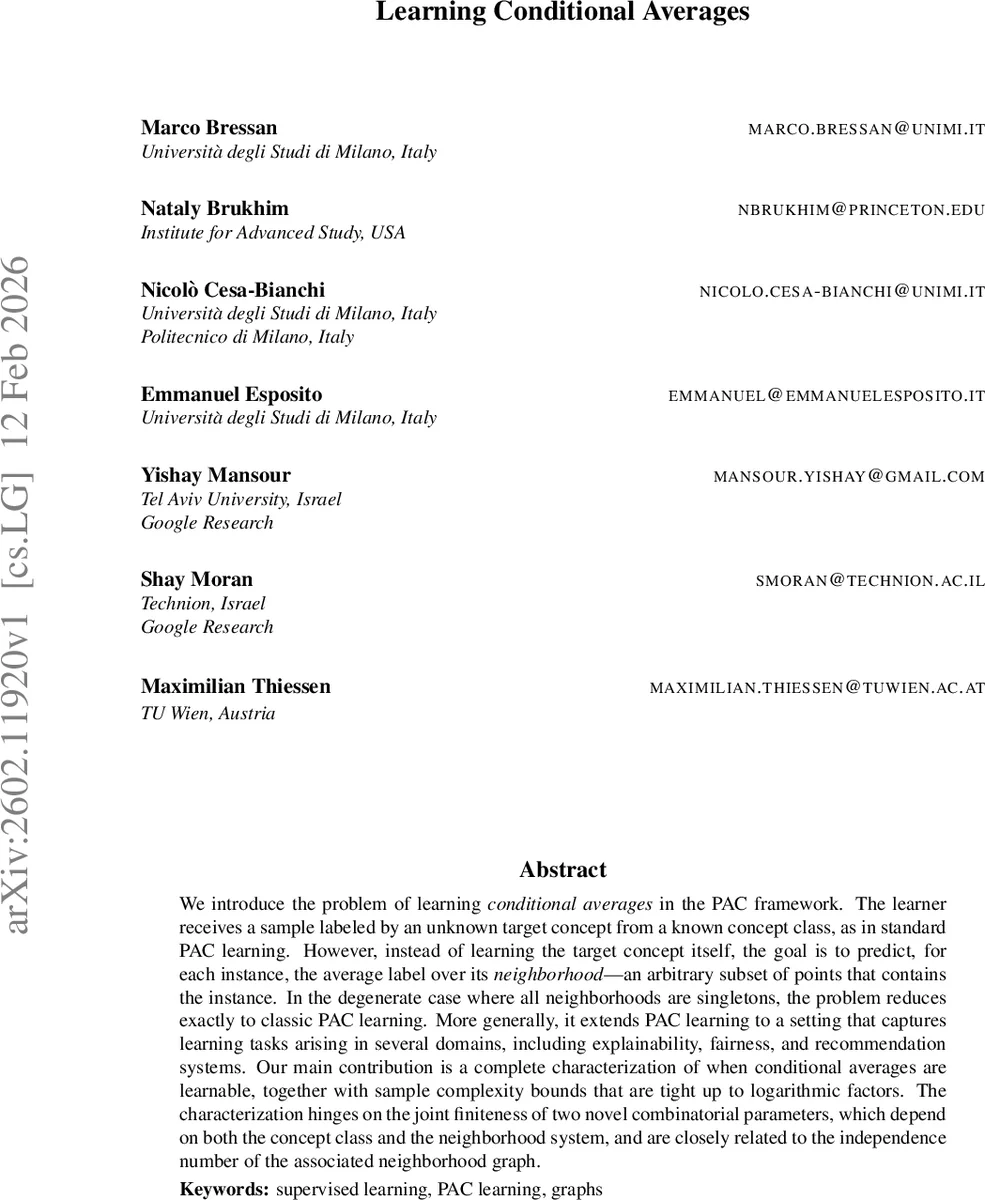
We introduce the problem of learning conditional averages in the PAC framework. The learner receives a sample labeled by an unknown target concept from a known concept class, as in standard PAC learning. However, instead of learning the target concept itself, the goal is to predict, for each instance, the average label over its neighborhood – an arbitrary subset of points that contains the instance. In the degenerate case where all neighborhoods are singletons, the problem reduces exactly to classic PAC learning. More generally, it extends PAC learning to a setting that captures learning tasks arising in several domains, including explainability, fairness, and recommendation systems. Our main contribution is a complete characterization of when conditional averages are learnable, together with sample complexity bounds that are tight up to logarithmic factors. The characterization hinges on the joint finiteness of two novel combinatorial parameters, which depend on both the concept class and the neighborhood system, and are closely related to the independence number of the associated neighborhood graph.
💡 Research Summary
The paper introduces “learning conditional averages” as a novel problem within the PAC (Probably Approximately Correct) learning framework. Instead of trying to recover the unknown target concept c∈C directly, the learner must predict, for every instance x, the average label of all points that belong to a predefined neighborhood N(x). The neighborhoods are arbitrary subsets containing x and are encoded by a directed graph G=(X,E); an edge (u,v) indicates that v belongs to the out‑neighborhood of u. The learner receives an i.i.d. sample S={(x_i,c(x_i))}_{i=1}^m drawn from an unknown distribution D, and the goal is to output a predictor h:X→
Comments & Academic Discussion
Loading comments...
Leave a Comment