Decision Support System for Technology Opportunity Discovery: An Application of the Schwartz Theory of Basic Values
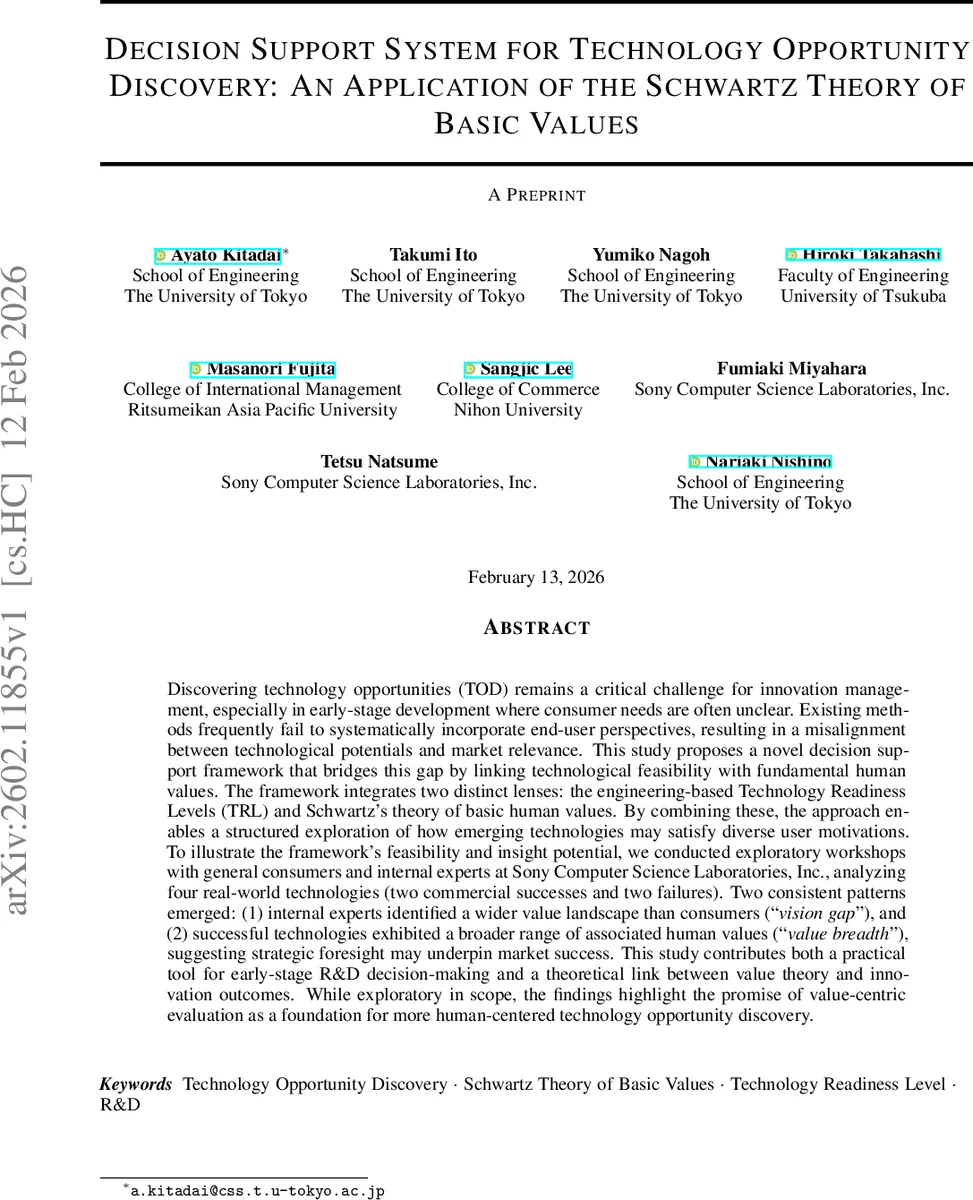
Discovering technology opportunities (TOD) remains a critical challenge for innovation management, especially in early-stage development where consumer needs are often unclear. Existing methods frequently fail to systematically incorporate end-user perspectives, resulting in a misalignment between technological potentials and market relevance. This study proposes a novel decision support framework that bridges this gap by linking technological feasibility with fundamental human values. The framework integrates two distinct lenses: the engineering-based Technology Readiness Levels (TRL) and Schwartz’s theory of basic human values. By combining these, the approach enables a structured exploration of how emerging technologies may satisfy diverse user motivations. To illustrate the framework’s feasibility and insight potential, we conducted exploratory workshops with general consumers and internal experts at Sony Computer Science Laboratories, Inc., analyzing four real-world technologies (two commercial successes and two failures). Two consistent patterns emerged: (1) internal experts identified a wider value landscape than consumers (vision gap), and (2) successful technologies exhibited a broader range of associated human values (value breadth), suggesting strategic foresight may underpin market success. This study contributes both a practical tool for early-stage R&D decision-making and a theoretical link between value theory and innovation outcomes. While exploratory in scope, the findings highlight the promise of value-centric evaluation as a foundation for more human-centered technology opportunity discovery.
💡 Research Summary
The paper addresses a persistent gap in technology opportunity discovery (TOD): existing methods either focus on technical feasibility or market signals, but rarely integrate the two in a systematic way that captures end‑user motivations. To bridge this gap, the authors propose a decision‑support framework that couples Technology Readiness Levels (TRL), a widely used metric for assessing the maturity of a technology, with Schwartz’s theory of basic human values, which classifies universal human motivations into ten value types (e.g., Achievement, Hedonism, Security).
The methodology proceeds in three stages. First, each core technology is decomposed into a set of “verb‑noun” functions (e.g., “transmit data”, “capture image”). In a market‑side workshop, a group of general consumers is shown these functions and asked to select the most relevant Schwartz value type for each function. To avoid the abstractness of the ten value categories, the authors also present the single values that belong to the chosen type and its adjacent types on Schwartz’s circular continuum, allowing participants to expand the evaluation to compatible values. Second, internal experts from Sony Computer Science Laboratories (CSL) repeat the same exercise, thereby generating a parallel set of value mappings that reflect expert knowledge of the technology’s capabilities. Third, the two sets of mappings are compared and combined with a TRL assessment (adapted from the EU Horizon 2020 scale) to produce two diagnostic indicators: (1) the “vision gap”, defined as the difference in the breadth of values identified by experts versus consumers, and (2) the “value breadth”, measured as the number of distinct value types linked to a given technology.
The authors applied this framework to four real‑world technologies developed at Sony CSL—two that have become commercial successes and two that failed to gain market traction. The workshops revealed that internal experts consistently identified a wider array of values (average ≈ 6.2) than consumers (average ≈ 3.8), confirming the existence of a vision gap. Moreover, the successful technologies were associated with a larger set of values (average ≈ 7.1) compared with the unsuccessful ones (average ≈ 3.4). These patterns suggest that technologies capable of satisfying a broader spectrum of human motivations are more likely to achieve market success, and that narrowing the vision gap could improve strategic foresight.
The paper contributes both theoretically and practically. Theoretically, it extends Schwartz’s value theory into the domain of innovation management, providing a structured way to map objective technology functions onto subjective human motivations. Practically, the framework offers R&D planners a concrete “value‑TRL matrix” that can be used to prioritize projects, balance portfolios, and design user‑centric roadmaps. By highlighting the vision gap and value breadth as early warning signals, the approach equips decision‑makers with actionable insights that go beyond traditional feasibility or market‑size analyses.
Limitations are acknowledged. The empirical work is exploratory, involving only four technologies and a modest number of participants, which constrains the generalizability of the findings. The value‑selection process is inherently subjective, raising concerns about inter‑rater reliability. Additionally, the framework does not yet address value conflicts (e.g., Security versus Freedom) that may arise in complex socio‑technical systems. Future research directions include scaling the methodology with large‑scale surveys, developing quantitative models to predict market outcomes from value‑TRL profiles, and incorporating mechanisms for handling value trade‑offs.
In sum, the study demonstrates that embedding a robust, cross‑cultural model of human values into early‑stage technology assessment can enrich TOD practices, making them more human‑centered and potentially more predictive of commercial success.
Comments & Academic Discussion
Loading comments...
Leave a Comment