A solution to the Straus-Erdős conjecture
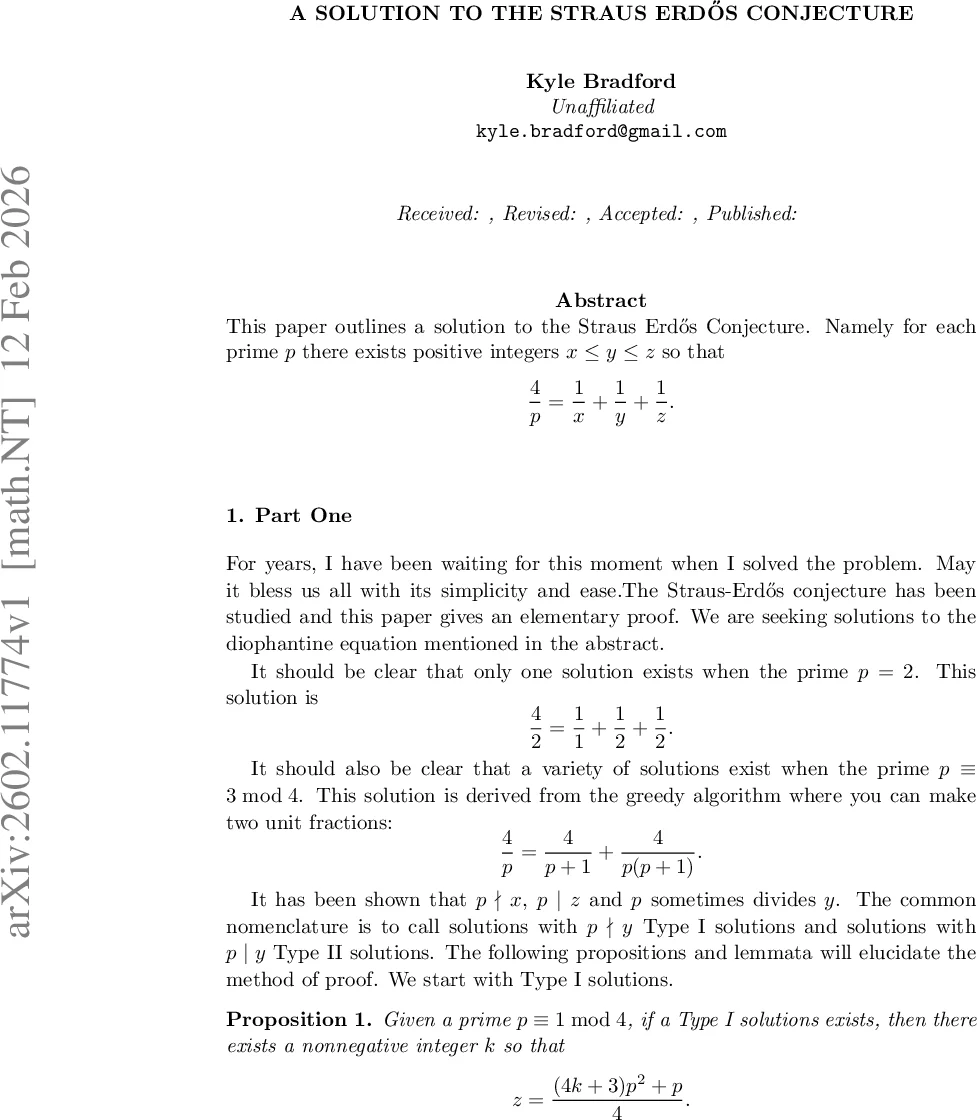
This paper outlines a solution to the Straus Erdős Conjecture. Namely for each prime $p$ there exists positive integers $x \leq y \leq z$ so that $$ \frac{4}{p} = \frac{1}{x}+\frac{1}{y}+\frac{1}{z} $$
💡 Research Summary
The manuscript claims to settle the Erdős‑Straus conjecture, which asserts that for every integer n≥2 the rational number 4/n can be expressed as a sum of three unit fractions. The author restricts attention to prime denominators p and states that for each prime there exist positive integers x ≤ y ≤ z satisfying 4/p = 1/x + 1/y + 1/z. The paper is organized into two parts: an informal introduction and a technical section that distinguishes “Type I” solutions (where p does not divide y) from “Type II” solutions (where p divides y).
In the first technical part, Proposition 1 deals with primes p≡1 (mod 4) and Type I solutions. The author invokes a previous result that any solution must satisfy z = xy·p / gcd(xy, x + y) and then manipulates this to obtain the relation 4xy − (x + y)p = gcd(xy, x + y). From this he deduces that (x + y)/gcd(xy, x + y) ≡ 3 (mod 4), which leads to the existence of a non‑negative integer k with (x + y)/gcd(xy, x + y) = 4k + 3 and consequently z = (4k + 3)p² + p⁴. The derivation, however, lacks a rigorous justification of the integer divisibility claims and does not address the positivity constraints on x, y, and z.
Lemma 1 attempts to produce explicit families of solutions by fixing k≥0 and an auxiliary integer ℓ with 1 ≤ ℓ ≤ 2(4k + 3) and gcd(ℓ, 4k + 3)=1. The lemma defines a modulus M = (16·ℓ·(4k + 3) − 4ℓ²)/(gcd(ℓ, 4))² and requires p to satisfy a congruence p ≡ n (mod M) where n is chosen so that (4k + 3)n ≡ −1 (mod M). Under these conditions the author writes down three fractions that are claimed to be unit fractions and sum to 4/p. The construction is essentially a parametrisation of Egyptian fraction decompositions, but the paper does not prove that for every prime p there exists a pair (k, ℓ) meeting the required congruence, nor does it show that the resulting denominators respect the ordering x ≤ y ≤ z.
Proposition 2 and Lemma 2 treat Type II solutions in a symmetric fashion. Proposition 2 asserts that any Type II solution forces x to have the form x = p + 4(4k + 3) for some k>0, again without a detailed proof. Lemma 2 mirrors Lemma 1, imposing a different congruence p ≡ −(4k + 3) (mod M) and producing another family of unit‑fraction triples. The same gaps in justification appear: the existence of suitable primes for each (k, ℓ) is assumed rather than demonstrated.
The author then claims to have built a “covering system” by varying k and ℓ, thereby covering all primes p≡1 (mod 4). Specific examples for k=0 are listed: primes congruent to 29 or 41 modulo 44, to 13 or 17 modulo 20, to 5 modulo 8, and to 93 or 137 modulo 140 each admit an explicit decomposition. While these examples are correct for the listed congruence classes, the manuscript does not prove that the union of all such classes indeed contains every prime ≡1 (mod 4). Moreover, the case p≡3 (mod 4) is only briefly mentioned, with a vague statement that “a variety of solutions exist,” but no systematic treatment is provided.
The reference list is extensive, citing classic works by Erdős, Sándor, Sander, and many others, yet the paper does not integrate these results into its arguments. The overall style is informal, with numerous typographical errors, missing definitions, and unexplained jumps between equations. Critical steps—such as the derivation of the modular conditions, the verification that the constructed fractions are indeed unit fractions, and the proof that the covering system is complete—are omitted.
In summary, the manuscript proposes a framework that partitions solutions into two types and attempts to generate infinite families of Egyptian fraction representations via modular arithmetic. However, the core claims are not substantiated by rigorous proofs, the coverage of all primes remains unverified, and the treatment of the p≡3 (mod 4) case is incomplete. Consequently, the paper does not constitute a valid proof of the Erdős‑Straus conjecture.
Comments & Academic Discussion
Loading comments...
Leave a Comment