Lagrangian Intersections, Symplectic Reduction and Kirwan Surjectivity
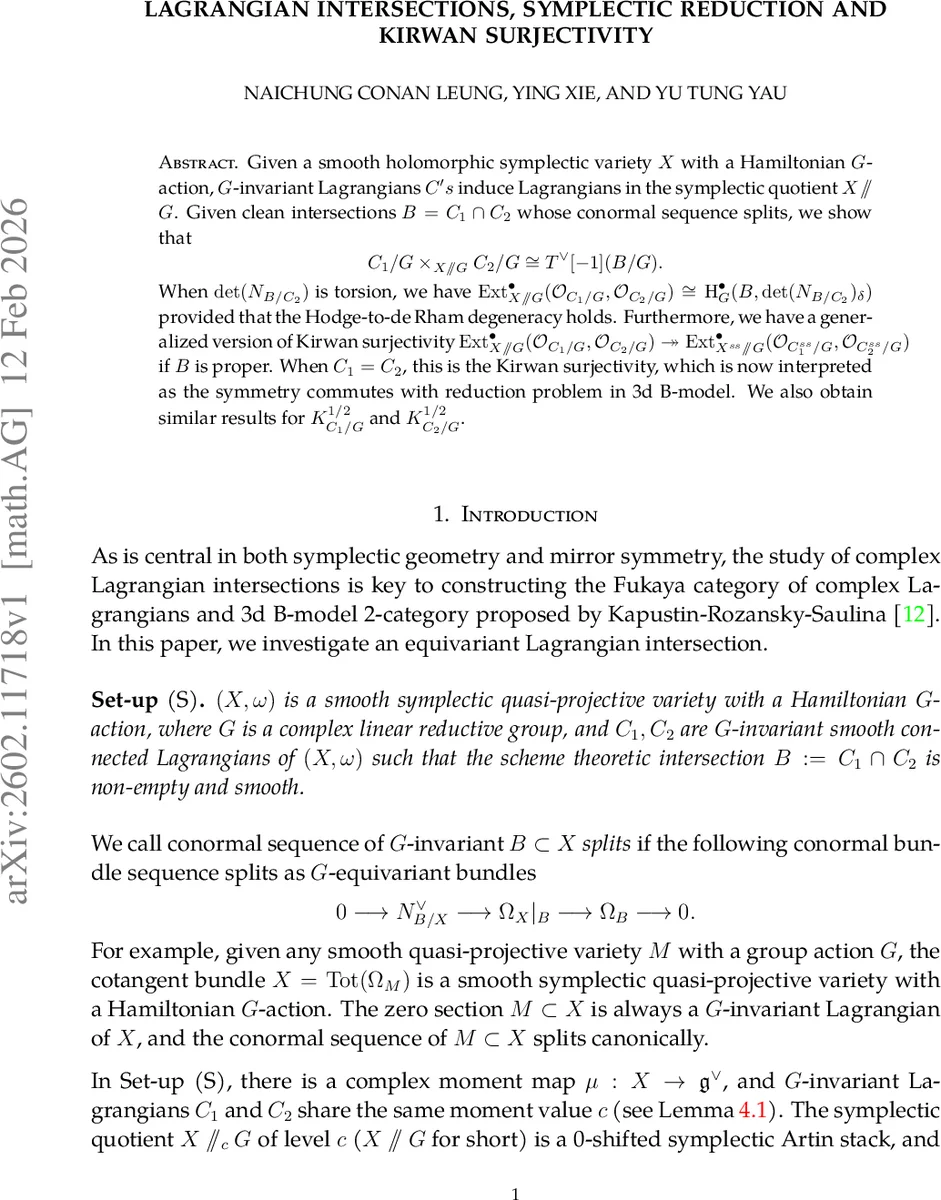
Given a smooth holomorphic symplectic variety $X$ with a Hamiltonian $G$-action, $G$-invariant Lagrangians $C’s$ induce Lagrangians in the symplectic quotient $X// G$. Given clean intersections $B=C_1\cap C_2$ whose conormal sequence splits, we show that $$C_1/G\times_{X// G} C_2/G\cong T^{\vee}-1.$$ When $det(N_{B/C_2})$ is torsion, we have $Ext^{\bullet}{X// G}(\mathcal{O}{C_1/G}, \mathcal{O}{C_2/G})\cong H^{\bullet}G(B, det(N{B/C_2})δ)$ provided that the Hodge-to-de Rham degeneracy holds. Furthermore, we have a generalized version of Kirwan surjectivity $Ext^{\bullet}{X// G}(\mathcal{O}{C_1/G}, \mathcal{O}{C_2/G})\twoheadrightarrow Ext^{\bullet}{X^{ss}// G}(\mathcal{O}{C_1^{ss}/G}, \mathcal{O}{C_2^{ss}/G})$ if $B$ is proper. When $C_1=C_2$, this is the Kirwan surjectivity, which is now interpreted as the symmetry commutes with reduction problem in 3d B-model. We also obtain similar results for $K_{C_1/G}^{1/2}$ and $K_{C_2/G}^{1/2}$.
💡 Research Summary
The paper studies equivariant Lagrangian intersections inside a smooth holomorphic symplectic variety (X) equipped with a Hamiltonian action of a complex reductive group (G). The authors fix two smooth, connected, (G)-invariant Lagrangians (C_{1},C_{2}\subset X) that share the same moment value. Their scheme‑theoretic intersection (B=C_{1}\cap C_{2}) is assumed to be smooth (a “clean” intersection) and the conormal exact sequence of (B\subset X) is required to split as a (G)-equivariant sequence. Under these hypotheses the derived fiber product of the quotient Lagrangians in the symplectic reduction, \
Comments & Academic Discussion
Loading comments...
Leave a Comment