Symmetry Spans and Enforced Gaplessness
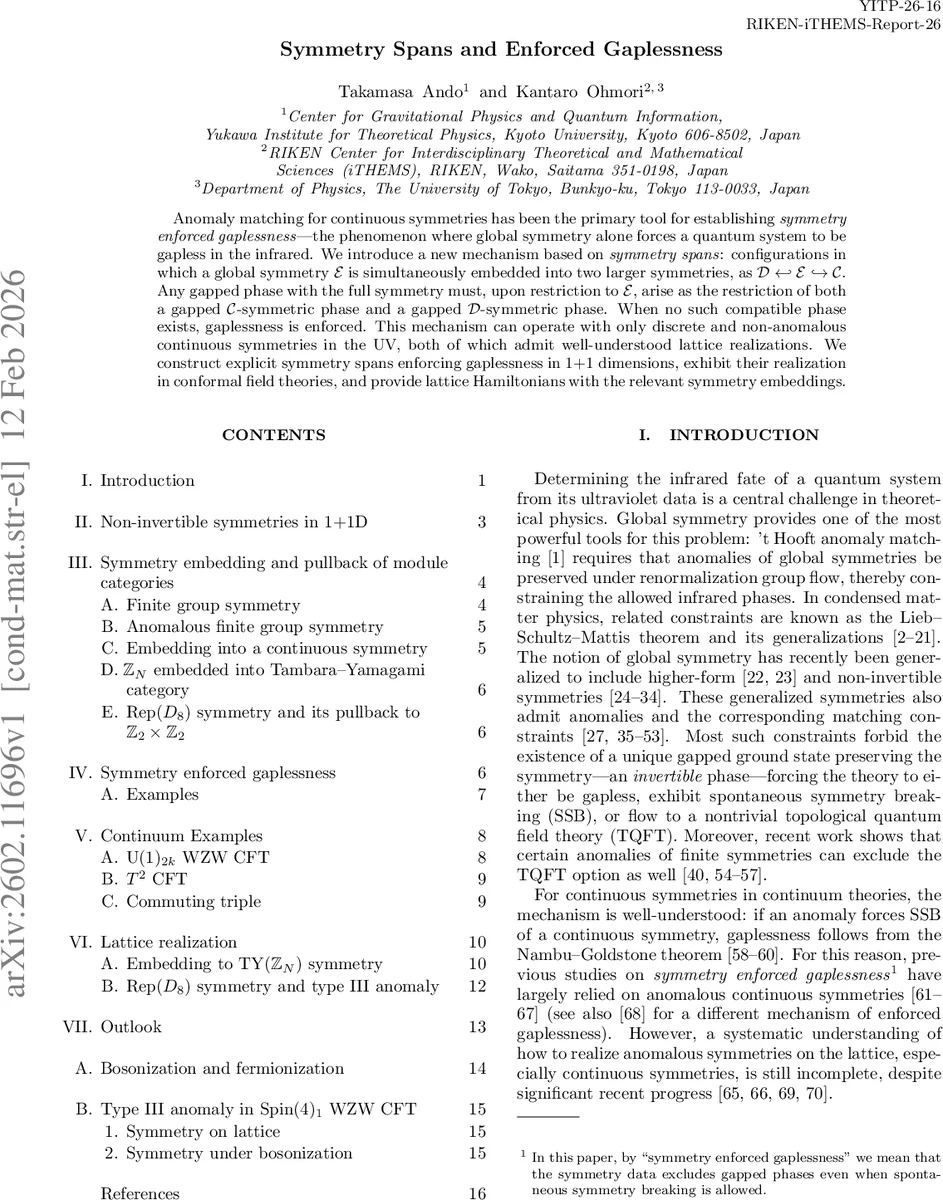
Anomaly matching for continuous symmetries has been the primary tool for establishing symmetry enforced gaplessness - the phenomenon where global symmetry alone forces a quantum system to be gapless in the infrared. We introduce a new mechanism based on \textit{symmetry spans}: configurations in which a global symmetry $\mathcal{E}$ is simultaneously embedded into two larger symmetries, as $\mathcal{D}\hookleftarrow\mathcal{E}\hookrightarrow\mathcal{C}$. Any gapped phase with the full symmetry must, upon restriction to $\mathcal{E}$, arise as the restriction of both a gapped $\mathcal{C}$-symmetric phase and a gapped $\mathcal{D}$-symmetric phase. When no such compatible phase exists, gaplessness is enforced. This mechanism can operate with only discrete and non-anomalous continuous symmetries in the UV, both of which admit well-understood lattice realizations. We construct explicit symmetry spans enforcing gaplessness in 1+1 dimensions, exhibit their realization in conformal field theories, and provide lattice Hamiltonians with the relevant symmetry embeddings.
💡 Research Summary
The paper introduces a novel mechanism for “symmetry‑enforced gaplessness” that does not rely on ’t Hooft anomalies of continuous symmetries. The key idea is a “symmetry span”: a global symmetry E that is simultaneously embedded into two larger symmetries C and D, written as D ← E → C. Any gapped phase preserving the full symmetry S_faith must, when restricted to E, arise as the restriction of both a C‑symmetric gapped phase and a D‑symmetric gapped phase. Mathematically, let TQFT(E) denote the category of gapped (topological) quantum field theories with E symmetry. The embedding functors i_C and i_D pull back gapped C‑ and D‑theories to E‑theories, giving sub‑categories i_C^* TQFT(C) and i_D^* TQFT(D). The necessary condition for a gapped phase to exist is that the intersection of these sub‑categories be non‑empty. When the intersection is empty, no gapped theory can realize both C and D simultaneously, and the system must be gapless.
The authors focus on 1+1 dimensions and consider spans of the form Vect H ↪ C ← Vect G, where Vect H and Vect G are the fusion‑category descriptions of finite‑group H and (possibly continuous) group G, while C is a non‑invertible fusion category (e.g. a Tambara–Yamagami category TY(A) or Rep(D₈)). An embedding i(φ,β) is specified by a group homomorphism φ:H→G and a 2‑cocycle β∈H²(H,U(1)). Physically, β corresponds to dressing symmetry operators with an SPT strip, while φ maps the H‑operators into the larger G‑operators.
Concrete examples are worked out in detail:
-
Z₂×Z₂ ↪ Z₄×Z₄ – The homomorphism φ sends (a,b) to (2a,2b) mod 4. Two choices of β (trivial and non‑trivial) illustrate how the pull‑back acts on SPT phases. The authors show that the pull‑back images of the C‑ and D‑theories have no common element, enforcing gaplessness.
-
Z_N embedded in TY(Z_N) – TY(A) contains an invertible A‑symmetry and a non‑invertible object N. For A=Z_N the full TY(Z_N) symmetry is anomalous: it does not admit a unique gapped ground state because the Z_N symmetry would have to be self‑dual under gauging, which is impossible for a non‑degenerate vacuum. Hence any model with this span is forced to be gapless.
-
Rep(D₈) → Z₂×Z₂ – Rep(D₈) is a non‑invertible fusion category whose restriction to the subgroup Z₂×Z₂ yields a Type III anomaly. Again the pull‑back categories have empty intersection, leading to enforced gaplessness.
The paper also connects these spans to conformal field theories. Examples include the U(1)_{2k} WZW model, torus (T²) CFTs, and a “commuting triple” construction. In each case the infrared theory possesses an anomalous continuous symmetry, but the ultraviolet description uses only discrete symmetries and non‑invertible symmetries that can be realized on a lattice.
Finally, explicit lattice Hamiltonians are constructed. Spin‑chain models with TY(Z_N) symmetry and with Rep(D₈) symmetry are presented, together with interaction terms that respect both embeddings. Numerical checks (or variational arguments) show that the low‑energy spectrum remains gapless, confirming the span‑based argument in a concrete microscopic setting.
Overall, the work provides a general, anomaly‑free framework for symmetry‑enforced gaplessness via symmetry spans, demonstrates its power through a variety of 1+1‑dimensional examples, and supplies explicit lattice realizations, opening the door to systematic exploration of gaplessness in higher dimensions and more intricate symmetry structures.
Comments & Academic Discussion
Loading comments...
Leave a Comment