Emergent spin-resolved electronic charge density waves and pseudogap phenomena from strong $d$-wave altermagnetism
Inspired by recent discovery of metallic $d$-wave altermagnetism in KV$_2$Se$_2$O, we develop a self-consistent microscopic many-body calculation of density-wave order for an itinerant altermagnetic metal. We show that the strong $d$-wave spin-momentum locking inherent to the altermagnetic band structure reconstructs the Fermi surface into spin-selective quasi-1D open sheets. This unique topology of Fermi surface drives an instability toward spin-resolved electronic charge density waves (CDWs), in which the ordering wave vectors for spin-up and spin-down electrons condense along two mutually orthogonal directions, forming spin-resolved stripe phases. As a consequence, this results in pronounced gap openings near the Fermi surface, and the superposition of these spin-resolved stripe orders leads to a checkerboard CDW in the charge channel and an antiphase spin-density-wave modulation in the spin channel. Upon increasing temperature, the density-wave order melts at $T_c$ due to thermal phase fluctuation while the gap opening persists, giving rise to a robust pseudogap regime, which eventually closes at a higher temperature $T_g$. The resulting simulations quantitatively reproduce the key features observed in the spectroscopic measurements, offering a consistent and generic understanding of the reported phenomena in KV$_2$Se$_2$O and, more broadly, in metallic altermagnets with strong spin-momentum locking.
💡 Research Summary
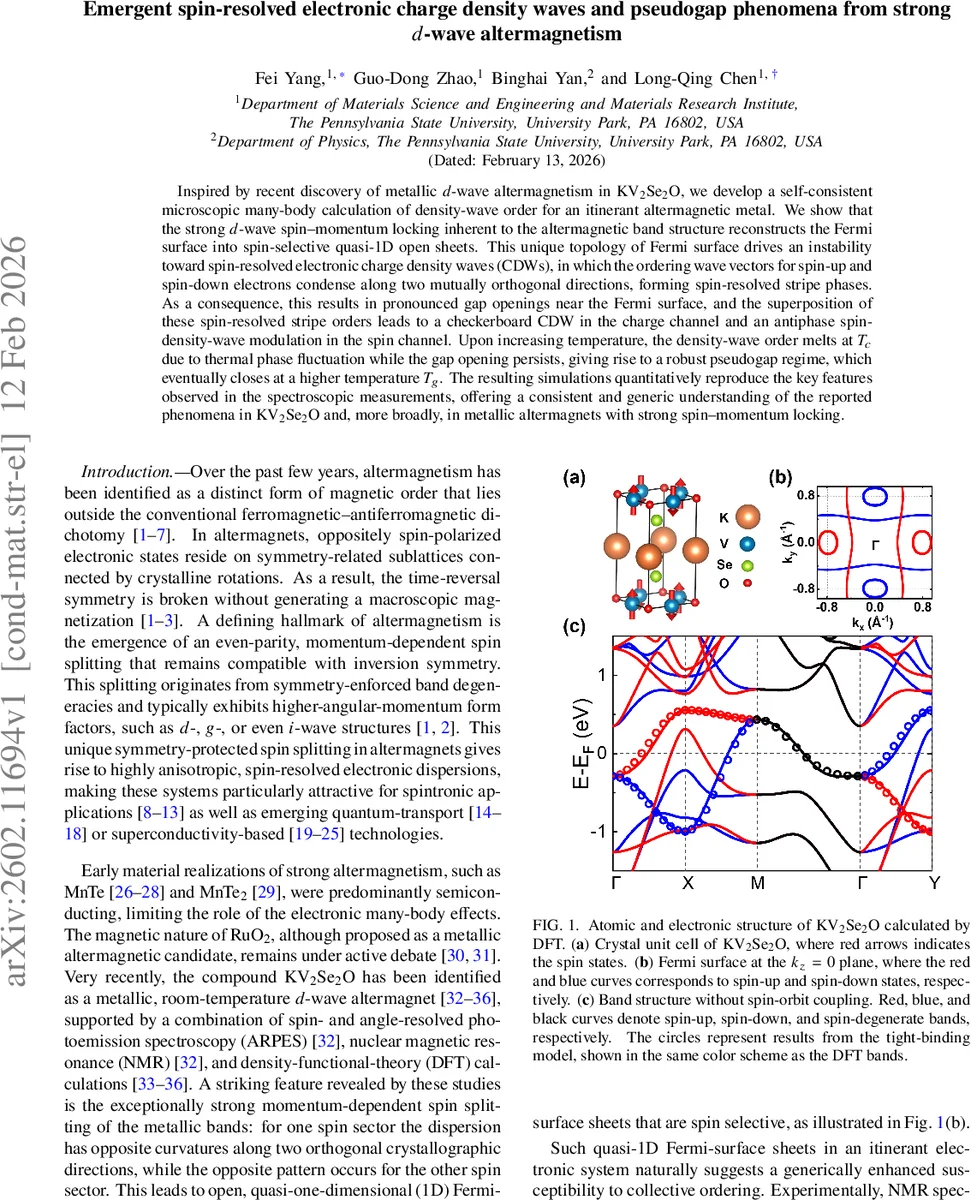
The paper presents a comprehensive theoretical study of density‑wave instabilities in a metallic d‑wave altermagnet, using KV₂Se₂O as a concrete example. Altermagnetism is a recently identified magnetic order that breaks time‑reversal symmetry without producing a net magnetization, because opposite spin‑polarized electronic states reside on symmetry‑related sublattices. In KV₂Se₂O the altermagnetic band structure exhibits a pronounced d‑wave spin‑momentum locking: the spin‑up band has a positive curvature along Γ–X and a negative curvature along Γ–Y, while the spin‑down band shows the opposite. This anisotropic splitting creates two quasi‑one‑dimensional (quasi‑1D) open Fermi‑surface sheets that are nearly parallel for each spin species but oriented orthogonally with respect to each other.
Starting from a tight‑binding model that reproduces the DFT bands (nearest‑ and next‑nearest‑neighbor hoppings t, t′ and a d‑wave spin‑splitting term t_j), the authors add a short‑range electron‑electron interaction V. They allow the interaction to decouple in the charge‑density‑wave (CDW) channel, but crucially they permit distinct ordering wave vectors Q↑ and Q↓ for the two spin sectors, reflecting the different nesting conditions of the spin‑selective Fermi sheets. A mean‑field (BCS‑like) treatment yields spin‑resolved order parameters Δ↑ and Δ↓ and a mean‑field Hamiltonian that can be diagonalized analytically.
Self‑consistent solutions show that the optimal Q vectors are aligned with the directions of the open sheets: Q↑ points along the x‑axis (θ=0) and Q↓ along the y‑axis (θ=π/2). Consequently the real‑space charge density for each spin takes the form ρ_s(r)=4V⁻¹|Δ_s|cos(Q_s·r+φ_s). The two orthogonal modulations superpose to produce a checkerboard‑type charge density wave (ρ↑+ρ↓) and an antiphase spin‑density wave (ρ↑−ρ↓). The calculated quasiparticle spectra display clear gaps at the Fermi level: the spin‑up sector opens a gap along Γ–X, the spin‑down sector along Γ–Y and X–M, and a spin‑degenerate gap appears along Γ–M. These features match the low‑temperature ARPES observations of KV₂Se₂O, which report gap openings and band back‑folding along the same high‑symmetry directions.
To address the temperature evolution, the authors go beyond static mean‑field theory and incorporate phase fluctuations of the order parameters. They decompose the phase φ_s into a static part φ_e,s and a fluctuating part δφ_s, and treat δφ_s as a bosonic phason mode. The phason has a dispersion Ω²(q)=m_p²+f_c(T)(v_s·q)², where m_p is a pinning gap arising from impurities, commensurability, or lattice defects, and v_s is the phason velocity. Thermal occupation of the phason leads to a Debye‑Waller‑like factor exp
Comments & Academic Discussion
Loading comments...
Leave a Comment