"I Was Told to Come Back and Share This": Social Media-Based Near-Death Experience Disclosures as Expressions of Spiritual Beliefs
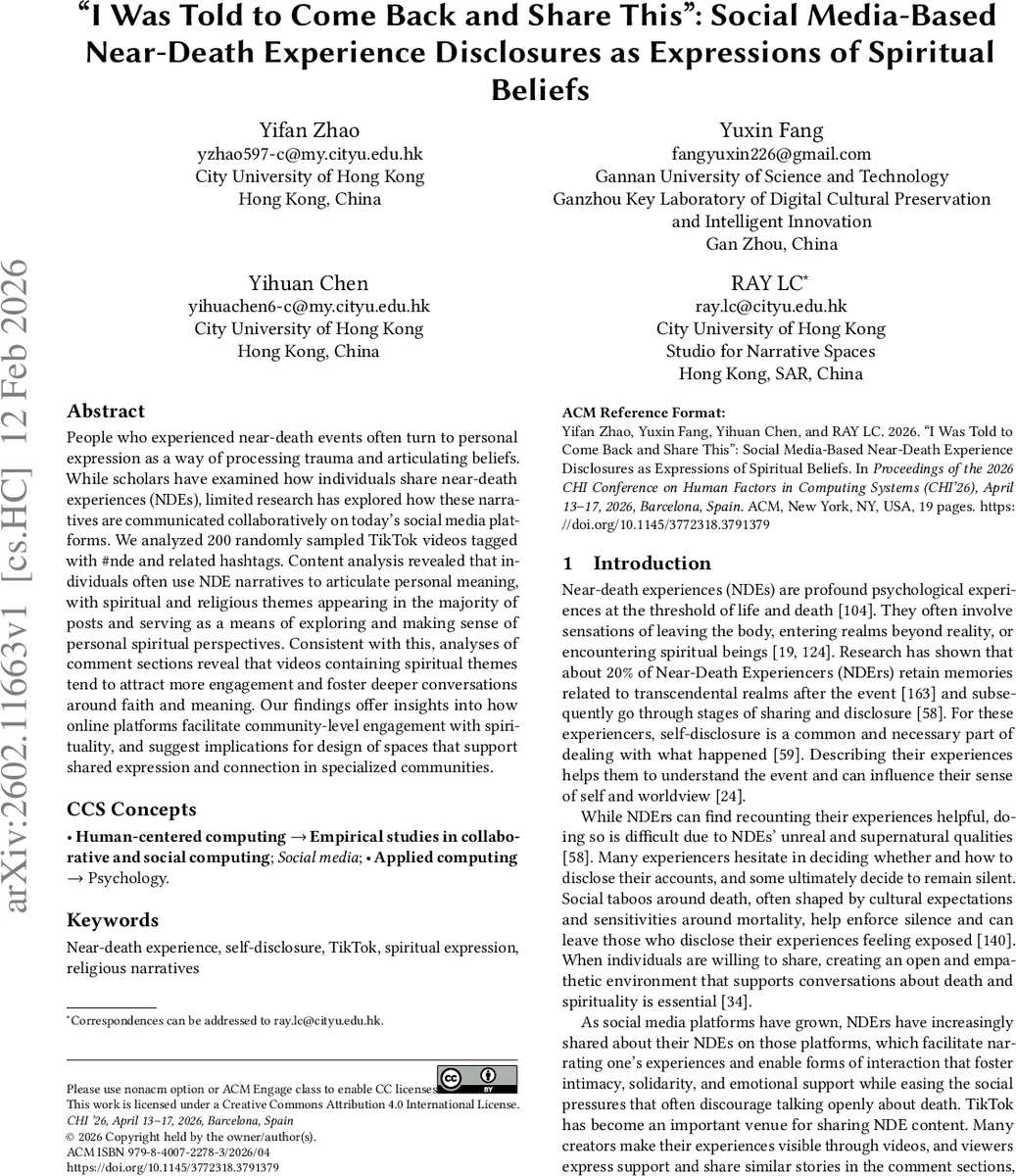
People who experienced near-death events often turn to personal expression as a way of processing trauma and articulating beliefs. While scholars have examined how individuals share near-death experiences (NDEs), limited research has explored how these narratives are communicated collaboratively on today’s social media platforms. We analyzed 200 randomly sampled TikTok videos tagged with #nde and related hashtags. Content analysis revealed that individuals often use NDE narratives to articulate personal meaning, with spiritual and religious themes appearing in the majority of posts and serving as a means of exploring and making sense of personal spiritual perspectives. Consistent with this, analyses of comment sections reveal that videos containing spiritual themes tend to attract more engagement and foster deeper conversations around faith and meaning. Our findings offer insights into how online platforms facilitate community-level engagement with spirituality, and suggest implications for design of spaces that support shared expression and connection in specialized communities.
💡 Research Summary
This paper investigates how near‑death experiences (NDEs) are disclosed, interpreted, and co‑constructed on the social media platform TikTok. While prior work in psychology, religious studies, and HCI has examined the personal therapeutic value of NDE narratives and their influence on world‑views, little attention has been paid to the collaborative, algorithm‑driven environment of contemporary short‑form video platforms. To fill this gap, the authors collected a dataset of 200 publicly available TikTok videos posted between December 2021 and December 2024 that were tagged with #nde and related hashtags such as #afterlife, #lifeafterdeath, and #neardeath. An IRB‑approved protocol ensured that only publicly visible content was harvested and that no personally identifying information beyond what is displayed on the platform was stored.
The methodological approach combines grounded theory coding with multimodal discourse analysis. Video content was first segmented into four narrative typologies: testimonial (first‑person recounting), educational (explanatory framing of NDE concepts), empathetic (emphasis on emotional resonance), and proselytizing (explicit religious or spiritual advocacy). Each video was also coded for the presence and framing of spiritual or religious elements, including references to divine beings, light, afterlife realms, and moral transformation.
Quantitative analysis shows that 78 % of the sampled videos contain explicit spiritual language, and these videos attract significantly higher engagement: on average 1.9 × more views, 1.9 × more likes, and 2.3 × more comments than videos lacking spiritual content. Qualitative analysis of the comment sections reveals three dominant interaction patterns: (1) expressions of empathy and shared awe, (2) personal anecdotes of similar experiences, and (3) theological discussion or debate. The platform’s native features—Duet and Stitch—are frequently employed to create response videos that reinterpret the original narrative, thereby fostering a process of co‑construction of meaning among creators and viewers.
Cultural analysis indicates divergent framing strategies: creators from East Asian contexts tend to emphasize concepts of impermanence, interconnectedness, and non‑dualistic spirituality, whereas creators from Western contexts more often invoke salvation, heaven, and personal relationship with a deity. This supports the claim that NDEs, while phenomenologically similar across cultures, are interpreted through culturally specific religious lenses.
The authors situate these findings within TikTok’s algorithmic architecture. The For You Page (FYP) recommendation system prioritizes engagement signals (watch time, comments, shares) and thus creates “interest‑based clustered publics” rather than traditional networked publics. This algorithmic curation amplifies niche spiritual content, allowing NDE narratives to reach audiences who may not be directly connected to the original creator but share a thematic interest.
From a design perspective, the paper proposes three “thanatosensitive” interventions for platforms handling sensitive death‑related content: (1) UI mechanisms that mitigate context collapse by allowing creators to segment audiences or flag content for specific spiritual communities; (2) AI‑assisted comment moderation and suggestion tools that promote empathetic language while filtering harassment; and (3) transparent guidelines for the use of Duet and Stitch in the context of trauma‑related storytelling, encouraging responsible co‑creation.
In conclusion, the study demonstrates that TikTok serves as a fertile environment for the public expression of NDEs and the collective negotiation of spiritual meaning. By combining rigorous mixed‑methods analysis with a sociotechnical lens, the authors provide empirical evidence that can inform future HCI research on death, spirituality, and the design of supportive digital spaces. The work expands the emerging field of “thanatosensitivity” and offers concrete design recommendations for fostering healthier, more empathetic online communities around some of humanity’s most profound experiences.
Comments & Academic Discussion
Loading comments...
Leave a Comment