Quantum-geometric thermal conductivity of superconductors
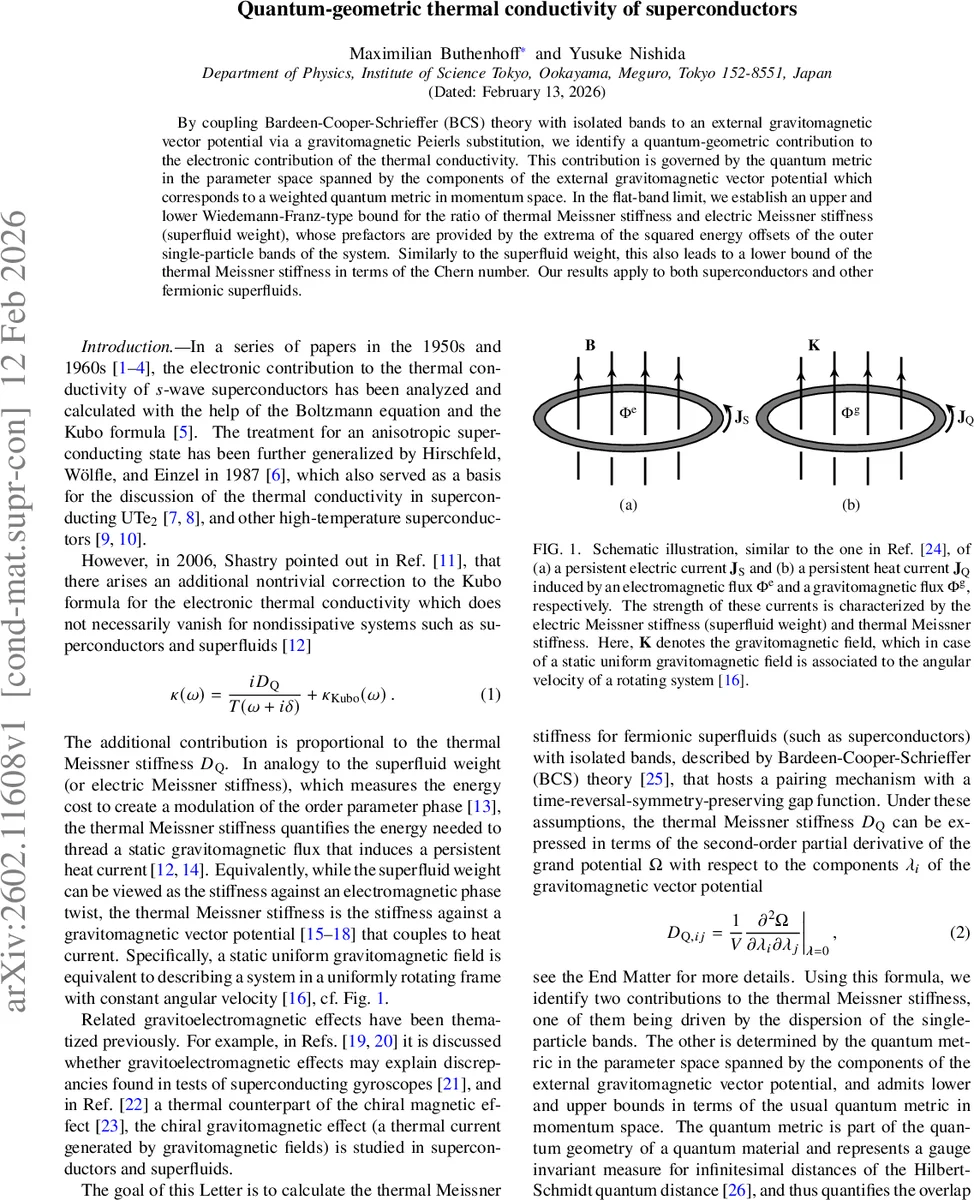
By coupling Bardeen-Cooper-Schrieffer (BCS) theory with isolated bands to an external gravitomagnetic vector potential via a gravitomagnetic Peierls substitution, we identify a quantum-geometric contribution to the electronic contribution of the thermal conductivity. This contribution is governed by the quantum metric in the parameter space spanned by the components of the external gravitomagnetic vector potential which corresponds to a weighted quantum metric in momentum space. In the flat-band limit, we establish an upper and lower Wiedemann-Franz-type bound for the ratio of thermal Meissner stiffness and electric Meissner stiffness (superfluid weight), whose prefactors are provided by the extrema of the squared energy offsets of the outer single-particle bands of the system. Similarly to the superfluid weight, this also leads to a lower bound of the thermal Meissner stiffness in terms of the Chern number. Our results apply to both superconductors and other fermionic superfluids.
💡 Research Summary
The paper develops a quantum‑geometric theory of the electronic contribution to thermal conductivity in superconductors (and more generally in fermionic superfluids) by coupling Bardeen‑Cooper‑Schrieffer (BCS) mean‑field theory to an external gravitomagnetic vector potential λ. The authors introduce a “gravitomagnetic Peierls substitution” (Eq. 3) that shifts the crystal momentum in a way proportional to the band energy offset ξₙ(k) rather than the usual electromagnetic charge. This substitution leads to an implicit relation for the twisted band energies ξₙ(λ)(k), which can be expanded in powers of λ (Eq. 4).
A crucial step is the identification of the Wilczek‑Zee connection in the parameter space spanned by the components of λ. Its real part defines a quantum metric g_{ij}(λ) (Eq. 5) that measures the infinitesimal distance between eigenstates as λ is varied. By relating the Wilczek‑Zee connection in λ‑space to the usual momentum‑space connection through the heat‑current operator J_Q^i = ½{K,∂_{k_i}K}, the authors show that the quantum metric in λ‑space is a weighted version of the momentum‑space quantum metric.
The thermal Meissner stiffness D_Q^{ij} is defined as the second derivative of the grand potential Ω with respect to λ (Eq. 2). Using the chain rule and the expanded quasiparticle energies E_{±n}(k,λ) (Eq. 11), the authors separate D_Q into two contributions:
-
Conventional part D_conv^Q (Eq. 13) – depends only on the band dispersion ξₙ(k) and its first and second momentum derivatives. This term is analogous to the usual kinetic contribution to superfluid weight.
-
Geometric part D_geom^Q (Eq. 14) – involves the band‑resolved quantum metric g^{(n)}{ij,m}(k) and the superconducting gap |Δ(k)|². It originates from inter‑band virtual transitions encoded in the fidelity F_n(k,λ) between a state and its time‑reversed partner; the second‑order λ‑derivative of the fidelity yields –8 g{ij}^{(n)}(k).
In the flat‑band limit (one isolated band with ξ_{n0}(k)≈μ), the conventional contribution vanishes, and the geometric term dominates. The resulting expression (Eq. 15) shows that D_Q is proportional to a weighted sum over the quantum metric of the flat band, with weights given by the squared energy offsets of the remaining (outer) bands. This leads to a Wiedemann‑Franz‑type inequality for the ratio of thermal Meissner stiffness to electric Meissner stiffness (the superfluid weight D_s):
\
Comments & Academic Discussion
Loading comments...
Leave a Comment