Collaboration drives phase transitions towards cooperation in prisoner's dilemma
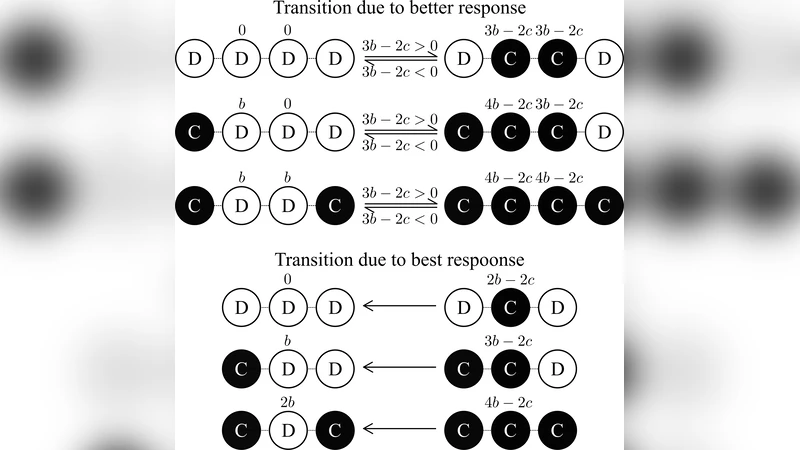
We present a collaboration ring model – a network of players playing the prisoner’s dilemma game and collaborating among the nearest neighbours by forming coalitions. The microscopic stochastic updating of the players’ strategies are driven by their innate nature of seeking selfish gains and shared intentionality. Cooperation emerges in such a structured population through non-equilibrium phase transitions driven by propensity of the players to collaborate and by the benefit that a cooperator generates. The robust results are qualitatively independent of number of neighbours and collaborators.
💡 Research Summary
The paper introduces a “collaboration ring” model in which agents are placed on a one‑dimensional ring network and play the Prisoner’s Dilemma (PD) with their two nearest neighbours. At each update step a randomly chosen agent either (i) with probability p forms a coalition with one neighbour and jointly selects a coalitional better‑response that guarantees each member a payoff at least as high as the current one, or (ii) with probability 1‑p adopts a standard best‑response against the fixed actions of its neighbours. The payoff matrix follows the usual PD conventions with benefit b and cost c (c > b, c < 2b). The key control parameters are the collaboration propensity p and the cooperative benefit b; the cost c is held constant.
Through extensive stochastic simulations the authors map the stationary cooperation fraction (\bar{x}^) over the (b, p) plane. They identify three broad regimes: (1) for b < b_c ≡ 2c/3 the system always ends in an absorbing all‑defector state regardless of p; (2) for b ≥ b_c and 0 < p < 1 the system reaches an active phase where cooperators and defectors coexist with a non‑zero (\bar{x}^); (3) for p = 1 the dynamics lead to absorbing states that are highly degenerate—either configurations with no adjacent cooperators (CC pairs) or no adjacent defectors (DD pairs). Five distinct phase transitions are observed, including both continuous and discontinuous jumps, notably a discontinuous transition at p = 1 that cannot be produced by best‑response dynamics alone.
To explain these phenomena analytically the authors first write a master equation for the Markov process. A naïve mean‑field approximation fails when p is large because it neglects correlations between neighbours. Instead they adopt a pairwise (Bethe‑type) approximation, treating the probabilities of the three possible neighbour‑pair types (CC, DD, CD) as independent variables while closing higher‑order correlations. This yields coupled differential equations for the average cooperator density (\bar{x}(t)) and the density of mixed pairs (\bar{y}(t)). Fixed‑point analysis of these equations reproduces the simulation phase diagram: for b < b_c the only stable fixed point is (0,0); for b ≥ b_c and 0 < p < 1 a unique interior fixed point corresponds to the active phase; for p = 1 the interior fixed point disappears and a line of neutrally stable fixed points satisfying (\bar{x}+\bar{y}^2=1) emerges, accounting for the multiplicity of absorbing states. The inflow rate of cooperators (J_C) derived from the pairwise theory matches the numerically measured rate across the whole parameter range, whereas the mean‑field prediction deviates strongly.
The authors further test robustness by varying the node degree k and the coalition size. The qualitative shape of the phase diagram persists, with the critical benefit shifting to (b_c = k/(k+1),c). Consequently, sparser networks (smaller k) facilitate cooperation, a result that aligns with empirical observations of cooperation in loosely connected societies.
In conclusion, the collaboration ring model integrates selfish payoff maximization with a minimal form of shared intentionality, showing that even a simple coalition mechanism can drive non‑equilibrium phase transitions toward cooperation. The work bridges non‑cooperative and cooperative game theory, offering a new, analytically tractable pathway to collective cooperation that is distinct from the classic five rules (kin selection, direct/indirect reciprocity, network reciprocity, group selection). This framework may prove valuable for understanding the emergence of cooperation in human and other biological systems where temporary coalitions and shared intentions play a pivotal role.
Comments & Academic Discussion
Loading comments...
Leave a Comment