The sharp interface limit of the matrix-valued Allen-Cahn equation
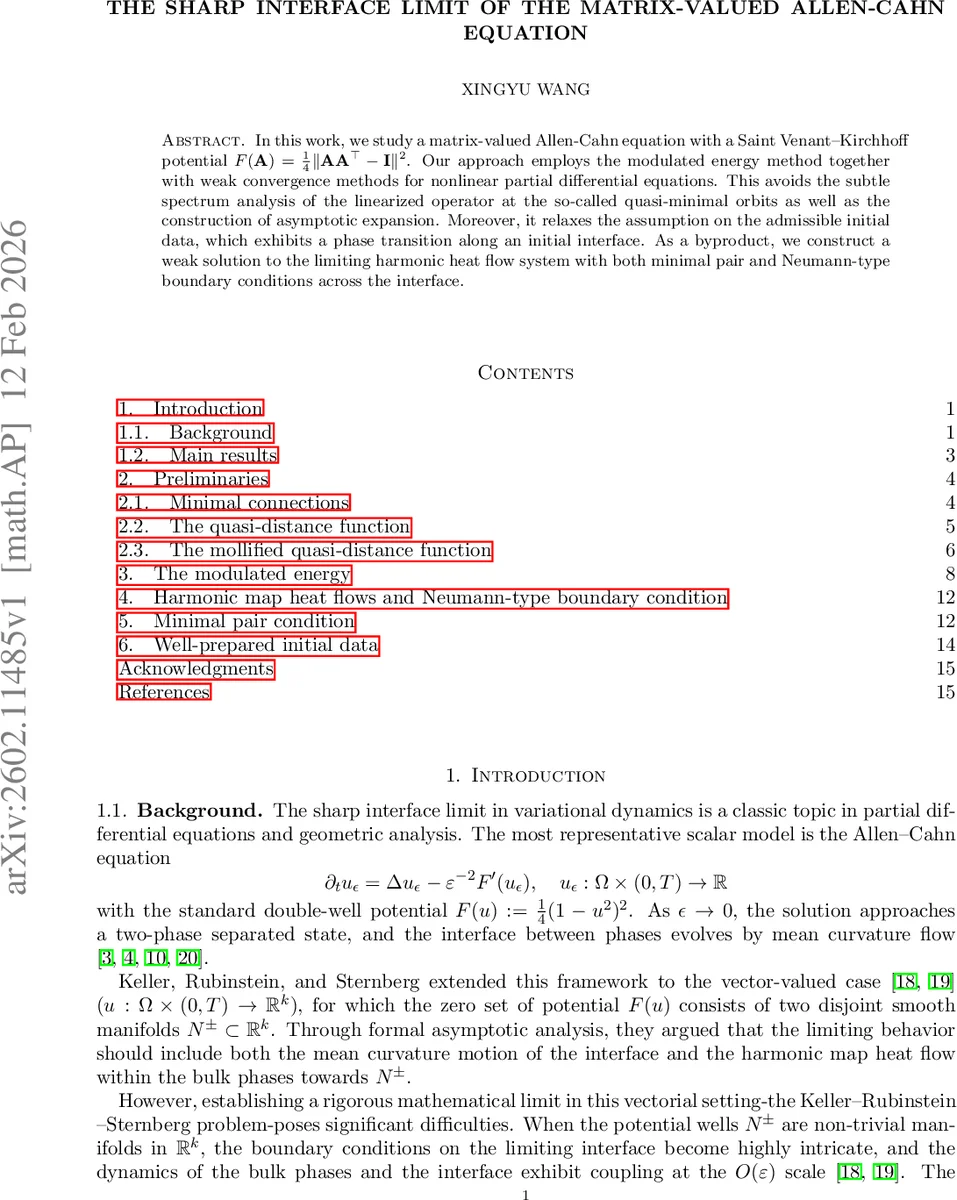
In this work, we study a matrix-valued Allen-Cahn equation with a Saint Venant-Kirchhoff potential $F(\mathbf{A})=\frac{1}{4}|\mathbf{A}\mathbf{A}^\top-\mathbf{I}|^2$. Our approach employs the modulated energy method together with weak convergence methods for nonlinear partial differential equations. This avoids the subtle spectrum analysis of the linearized operator at the so-called quasi-minimal orbits as well as the construction of asymptotic expansion. Moreover, it relaxes the assumption on the admissible initial data, which exhibits a phase transition along an initial interface. As a byproduct, we construct a weak solution to the limiting harmonic heat flow system with both minimal pair and Neumann-type boundary conditions across the interface.
💡 Research Summary
The paper addresses the sharp‑interface limit of a matrix‑valued Allen‑Cahn equation driven by the Saint Venant–Kirchhoff potential
(F(A)=\frac14|AA^{\top}-I|^{2}). The zero set of this potential is the orthogonal group (O(n)=O_{+}(n)\cup O_{-}(n)). As the small parameter (\varepsilon\to0), solutions are expected to separate into two bulk phases (\Omega^{\pm}{t}) where the matrix field takes values in the two connected components (O{\pm}(n)), while an interface (\Gamma_{t}) moves by mean‑curvature flow. The limiting system should consist of (i) the harmonic map heat flow inside each bulk, (ii) the mean‑curvature evolution of the interface, (iii) a “minimal pair” condition across the interface (the two orthogonal matrices differ by a reflection), and (iv) a Neumann‑type jump condition for the normal derivative of the matrix field on the interface.
Previous works (notably
Comments & Academic Discussion
Loading comments...
Leave a Comment