Quantifying the effect of graph structure on strong Feller property of SPDEs
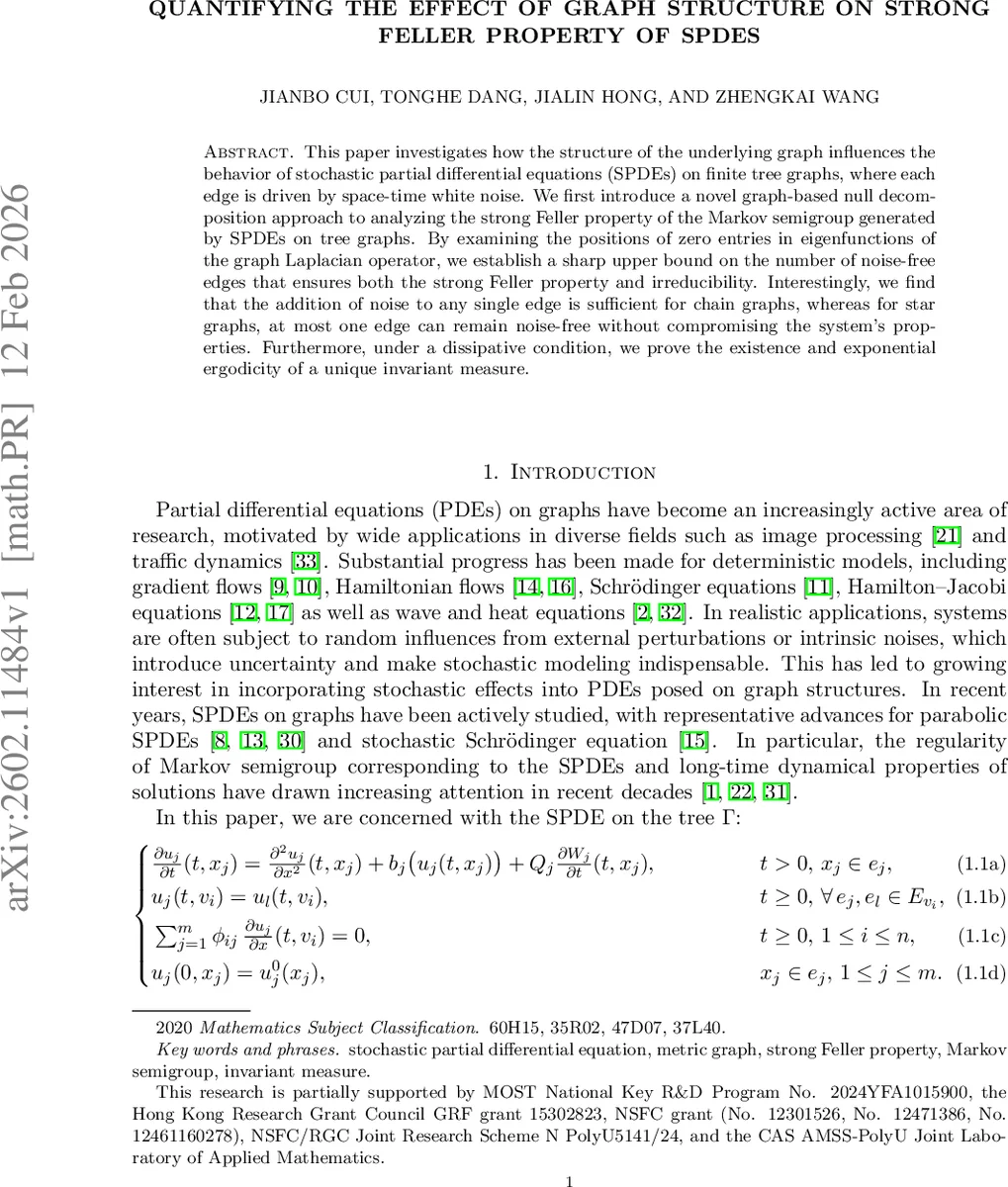
This paper investigates how the structure of the underlying graph influences the behavior of stochastic partial differential equations (SPDEs) on finite tree graphs, where each edge is driven by space-time white noise. We first introduce a novel graph-based null decomposition approach to analyzing the strong Feller property of the Markov semigroup generated by SPDEs on tree graphs. By examining the positions of zero entries in eigenfunctions of the graph Laplacian operator, we establish a sharp upper bound on the number of noise-free edges that ensures both the strong Feller property and irreducibility. Interestingly, we find that the addition of noise to any single edge is sufficient for chain graphs, whereas for star graphs, at most one edge can remain noise-free without compromising the system’s properties. Furthermore, under a dissipative condition, we prove the existence and exponential ergodicity of a unique invariant measure.
💡 Research Summary
This paper investigates how the underlying graph structure influences the regularizing properties of stochastic partial differential equations (SPDEs) defined on finite tree graphs, with particular focus on the strong Feller property, irreducibility, and the existence of a unique invariant measure. The authors consider a reaction‑diffusion SPDE on a tree Γ = (V,E), where each edge e_j is parametrized by the interval
Comments & Academic Discussion
Loading comments...
Leave a Comment