Defining causal mechanism in dual process theory and two types of feedback control
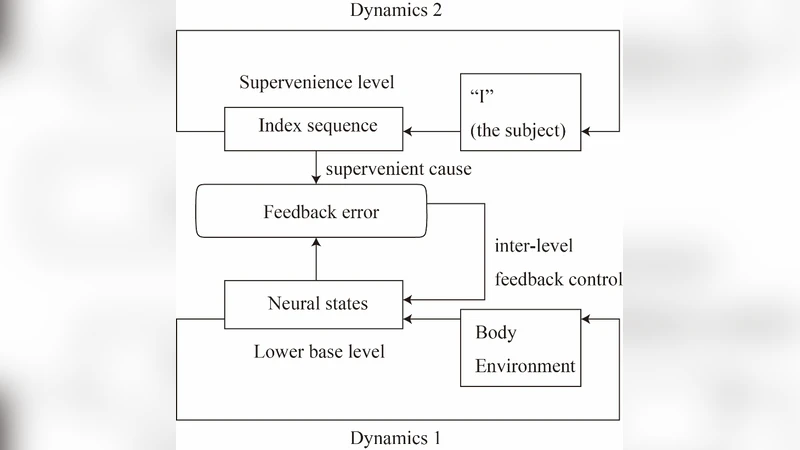
Mental events are considered to supervene on physical events. A supervenient event does not change without a corresponding change in the underlying subvenient physical events. Since wholes and their parts exhibit the same supervenience-subvenience relations, inter-level causation has been expected to serve as a model for mental causation. We proposed an inter-level causation mechanism to construct a model of consciousness and an agent’s self-determination. However, a significant gap exists between this mechanism and cognitive functions. Here, we demonstrate how to integrate the inter-level causation mechanism with the widely known dual-process theories. We assume that the supervenience level is composed of multiple supervenient functions (i.e., neural networks), and we argue that inter-level causation can be achieved by controlling the feedback error defined through changing algebraic expressions combining these functions. Using inter-level causation allows for a dual laws model in which each level possesses its own distinct dynamics. In this framework, the feedback error is determined independently by two processes: (1) the selection of equations combining supervenient functions, and (2) the negative feedback error reduction to satisfy the equations through adjustments of neurons and synapses. We interpret these two independent feedback controls as Type 1 and Type 2 processes in the dual process theories. As a result, theories of consciousness, agency, and dual process theory are unified into a single framework, and the characteristic features of Type 1 and Type 2 processes are naturally derived.
💡 Research Summary
The paper tackles the longstanding philosophical problem of mental causation by grounding it in a concrete inter‑level causation mechanism and then embedding that mechanism within the well‑established dual‑process framework of cognition. Starting from the premise that mental events supervene on physical (neural) events, the authors argue that supervenience is not a monolithic mapping but a collection of multiple “supervenient functions,” each realized as a distinct neural network module (e.g., perception, language, affect). These modules are combined algebraically—through sums, products, nonlinear transformations, etc.—to form higher‑level mental states. The crucial innovation is the definition of a feedback error that arises whenever the algebraic combination of supervenient functions fails to satisfy a chosen equation.
Two independent control processes generate and reduce this error. The first process selects which algebraic equation is appropriate for the current context; this selection is rapid, automatic, and driven by learned heuristics or environmental cues. The second process implements a negative‑feedback loop that adjusts neuronal activations, synaptic weights, and network connectivity so that the chosen equation is satisfied, thereby minimizing the error. Because the two processes operate on different hierarchical levels—one at the level of symbolic equation selection, the other at the level of low‑level neural parameters—they constitute distinct causal pathways.
The authors map these pathways onto the classic Type 1 (fast, automatic) and Type 2 (slow, deliberative) processes of dual‑process theory. Type 1 corresponds to the equation‑selection stage, reflecting intuitive, heuristic‑driven cognition. Type 2 corresponds to the error‑reduction stage, reflecting conscious, effortful manipulation of neural resources (e.g., prefrontal control, working‑memory maintenance, synaptic plasticity). By doing so, the paper offers a mechanistic account of why Type 1 and Type 2 processes differ not merely in speed but in the level of the causal hierarchy at which they operate.
The authors introduce the “dual‑laws model,” in which each level—mental (algebraic) and neural (parameter) — possesses its own dynamical equations, yet the two levels are coupled through the shared feedback error signal. This coupling yields a unified system that can generate behavior, experience, and agency while preserving the distinct dynamics of each level.
Key contributions are threefold. First, the philosophical notion of supervenience is translated into a mathematically precise framework (algebraic combinations + feedback error), making it amenable to empirical testing. Second, dual‑process theory receives a novel structural interpretation: Type 1 and Type 2 processes are identified as independent inter‑level feedback controls rather than merely speed‑based variants of a single system. Third, consciousness and self‑determination are reframed as the system’s drive to minimize the inter‑level feedback error, thereby unifying intentional control and automatic processing under a single optimization principle.
The paper’s implications span neuroscience, AI, and philosophy. Empirically, one could record prefrontal activity (reflecting equation selection) alongside synaptic plasticity markers (reflecting error reduction) to validate the model. In artificial intelligence, architectures could be built that instantiate multiple subnetworks, combine them algebraically, and employ separate fast‑selection and slow‑adaptation loops, potentially reproducing human‑like dual‑process behavior. Philosophically, the framework offers a way to reconcile mental freedom with physical determinism: the higher‑level algebraic choices exert causal efficacy precisely because they shape the lower‑level error‑minimization dynamics.
In sum, the authors present a comprehensive, mathematically grounded model that integrates inter‑level supervenient causation with dual‑process cognition, thereby providing a unified account of consciousness, agency, and the characteristic features of Type 1 and Type 2 processes.
Comments & Academic Discussion
Loading comments...
Leave a Comment