Bounded Local Generator Classes for Deterministic State Evolution
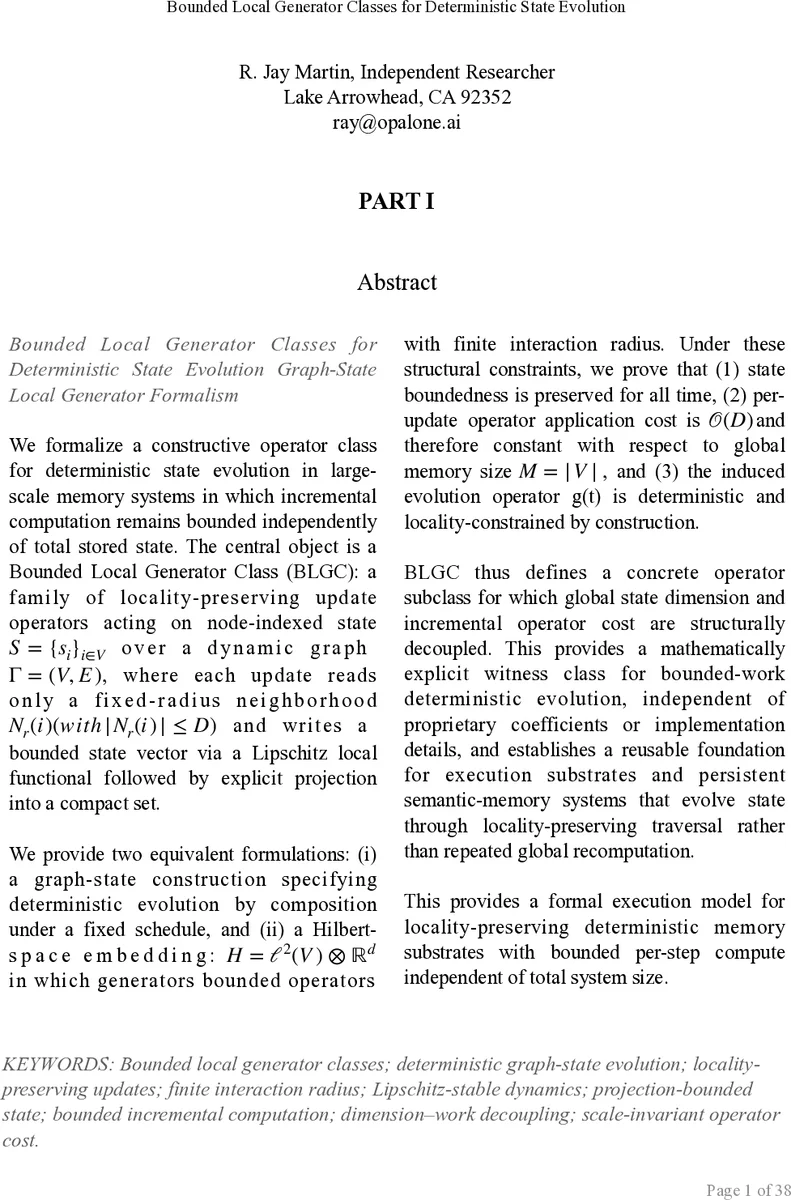
We formalize a constructive subclass of locality-preserving deterministic operators acting on graph-indexed state systems. We define the class of Bounded Local Generator Classes (BLGC), consisting of finite-range generators operating on bounded state spaces under deterministic composition. Within this class, incremental update cost is independent of total system dimension. We prove that, under the BLGC assumptions, per-step operator work satisfies W_t = O(1) as the number of nodes M \to \infty, establishing a structural decoupling between global state size and incremental computational effort. The framework admits a Hilbert-space embedding in \ell^2(V; \mathbb{R}^d) and yields bounded operator norms on admissible subspaces. The result applies specifically to the defined subclass and does not claim universality beyond the stated locality and boundedness constraints.
💡 Research Summary
The paper introduces a mathematically rigorous framework called Bounded Local Generator Classes (BLGC) for deterministic evolution of large‑scale graph‑indexed state systems while keeping per‑step computational effort independent of the total number of nodes. The authors begin by defining a countable graph Γ = (V,E) where each node i carries a d‑dimensional real vector s_i that is constrained to lie inside the unit ball B₁(0) ⊂ ℝᵈ. This boundedness guarantees that the global state space 𝒮 = ∏_{i∈V} B₁(0) is compact and can be embedded in the Hilbert space ℓ²(V) ⊗ ℝᵈ.
A key structural assumption is a finite interaction radius r: for every node i the set of neighbors N_r(i) = {j | dist_Γ(i,j) ≤ r} contains at most D nodes, where D is a constant that does not grow with the total node count M = |V|. This “bounded‑neighborhood” condition is stronger than a simple bounded degree constraint and is essential for achieving scale‑invariant work.
The local generator G_i is then defined as a deterministic update that (1) reads the states of nodes in N_r(i) (at most D vectors), (2) applies a Lipschitz‑continuous function f_i : (ℝᵈ)^{|N_r(i)|} → ℝᵈ with Lipschitz constant L and bounded output norm B, (3) adds a fixed step size η · f_i to the current state s_i, and (4) projects the result back onto the unit ball via a projection operator Π. Consequently, G_i modifies only the state of node i, leaves all other nodes untouched, and guarantees that the updated state remains within the prescribed bound.
A deterministic schedule π : ℕ → V specifies which node’s generator is applied at each discrete time step t. The global evolution is given by the composition g(t) = G_{π(t‑1)} ∘ … ∘ G_{π(0)} and the state update S_{t+1} = G_{π(t)}(S_t). Because the schedule is fixed, the trajectory is fully deterministic for any initial configuration.
Two lemmas constitute the core technical results. Lemma 1 (State Boundedness) proves by induction that if the initial state belongs to 𝒮, then every subsequent state S_t also belongs to 𝒮. The proof hinges on the projection Π, which forces any intermediate vector back into the unit ball, ensuring that no node ever leaves the compact set. Lemma 2 (Bounded Work per Update) shows that the computational cost of a single generator application is O(D) = O(1). The argument notes that the only potentially scaling factor is the number of neighbor vectors read, which is bounded by D; all other operations (vector arithmetic, evaluation of f_i, projection) are constant‑time assuming fixed dimension d. Hence the per‑step work does not depend on M, establishing the desired dimension‑work decoupling.
The authors discuss the significance of these findings. By constructing a class of operators whose locality and boundedness are built into their definition, they provide a “structural witness” that guarantees scale‑invariant incremental cost without resorting to empirical measurement. This has immediate relevance for distributed computing, edge AI, and any setting where global memory scans are prohibitive. The framework also aligns with classical finite‑range interaction models from statistical mechanics (e.g., Lieb‑Robinson bounds) and with the theory of interacting particle systems, yet it extends those ideas to continuous‑valued, bounded state vectors and deterministic schedules.
Limitations are acknowledged: the analysis assumes fixed dimension d, fixed Lipschitz constants, and a static schedule. Real systems may involve adaptive step sizes, dynamic graph topologies, or stochastic scheduling, which would require additional probabilistic or adaptive analysis. Moreover, while the asymptotic per‑step cost is constant, practical implementations must still contend with hardware‑level factors such as cache behavior, memory latency, and parallelism overhead.
In summary, the paper delivers a clear, mathematically grounded definition of BLGC, proves that such systems preserve bounded state and incur O(1) work per update regardless of system size, and positions this class as a useful abstraction for designing scalable, deterministic, locality‑preserving algorithms in large‑scale computational substrates.
Comments & Academic Discussion
Loading comments...
Leave a Comment