Scaling World Model for Hierarchical Manipulation Policies
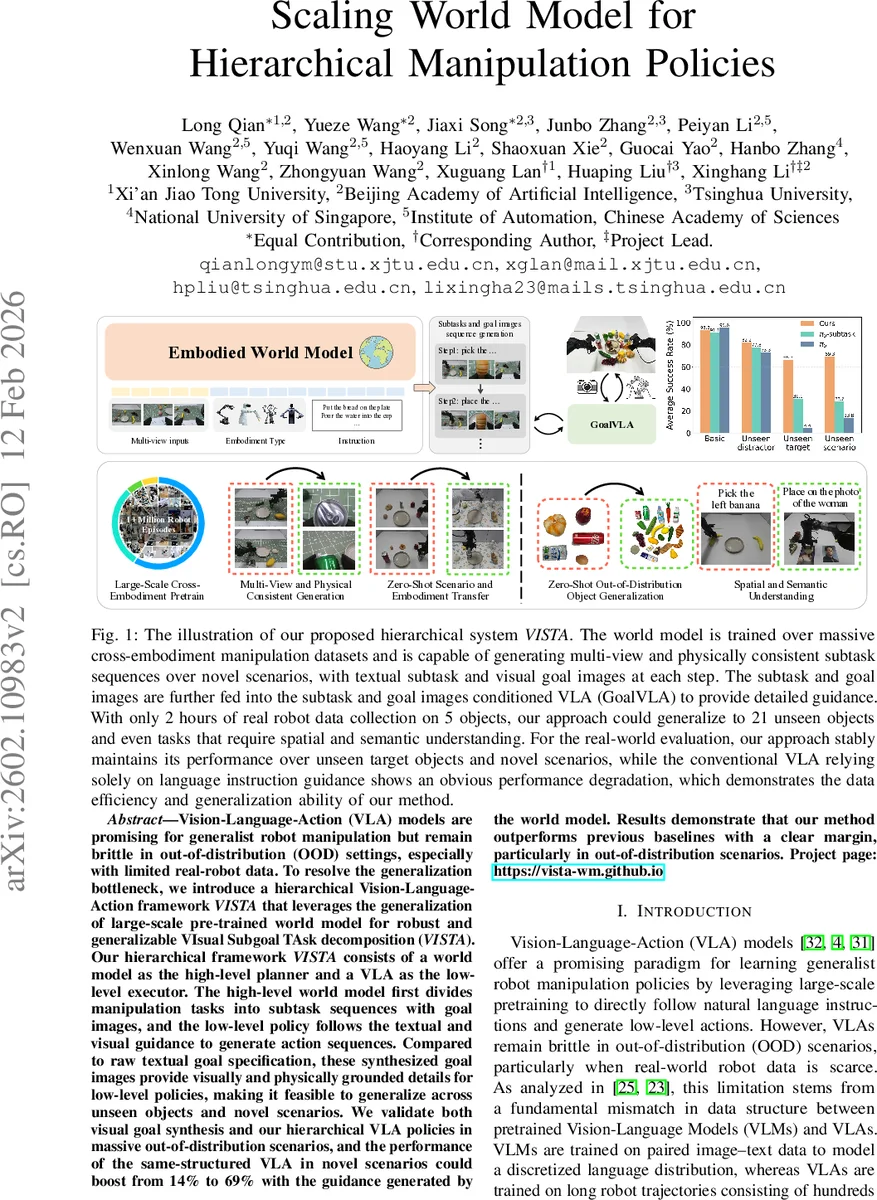
Vision-Language-Action (VLA) models are promising for generalist robot manipulation but remain brittle in out-of-distribution (OOD) settings, especially with limited real-robot data. To resolve the generalization bottleneck, we introduce a hierarchical Vision-Language-Action framework \our{} that leverages the generalization of large-scale pre-trained world model for robust and generalizable VIsual Subgoal TAsk decomposition VISTA. Our hierarchical framework \our{} consists of a world model as the high-level planner and a VLA as the low-level executor. The high-level world model first divides manipulation tasks into subtask sequences with goal images, and the low-level policy follows the textual and visual guidance to generate action sequences. Compared to raw textual goal specification, these synthesized goal images provide visually and physically grounded details for low-level policies, making it feasible to generalize across unseen objects and novel scenarios. We validate both visual goal synthesis and our hierarchical VLA policies in massive out-of-distribution scenarios, and the performance of the same-structured VLA in novel scenarios could boost from 14% to 69% with the guidance generated by the world model. Results demonstrate that our method outperforms previous baselines with a clear margin, particularly in out-of-distribution scenarios. Project page: \href{https://vista-wm.github.io/}{https://vista-wm.github.io}
💡 Research Summary
The paper addresses the brittleness of Vision‑Language‑Action (VLA) models in out‑of‑distribution (OOD) robot manipulation, especially when only a few hours of real‑world data are available. The authors propose VISTA (Visual Subgoal Task Decomposition), a hierarchical framework that combines a large‑scale pre‑trained embodied world model as a high‑level planner with a goal‑conditioned VLA (GoalVLA) as a low‑level executor.
The world model receives an initial observation image and a global natural‑language instruction. It treats both textual subtasks and visual goal images as a unified token sequence using an image tokenizer (IBQ‑Tokenizer) and a text tokenizer (Qwen‑3), mapping them into a shared vocabulary. Trained via standard autoregressive language modeling on the EMU3.5 dataset (with additional fine‑tuning), the model learns to generate an interleaved sequence of textual sub‑instructions (l_i) and multi‑view goal images (g_i). Beam search is used at inference time to produce globally coherent milestone sequences, and the inverse tokenizer reconstructs pixel‑level images. These visual subgoals encode precise spatial and physical constraints, mitigating the ambiguity of pure language specifications and avoiding the drift problems of dense video prediction.
GoalVLA takes the current camera observation, the current textual subtask, and its associated goal image as inputs and predicts an “action chunk” – a short sequence of robot joint commands. When the observed scene aligns with the goal image, a subtask switcher advances to the next milestone. This hierarchical loop provides the low‑level controller with both “what” (text) and “how” (visual target) information, dramatically improving robustness in novel scenarios.
Experiments are conducted with only 2 hours of tele‑operated data collected on five objects. The resulting system is evaluated on 21 unseen objects and on tasks that require both spatial reasoning and semantic understanding. In these OOD settings, the baseline VLA that relies solely on language guidance achieves only 14 % success, whereas VISTA reaches 69 % success—a more than five‑fold improvement. The authors attribute this gain to the physically grounded visual subgoals that reduce uncertainty in action prediction and to the multi‑view consistency that preserves physical plausibility over long horizons.
Key contributions include: (1) a scalable pipeline that relabels millions of robot trajectories into interleaved text‑image sequences, (2) a generative embodied world model capable of producing physically consistent, multi‑view visual subgoals, and (3) the VISTA framework that integrates this world model with a goal‑image‑conditioned VLA, delivering state‑of‑the‑art OOD performance with minimal real‑world data.
The paper also discusses limitations: current image synthesis operates at relatively low resolution, which may miss fine object details, and online replanning with high‑resolution visual goals can be computationally expensive. Future work is suggested to incorporate high‑resolution diffusion models for goal generation and more efficient real‑time planning mechanisms. Overall, VISTA demonstrates that leveraging large‑scale world models to provide visual subgoals is an effective strategy for building data‑efficient, generalizable robot manipulation systems.
Comments & Academic Discussion
Loading comments...
Leave a Comment