A Logarithmic Spiral Formed by a Sequence of Regular Polygons
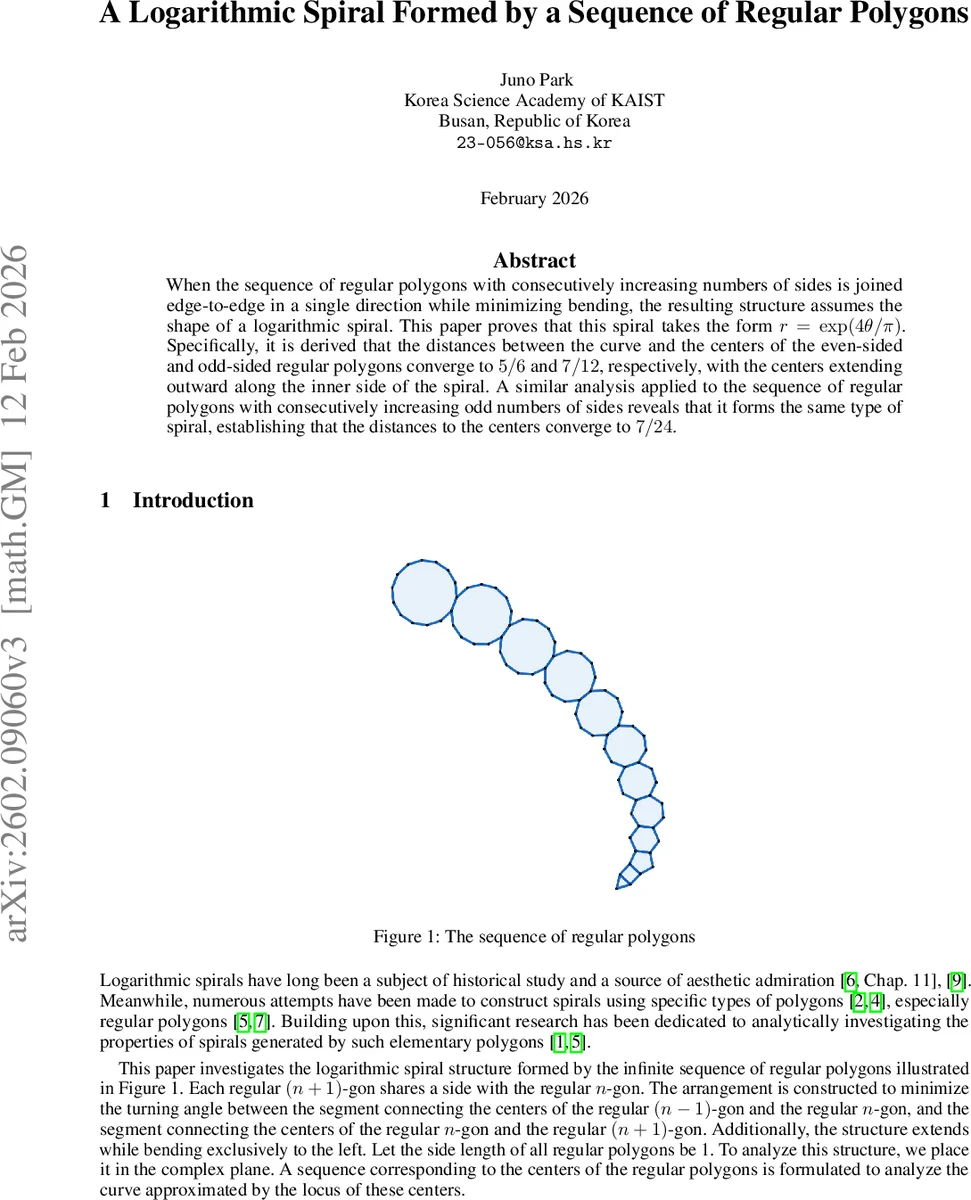
When the sequence of regular polygons with consecutively increasing numbers of sides is joined edge-to-edge in a single direction while minimizing bending, the resulting structure assumes the shape of a logarithmic spiral. This paper proves that this spiral takes the form r=exp(4θ/π). Specifically, it is derived that the distances between the curve and the centers of the even-sided and odd-sided regular polygons converge to 5/6 and 7/12, respectively, with the centers extending outward along the inner side of the spiral. A similar analysis applied to the sequence of regular polygons with consecutively increasing odd numbers of sides reveals that it forms the same type of spiral, establishing that the distances to the centers converge to 7/24.
💡 Research Summary
**
The paper investigates a geometric construction in which regular polygons of unit side length are joined edge‑to‑edge in a single (left‑handed) direction, with the turning angle between successive polygon centers minimized. By placing the construction in the complex plane, the authors define a sequence of complex numbers (P_n) that represent the centers of the regular (n)-gons. The key formula (Definition 1) expresses (P_n) as a sum involving cotangents and the harmonic series (H_k) together with the alternating harmonic series (h_k).
To compare the discrete set ({P_n}) with a smooth curve, the authors introduce an equivalence relation (\sim_{\circlearrowright}) that allows for a rigid motion (rotation and translation) and an error term of order (O(1/n)). Using asymptotic expansions of the harmonic and alternating harmonic series (Lemmas 3 and 4) and the Euler–Maclaurin summation formula (Lemma 5), they transform the discrete sum into an integral that can be evaluated explicitly.
The central technical result (Theorem 6) shows that after a suitable scaling by (2\pi(1+i\pi/4)), the sequence (P_n) is asymptotically equivalent to
\
Comments & Academic Discussion
Loading comments...
Leave a Comment