Gradually opening Schrödinger's box reveals a cascade of sharp dynamical transitions
Quantum mechanics predicts that unobserved systems may exist in a superposition of states, yet measurement produces definite outcomes, a tension at the heart of the quantum-to-classical boundary. How the transformation between these opposing regimes unfolds as observation strength increases has remained experimentally unexplored. Here, by continuously tuning the measurement strength on a superconducting qubit, we reveal that measurement-dominated dynamics emerge not gradually but through three distinct transitions: coherent oscillations abruptly halt; the system then freezes near a stable quantum state; and finally enters the quantum Zeno regime, where stronger observation paradoxically slows relaxation. Decoherence, rather than washing out this structure, reorganizes it, inverting the order in which transitions appear and decoupling signatures that coincide in idealized models. These results establish that the route from quantum dynamics to measurement-dominated behavior unfolds in sharp transitions governed by the interplay between observation and environment.
💡 Research Summary
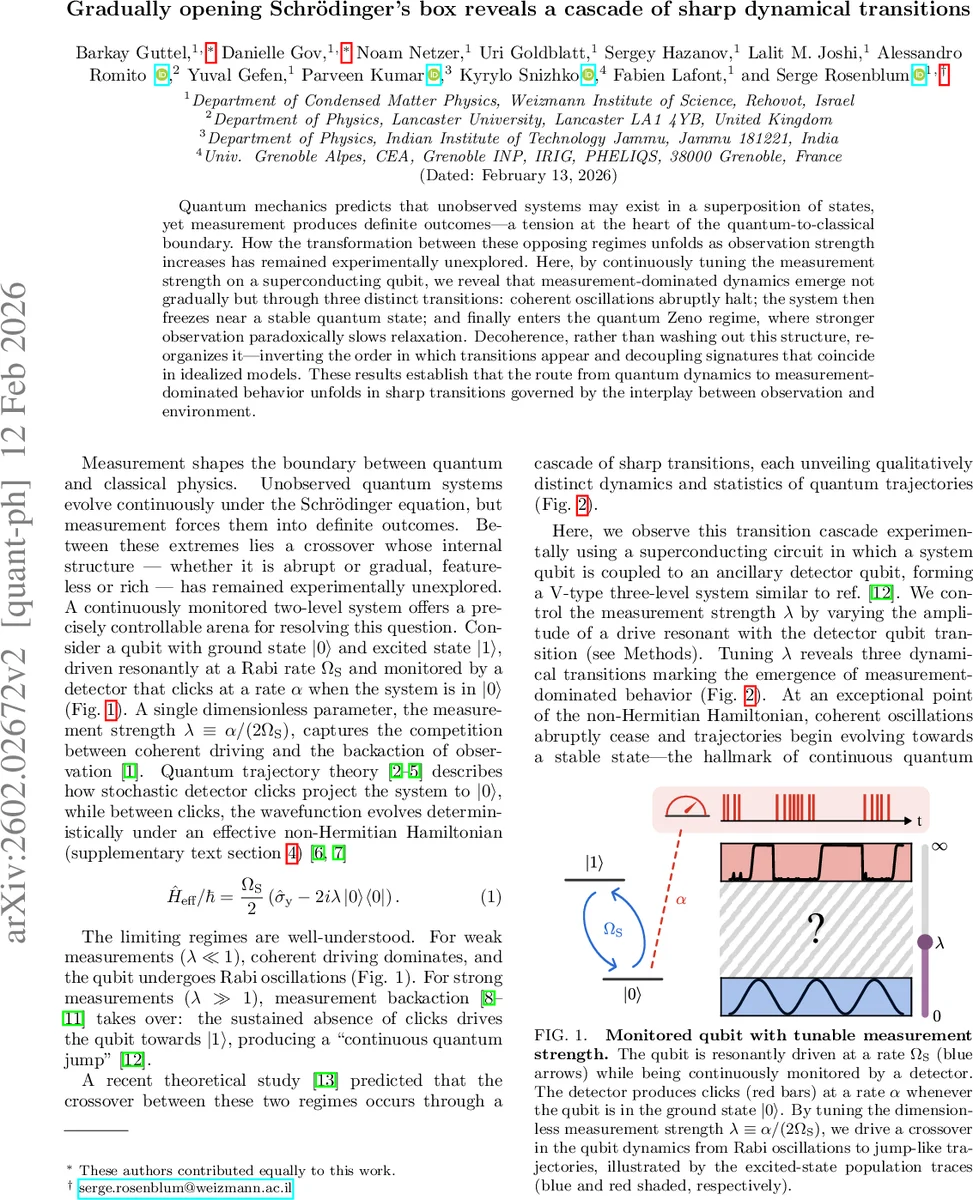
The authors investigate how a quantum system’s dynamics evolve as the strength of continuous measurement is increased, using a superconducting qubit coupled to an ancillary detector qubit as a controllable platform. The qubit is resonantly driven at a Rabi rate ΩS while the detector clicks at a rate α whenever the qubit occupies the ground state |0⟩. The dimensionless measurement strength λ = α/(2ΩS) quantifies the competition between coherent driving and measurement back‑action. By varying λ over a wide range, the experiment reveals three sharp dynamical transitions rather than a smooth crossover.
The first transition occurs at λc1 ≈ 1, where the non‑Hermitian effective Hamiltonian H_eff = (ΩS/2)(σy − 2iλ|0⟩⟨0|) reaches an exceptional point. At this point, measurement back‑action exactly balances the Rabi drive at a specific Bloch‑sphere angle θ+(λ), creating a stable fixed point |ψ+⟩. Trajectories that experience a long “no‑click” interval evolve deterministically toward this state, and the region of the Bloch sphere beyond θ+ becomes forbidden. Conditional quantum state tomography performed after selecting no‑click sequences shows the abrupt cessation of oscillations and the emergence of a deterministic jump‑like evolution, confirming the theoretical prediction.
The second transition appears at λc2 ≈ 2√3 ≈ 1.15 in the ideal model. Here the dwell time per unit angle τθ(θ) near the fixed point diverges, indicating that trajectories become “frozen” near |ψ+⟩ for extended periods. The divergence follows a power‑law τθ(θ) ∝ |θ − θ+(λ)|^{ξ(λ)} with an exponent ξ that changes sign at the transition. Experimentally, the authors extract ξ from the angular distribution of first‑click events and locate the transition at λobs2 ≈ 0.92, lower than λc2. This shift is attributed to decoherence (finite T1 and T2), which also pushes λc1 upward, causing the two transitions to cross and invert their order—a striking manifestation of environment‑induced reordering of dynamical phases.
The third transition marks the entry into the quantum Zeno regime. In the ideal picture it occurs at λc3 = 2, where the Liouvillian superoperator develops an exceptional point and measurement back‑action begins to suppress, rather than accelerate, relaxation toward the steady state. Beyond this point the ensemble‑averaged excited‑state population decays exponentially without oscillations, and the decay rate decreases as λ increases. The experiment observes this crossover at λobs3 ≈ 1.09, again lower than the ideal value because of a finite waiting time τB in the detector’s excited state between clicks, which effectively reduces the measurement strength.
Throughout the study, the authors combine binary click records with both conditional and unconditional state tomography, allowing them to resolve features that would be hidden in simple ensemble averages. They demonstrate that each transition is associated with a distinct statistical signature: disappearance of Rabi oscillations in the no‑click conditional dynamics, a change in the power‑law exponent governing dwell times, and the disappearance of under‑damped oscillations in the ensemble‑averaged decay. Importantly, while decoherence reshapes the locations and ordering of the transitions, the transitions themselves remain robust, underscoring that the crossover from coherent quantum dynamics to measurement‑dominated behavior is governed by sharp, non‑Hermitian dynamical phase transitions rather than a gradual interpolation. This work provides a detailed experimental map of dynamical phases in a continuously monitored qubit and offers new insights for quantum control, measurement‑based feedback, and the fundamental understanding of the quantum‑classical boundary.
Comments & Academic Discussion
Loading comments...
Leave a Comment