Cosmological singularity, conformal anomaly and symmetric polynomials
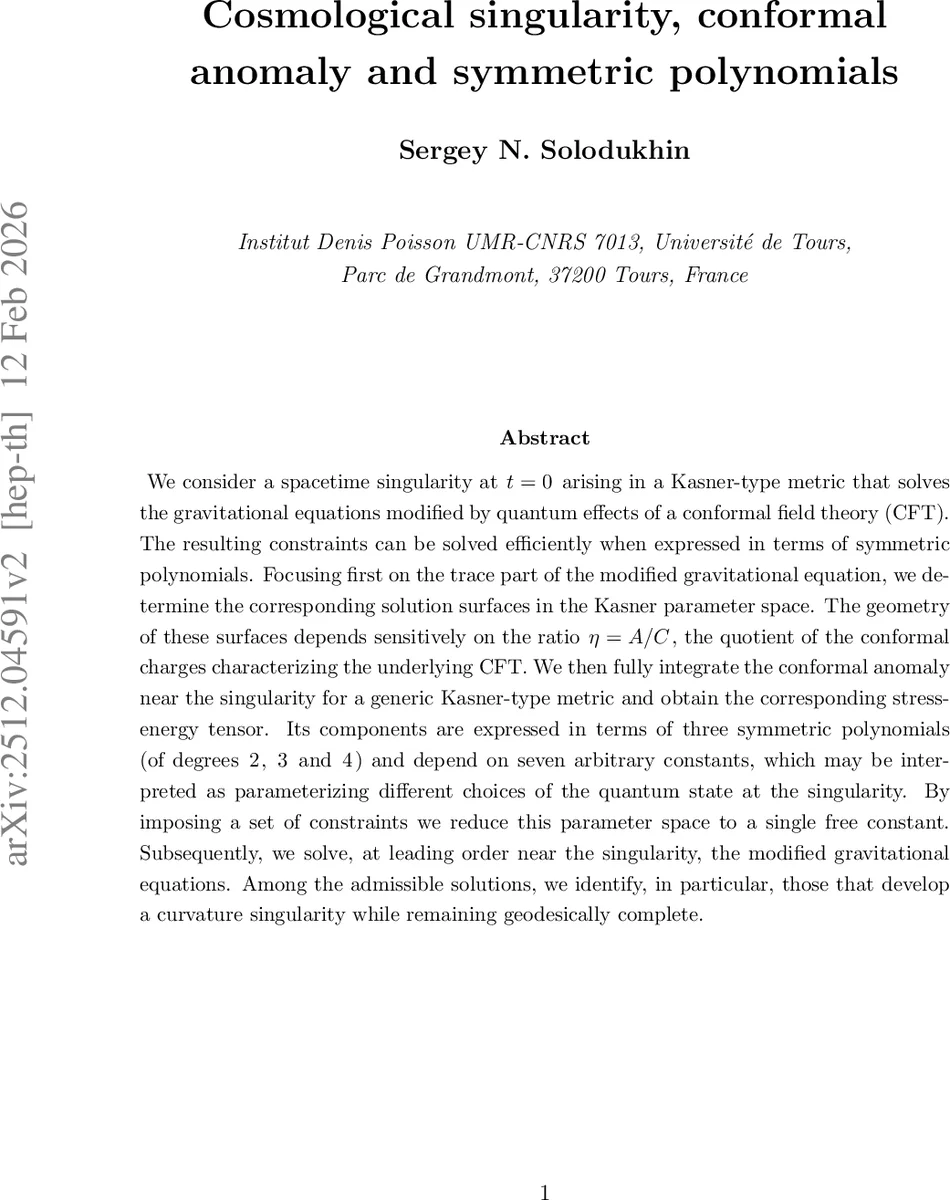
We consider a spacetime singularity at $t = 0$ arising in a Kasner-type metric that solves the gravitational equations modified by quantum effects of a conformal field theory (CFT). The resulting constraints can be solved efficiently when expressed in terms of symmetric polynomials. Focusing first on the trace part of the modified gravitational equation, we determine the corresponding solution surfaces in Kasner-parameter space. The geometry of these surfaces depends sensitively on the ratio $η= A/C$, the quotient of the conformal charges characterizing the underlying CFT. We then fully integrate the conformal anomaly near the singularity for a generic Kasner-type metric and obtain the corresponding stress-energy tensor. Its components are expressed in terms of three symmetric polynomials (of degrees $2$, $3$ and $4$) and depend on seven arbitrary constants, which may be interpreted as parameterizing different choices of the quantum state at the singularity. By imposing a set of constraints we reduce this parameter space to a single free constant. Subsequently, we solve, at leading order near the singularity, the modified gravitational equations. Among the admissible solutions, we identify, in particular, those that develop a curvature singularity while remaining geodesically complete.
💡 Research Summary
The paper investigates the influence of quantum conformal field theory (CFT) back‑reaction on the classical Kasner cosmological singularity. Starting from the anisotropic Kasner‑type metric
(ds^{2}=-dt^{2}+t^{2a}dx_{1}^{2}+t^{2b}dx_{2}^{2}+t^{2c}dx_{3}^{2})
the authors first review the classical vacuum Einstein equations, which enforce the well‑known Kasner constraints (a+b+c=1) and (a^{2}+b^{2}+c^{2}=1). Because the metric is symmetric under permutations of the spatial coordinates, any scalar built from the curvature can be expressed in terms of the elementary symmetric polynomials
(e_{1}=a+b+c,; e_{2}=ab+bc+ac,; e_{3}=abc).
These provide a compact language for handling the otherwise cumbersome algebra.
In the semiclassical setting the Einstein equations acquire a source term given by the expectation value of the stress‑energy tensor of a conformal quantum field. The trace of this tensor is fixed by the conformal anomaly:
(g^{\mu\nu}T_{\mu\nu}=-(4\pi)^{-2}\bigl(A,E_{4}-C,W^{2}\bigr)),
where (E_{4}) is the Euler density, (W^{2}) the square of the Weyl tensor, and (A) and (C) are the two conformal charges of the CFT. The authors deliberately keep (A) and (C) arbitrary (allowing non‑unitary or higher‑spin theories) and introduce the ratio (\eta=A/C).
The analysis proceeds in two steps.
Step 1 (Trace equation). Near the singularity the Ricci scalar behaves as (R\sim t^{-2}) while the anomaly side behaves as (\sim t^{-4}). Consistency therefore requires the cancellation of the leading (t^{-4}) term. Expressed through the symmetric polynomials, this condition yields a “master equation” that defines a surface in the ((e_{1},e_{2},e_{3})) space. The geometry of this surface depends sensitively on (\eta); for certain ranges of (\eta) the surface reduces to a curve that deforms the classical Kasner circle, while for other values it splits into disconnected branches.
Step 2 (Full tensorial equations). The authors solve the covariant conservation law (\nabla_{\mu}T^{\mu}{}_{\nu}=0) for the generic Kasner ansatz without imposing any a‑priori constraints on ((a,b,c)). The general solution contains seven integration constants, reflecting the freedom to choose a quantum state at the singularity, and three symmetric polynomials of degrees 2, 3, 4. Physical regularity requirements—finite four‑volume density, convergence of integrated curvature invariants, and geodesic completeness—are then imposed sequentially. These conditions eliminate six of the seven constants, leaving a single free parameter that can be interpreted as the remaining state‑dependent degree of freedom.
Substituting the resulting stress‑energy tensor back into the semiclassical Einstein equations, the left‑hand side scales as (t^{-2}) while the right‑hand side scales as (t^{-4}). Matching the two sides fixes the remaining constant and yields explicit leading‑order solutions for the Kasner exponents.
Two families of admissible solutions emerge. The first reproduces the classical Kasner singularity: curvature invariants diverge as (t\to0) and null geodesics reach the singularity in finite affine parameter, i.e. the spacetime is geodesically incomplete. The second family corresponds to exponents satisfying (a\le-1,; b\le-1,; c\le-1). In this regime the curvature still diverges, but the affine length of any null geodesic to the singularity is infinite; consequently the spacetime is geodesically complete despite the presence of a curvature singularity. This remarkable result shows that quantum conformal back‑reaction can render a classically pathological singularity physically harmless.
The paper concludes that symmetric polynomials provide an efficient algebraic framework for handling semiclassical corrections in anisotropic cosmologies. The ratio (\eta=A/C) controls the deformation of the Kasner parameter space, and quantum effects, while not eliminating singularities outright, can qualitatively change their physical impact by restoring geodesic completeness in a non‑trivial region of parameter space. This work thus opens a new avenue for exploring singularity resolution mechanisms within the well‑understood setting of conformal anomalies.
Comments & Academic Discussion
Loading comments...
Leave a Comment