A mixed fractional CIR model: positivity and an implicit Euler scheme
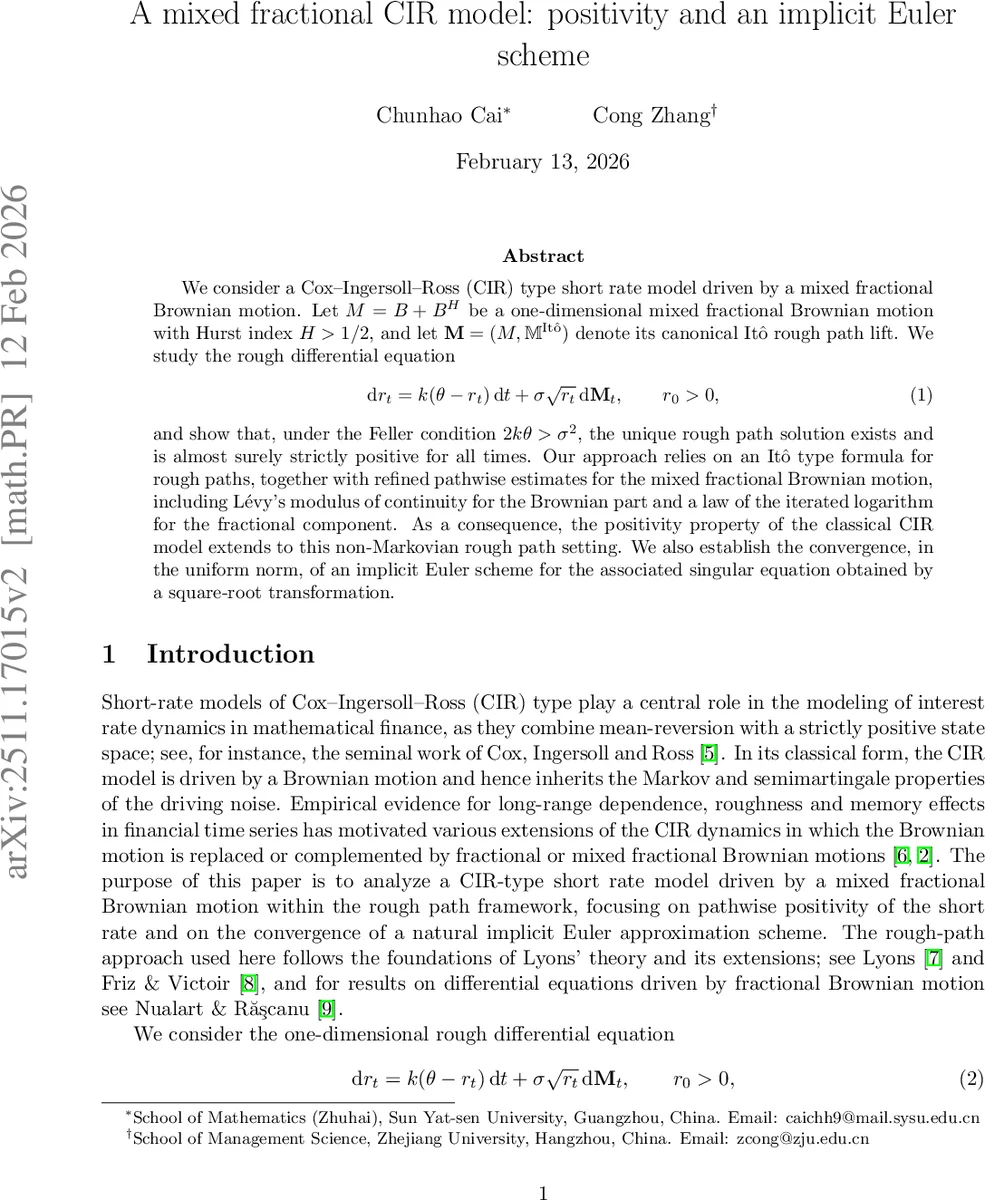
We consider a Cox–Ingersoll–Ross (CIR) type short rate model driven by a mixed fractional Brownian motion. Let $M=B+B^H$ be a one-dimensional mixed fractional Brownian motion with Hurst index $H>1/2$, and let $\mathbf{M}=(M,\mathbb{M}^{\mathrm{It\hat{o}}})$ denote its canonical Itô rough path lift. We study the rough differential equation \begin{equation}\label{eqn1} \dd r_t = k(θ-r_t),\dd t + σ\sqrt{r_t},\dd\mathbf{M}_t,\qquad r_0>0, \end{equation} and prove that, under the Feller condition $2kθ>σ^2$, the unique rough path solution is almost surely strictly positive for all times. The proof relies on an Itô type formula for rough paths, together with refined pathwise estimates for the mixed fractional Brownian motion, including Lévy’s modulus of continuity for the Brownian part and a law of the iterated logarithm for the fractional component. As a consequence, the positivity property of the classical CIR model extends to this non-Markovian rough path setting. We also establish the convergence of an implicit Euler scheme for the associated singular equation obtained by a square-root transformation.
💡 Research Summary
This paper studies a Cox–Ingersoll–Ross (CIR) type short‑rate model driven by a mixed fractional Brownian motion (fBm) (M_t = B_t + B^H_t), where (B) is a standard Brownian motion and (B^H) is an independent fBm with Hurst index (H>1/2). The authors work within the rough‑path framework, treating the canonical Itô lift (\mathbf{M}=(M,\mathbb{M}^{\mathrm{It\hat{o}}})) as a Gaussian rough path of regularity (\alpha\in(1/3,1/2]).
The main stochastic differential equation (SDE) is
\
Comments & Academic Discussion
Loading comments...
Leave a Comment