Observation of Hexagonal Close-Packed Water Ice at Conditions in Ice Giant Planetary Interiors
Knowing the phase transformations in dense water ice is key to unraveling the peculiar geophysical properties of Uranus and Neptune, whose stratified interior models predict a thick ice layer beneath a convective ionic fluid layer. In the latter, water ice is currently assumed to adopt an fcc superionic structure, a phase that has recently been observed experimentally. Here, we report the observation of an hcp ice phase under such planetary conditions, using synchrotron x-ray diffraction in laser-heated diamond anvil cells. Between 80 and 200 GPa, we observe the coexistence of fcc and hcp ices, arising from stacking disorder developing within the fcc oxygen lattice upon temperature cycling. Above 200 GPa, the hcp phase dominates at high temperature, indicating increased thermodynamic stability upon entering a superionic state suggested by an anomalous thermal expansion. An anisotropic proton conductivity of superionic hcp ice, and the existence of a fcc-hcp martensitic transition may have planetary implications for dynamo models and for the dynamics of the ice mantle.
💡 Research Summary
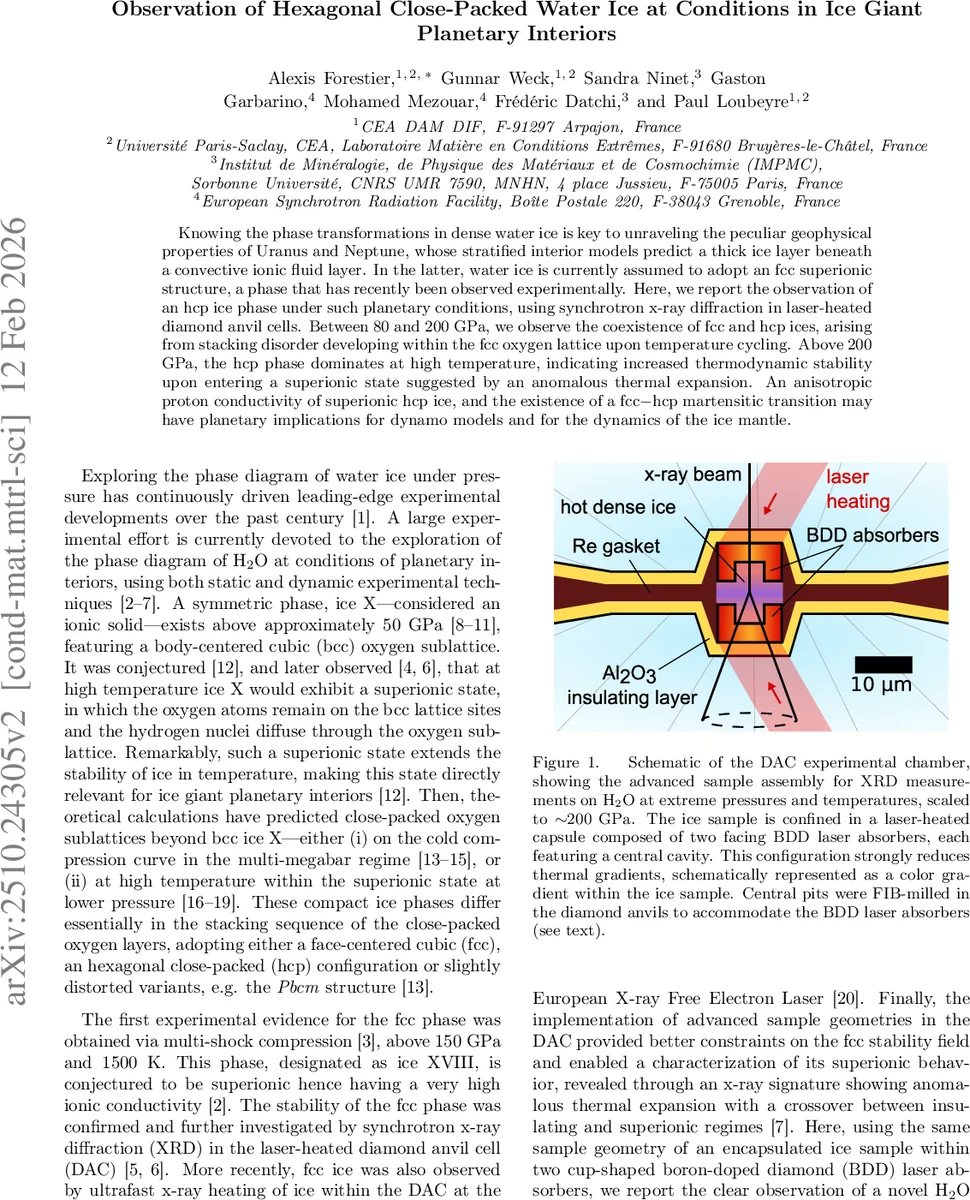
The authors investigate the crystal structure of water ice under pressure–temperature conditions that mimic the deep interiors of the ice‑giant planets Uranus and Neptune. Using laser‑heated diamond‑anvil cells (DACs) equipped with boron‑doped‑diamond (BDD) laser absorbers, they performed synchrotron X‑ray diffraction experiments at the European Synchrotron Radiation Facility (ESRF‑EBS) on the ID27 beamline. Two experimental runs covered pressures from 80 GPa up to 220 GPa and temperatures from roughly 1000 K to 2600 K.
In the first run (≈80 GPa), the sample was heated to ~2000 K to produce high‑quality single crystals of the known face‑centered‑cubic (fcc) superionic ice. Upon cooling, the fcc (111) and (200) reflections broadened and developed diffuse streaks, indicating the formation of stacking faults. At temperatures around 1086 K, distinct Bragg peaks indexed to a hexagonal close‑packed (hcp) lattice (a = 2.383 Å, c = 3.882 Å, c/a ≈ 1.629) appeared alongside the remaining fcc peaks. This evolution demonstrates a martensitic‑type fcc‑to‑hcp transition driven by temperature cycling, where the oxygen sub‑lattice retains the same close‑packed density but changes its stacking sequence.
The second run pushed the pressure beyond 200 GPa. After several annealing cycles below 1500 K to relieve non‑hydrostatic stresses while staying within the stability field of bcc ice X, the sample was heated to 1800–2300 K. New diffraction features again revealed co‑existence of fcc and hcp domains. At 197 GPa and 2250 K the hcp reflections grew relative to the fcc ones; at 219 GPa and 2630 K the fcc peaks vanished entirely, leaving only the hcp pattern. This pressure‑dependent dominance indicates that hcp ice becomes thermodynamically favored at higher pressures within the superionic regime.
Thermal‑expansion analysis of the hcp phase showed an almost invariant a‑axis but a pronounced, non‑linear expansion of the c‑axis, producing an S‑shaped curve reminiscent of the “type‑I superionic transition” previously identified for fcc ice. The anisotropic expansion suggests that proton diffusion is preferentially aligned along the hexagonal c‑direction, implying an anisotropic superionic conductivity. Such behavior parallels recent observations of pseudo‑hcp superionic ammonia, where proton hopping is also c‑axis dominated.
The authors compare their results with recent machine‑learning‑based ab‑initio simulations, which predict nearly degenerate free energies for fcc and hcp (or quasi‑hcp) arrangements over a broad P‑T range. The experimental observation of stacking‑disorder‑driven coexistence supports these theoretical expectations and highlights the role of mechanical plasticity in enabling both structures to persist. Importantly, the hcp superionic ice is expected to have a lower electrical conductivity than the fcc counterpart because the anisotropic proton pathways reduce the overall charge transport. This property makes hcp ice a plausible candidate for the electrically conductive, yet relatively inert, inner solid layer postulated in dynamo models of ice giants. In such models, a thin, highly conductive outer shell drives the magnetic field, while a less conductive solid core provides a stratified, non‑convective region. The discovery that hcp superionic ice could occupy this inner region adds a new dimension to planetary interior modeling.
In summary, the paper provides (1) the first experimental evidence for a hexagonal close‑packed superionic water ice phase under planetary‑relevant conditions, (2) a clear demonstration that fcc‑hcp transitions can be induced by temperature cycling via a martensitic mechanism, and (3) a characterization of the hcp phase’s anisotropic thermal expansion and inferred proton conductivity. These findings refine our understanding of the phase diagram of dense water, suggest that both fcc and hcp superionic ices may coexist over a wide pressure range, and have direct implications for the magnetic‑field generation and internal dynamics of Uranus and Neptune.
Comments & Academic Discussion
Loading comments...
Leave a Comment