Elliptic curves and Fourier coefficients of meromorphic modular forms
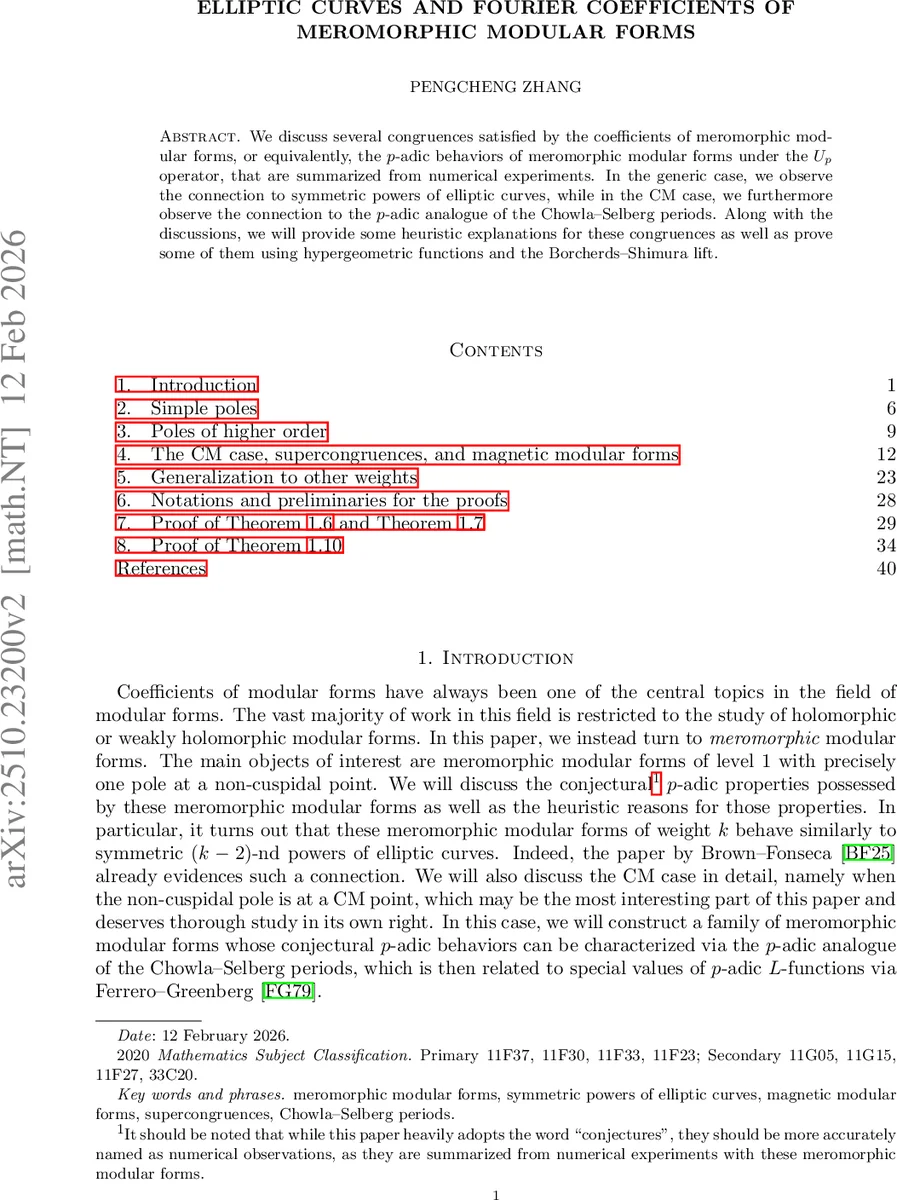
We discuss several congruences satisfied by the coefficients of meromorphic modular forms, or equivalently, the $p$-adic behaviors of meromorphic modular forms under the $U_p$ operator, that are summarized from numerical experiments. In the generic case, we observe the connection to symmetric powers of elliptic curves, while in the CM case, we furthermore observe the connection to the $p$-adic analogue of the Chowla–Selberg periods. Along with the discussions, we will provide some heuristic explanations for these congruences as well as prove some of them using hypergeometric functions and the Borcherds–Shimura lift.
💡 Research Summary
The paper investigates congruence phenomena satisfied by the Fourier coefficients of meromorphic modular forms of level 1 that have exactly one pole at a non‑cuspidal point. The author focuses first on the classical weights (k\in{4,6,8,10,14}) and later extends the results to all even weights.
A central notion introduced is “magnetic” modular forms: a form (f(\tau)=\sum a_n q^n) is called (r)-magnetic if (n^r\mid a_n) for every positive integer (n). Using results of Li–Neururer and Pasol–Zudilin, the paper shows that the meromorphic forms (E_4(j)) and (E_4(j-1728)) are 1‑magnetic. The magnetic property is proved via the Borcherds–Shimura lift: one finds a half‑integral weight preimage, establishes divisibility for its coefficients, and then transfers the property to the image.
The author then studies the (p)-adic behaviour under the Atkin operator (U_p). For a prime (p\ge5) and any rational constant (c) with (v_p(c)=0), a supercongruence is proved: \
Comments & Academic Discussion
Loading comments...
Leave a Comment