Reconstruction of tensor categories of type $G_2$
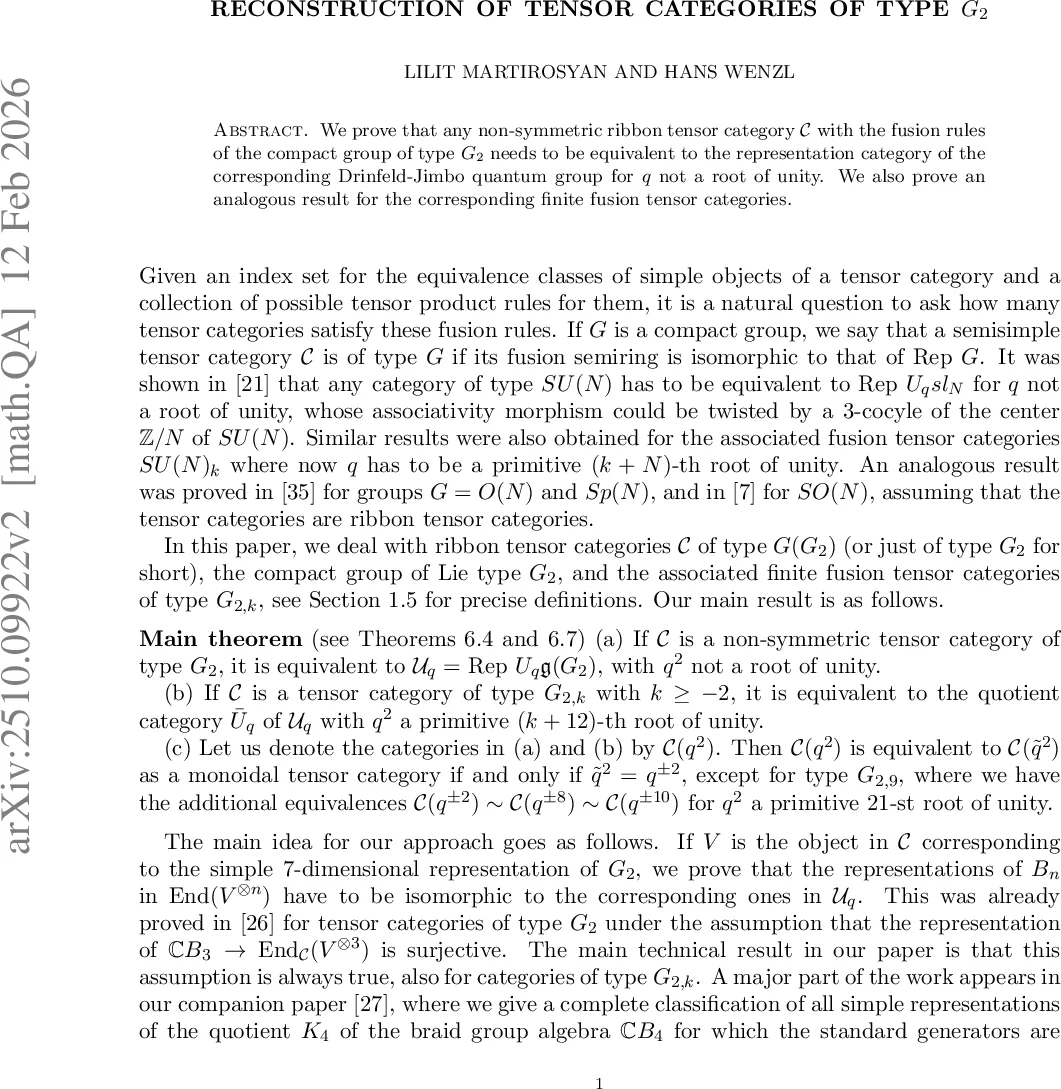
We prove that any non-symmetric ribbon tensor category $\mathcal{C}$ with the fusion rules of the compact group of type $G_2$ needs to be equivalent to the representation category of the corresponding Drinfeld-Jimbo quantum group for $q$ not a root of unity. We also prove an analogous result for the corresponding finite fusion tensor categories.
💡 Research Summary
The paper provides a complete classification of ribbon tensor categories whose fusion rules coincide with those of the compact Lie group G₂. The authors prove that any non‑symmetric ribbon tensor category 𝒞 of type G₂ is necessarily equivalent, as a monoidal category, to the representation category Rep U_q(g₂) of the Drinfeld‑Jimbo quantum group for a parameter q such that q² is not a root of unity. Moreover, for the associated finite fusion categories (denoted G₂,k with k ≥ −2), they show that 𝒞 is equivalent to the quotient category \overline{U}_q obtained from the tilting modules of U_q(g₂) when q² is a primitive (k+12)‑th root of unity.
The central technical achievement is the proof that the braid‑group representations arising from the 7‑dimensional fundamental object V in any such category generate the entire endomorphism algebras End(V^{⊗ n}) for all n. This is accomplished in several steps. First, the authors analyze representations of the braid groups B₃ and B₄, relying on a detailed classification of the representations of the algebra K₄ = ℂ B₄ / ⟨σ_i diagonalizable, σ_i³ relation⟩. They show that the B₄‑action on Hom(V_{Λ₁+Λ₂}, V^{⊗4}) must be the unique 8‑dimensional indecomposable representation of K₄. From this they deduce that the image of Bₙ in End(V^{⊗ n}) is already the whole algebra, a property that can be propagated inductively to all n.
Having established braid‑group completeness, the authors compare the resulting structure with that of the quantum group U_q(g₂). The R‑matrix of U_q(g₂) provides a braiding, while the ribbon twist on a simple object of highest weight λ is given by Θ_λ = q^{C_λ}, where C_λ = (λ+2ρ, λ) is the quantum Casimir eigenvalue. Using Drinfeld’s formula for the square of the braiding on a submodule, they verify that the braiding and twist in any category of type G₂ must match those of U_q(g₂) for the same parameter q. Consequently, the reconstruction theorems of Müger and others imply that the whole category is equivalent to Rep U_q(g₂).
For the finite fusion case G₂,k, the same argument applies after replacing U_q(g₂) by its tilting‑module quotient \overline{U}_q at a root of unity. The fusion rules are described by the Kac–Weyl formula with an affine Weyl group W_k acting on the weight lattice; the authors explain how to truncate the ordinary G₂ tensor product using this affine action. The braid‑group completeness result still holds, leading to the equivalence 𝒞 ≅ \overline{U}_q.
The paper also addresses the uniqueness of the equivalence. In general, the categories C(q²) and C(ṽq²) are monoidally equivalent if and only if ṽq² = q^{±2}. An exceptional phenomenon occurs for the case G₂,9 (i.e., when q² is a primitive 21‑st root of unity); there the categories C(q^{±2}), C(q^{±8}) and C(q^{±10}) are all equivalent. This extra symmetry stems from the specific arithmetic of the 21‑st roots of unity.
Finally, the authors relate their results to the spider (or trivalent) diagrammatic calculus introduced by Kuperberg for G₂. They show that each category of type G₂ or G₂,k can be realized as a spider category modulo negligible morphisms, providing a second, more conceptual proof of the main theorem. Connections to earlier work on SU(N), SO(N), and Sp(N) tensor categories are discussed, and the paper outlines how the methods might extend to other exceptional types such as E₆, E₇, E₈.
In summary, the work establishes that the only non‑symmetric ribbon tensor categories with G₂ fusion rules are the standard quantum‑group categories at generic q, and the only finite fusion categories with those rules are the corresponding root‑of‑unity quotients, up to the obvious q ↔ q⁻¹ symmetry (with a special extra symmetry for the 21‑st root case). This completes the classification for G₂ and provides a robust framework for tackling similar problems for other exceptional Lie types.
Comments & Academic Discussion
Loading comments...
Leave a Comment