A decomposition of graph a-numbers
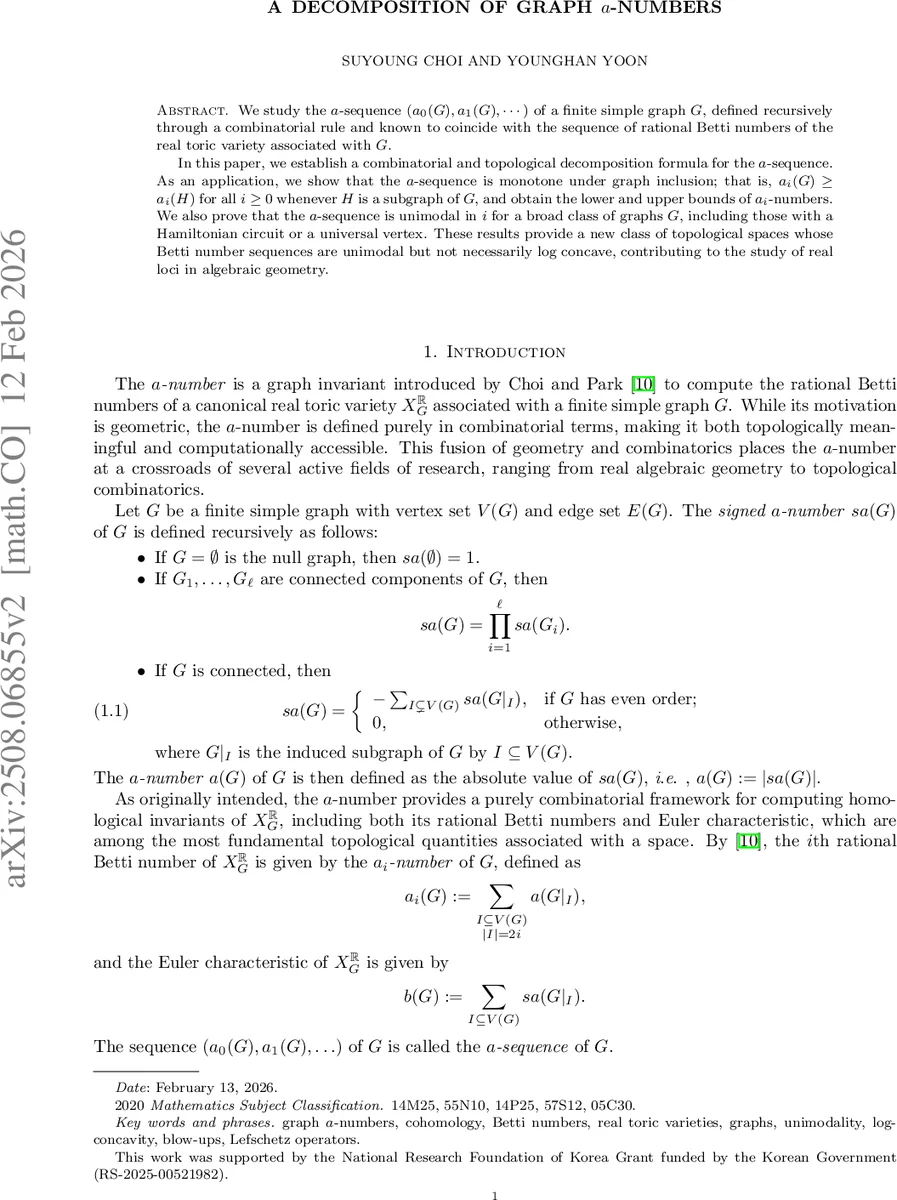
We study the $a$-sequence $(a_0(G), a_1(G), \cdots)$ of a finite simple graph $G$, defined recursively through a combinatorial rule and known to coincide with the sequence of rational Betti numbers of the real toric variety associated with $G$. In this paper, we establish a combinatorial and topological decomposition formula for the $a$-sequence. As an application, we show that the $a$-sequence is monotone under graph inclusion; that is, $a_i(G) \geq a_i(H)$ for all $i \geq 0$ whenever $H$ is a subgraph of $G$, and obtain the lower and upper bounds of $a_i$-numbers. We also prove that the $a$-sequence is unimodal in $i$ for a broad class of graphs $G$, including those with a Hamiltonian circuit or a universal vertex. These results provide a new class of topological spaces whose Betti number sequences are unimodal but not necessarily log concave, contributing to the study of real loci in algebraic geometry.
💡 Research Summary
The paper investigates the graph a‑sequence, a family of invariants (a₀(G), a₁(G), …) attached to a finite simple graph G. The a‑numbers were introduced as a purely combinatorial tool that coincides with the rational Betti numbers of the real toric variety X_R(G) associated with G. The authors develop a new decomposition formula for the a‑numbers and use it to prove two major structural results: monotonicity under graph inclusion and unimodality of the a‑sequence for broad classes of graphs.
The a‑number a(G) is defined via a signed quantity sa(G) that is computed recursively: sa(∅)=1, sa(G)=∑_{I⊂V(G)} (−1)^{|I|} sa(G|I) when |V(G)| is even, and zero otherwise. The absolute value a(G)=|sa(G)|, and the i‑th a‑number a_i(G) is the sum of a(G|I) over all vertex subsets I of size 2i. This definition can be reformulated in terms of the Möbius function of a graded poset consisting of vertex subsets whose induced subgraphs have only even‑order components; a_i(G) equals the absolute value of the i‑th Whitney number of the first kind of that poset.
A central technical device is the “reconnected complement” G∗I. For a subset I⊆V(G), G∗I has vertex set V(G)\I and an edge {a,b} whenever a and b are connected by a path in the induced subgraph G|I∪{a,b}. This operation appears naturally in the face structure of the graph associahedron P_G: each face corresponds to a proper subset I with G|I connected, and the face is combinatorially equivalent to the product P_{G|I}×P_{G∗I}.
The main decomposition theorem (Theorem 1.1) states that for any pair of vertices e={u,v} (possibly already an edge) and any i≥0, \
Comments & Academic Discussion
Loading comments...
Leave a Comment