Grover's algorithm is an approximation of imaginary-time evolution
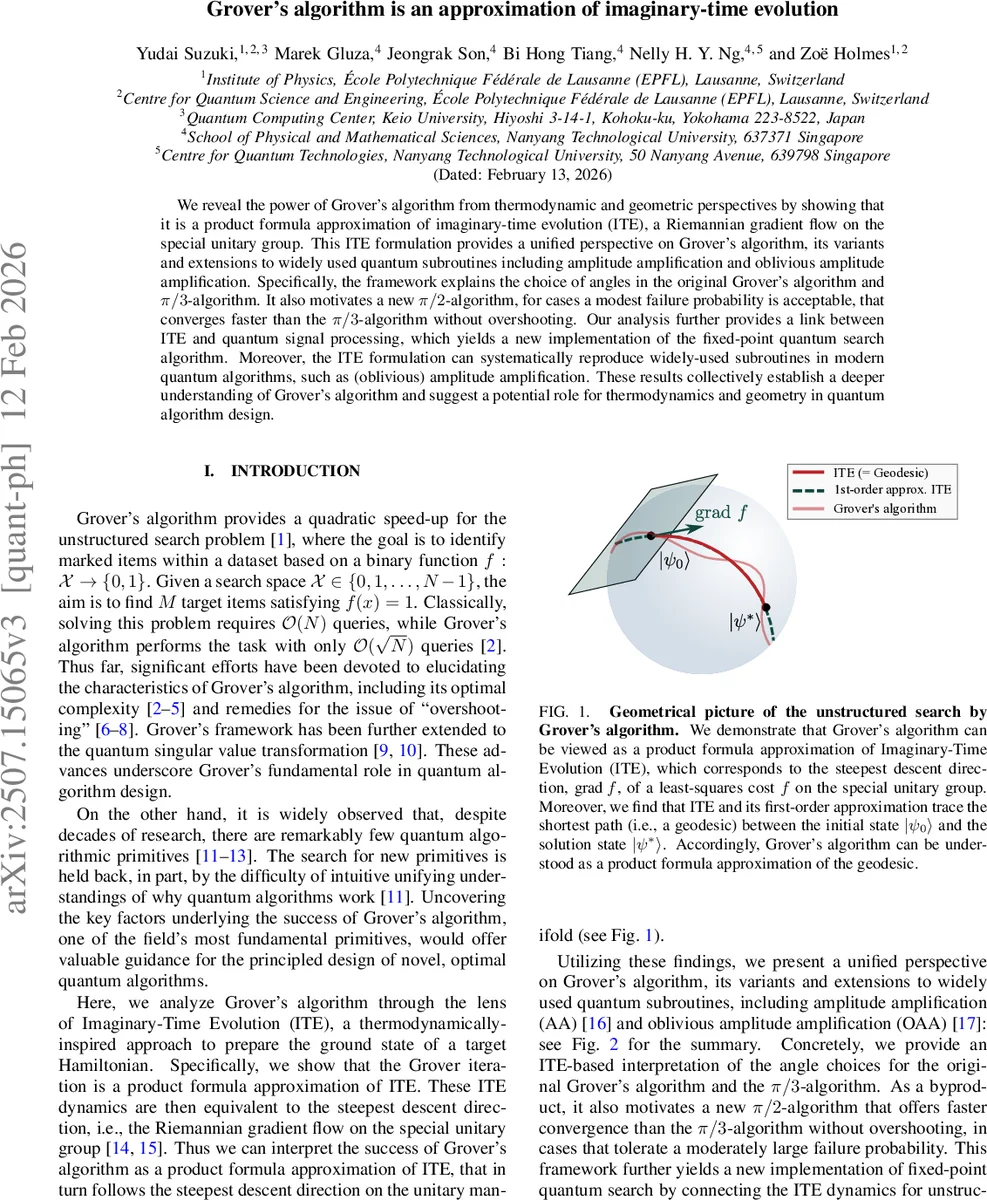
We reveal the power of Grover’s algorithm from thermodynamic and geometric perspectives by showing that it is a product formula approximation of imaginary-time evolution (ITE), a Riemannian gradient flow on the special unitary group. This ITE formulation provides a unified perspective on Grover’s algorithm, its variants and extensions to widely used quantum subroutines including amplitude amplification and oblivious amplitude amplification. Specifically, the framework explains the choice of angles in the original Grover’s algorithm and $π/3$-algorithm. It also motivates a new $π/2$-algorithm, for cases a modest failure probability is acceptable, that converges faster than the $π/3$-algorithm without overshooting. Our analysis further provides a link between ITE and quantum signal processing, which yields a new implementation of the fixed-point quantum search algorithm. Moreover, the ITE formulation can systematically reproduce widely-used subroutines in modern quantum algorithms, such as (oblivious) amplitude amplification. These results collectively establish a deeper understanding of Grover’s algorithm and suggest a potential role for thermodynamics and geometry in quantum algorithm design.
💡 Research Summary
The paper presents a novel thermodynamic and geometric interpretation of Grover’s search algorithm by showing that it is a product‑formula approximation of imaginary‑time evolution (ITE). ITE, a non‑unitary process that drives an initial state toward the ground (or highest‑eigenvalue) state of a Hamiltonian, can be expressed as a double‑bracket flow (\partial_\tau\Psi=
Comments & Academic Discussion
Loading comments...
Leave a Comment