Robust Short-Term OEE Forecasting in Industry 4.0 via Topological Data Analysis
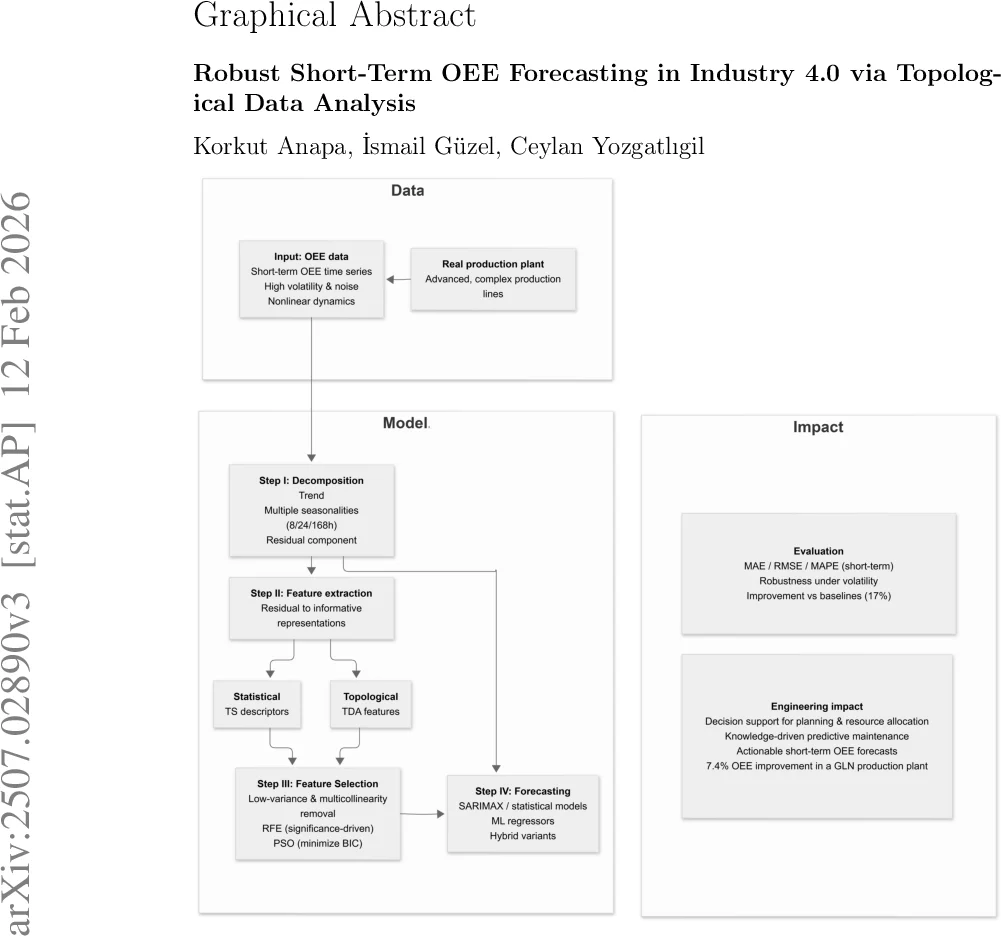
In Industry 4.0 manufacturing environments, forecasting Overall Equipment Efficiency (OEE) is critical for data-driven operational control and predictive maintenance. However, the highly volatile and nonlinear nature of OEE time series–particularly in complex production lines and hydraulic press systems–limits the effectiveness of forecasting. This study proposes a novel informational framework that leverages Topological Data Analysis (TDA) to transform raw OEE data into structured engineering knowledge for production management. The framework models hourly OEE data from production lines and systems using persistent homology to extract large-scale topological features that characterize intrinsic operational behaviors. These features are integrated into a SARIMAX (Seasonal Autoregressive Integrated Moving Average with Exogenous Regressors) architecture, where TDA components serve as exogenous variables to capture latent temporal structures. Experimental results demonstrate forecasting accuracy improvements of at least 17% over standard seasonal benchmarks, with Heat Kernel-based features consistently identified as the most effective predictors. The proposed framework was deployed in a Global Lighthouse Network manufacturing facility, providing a new strategic layer for production management and achieving a 7.4% improvement in total OEE. This research contributes a formal methodology for embedding topological signatures into classical stochastic models to enhance decision-making in knowledge-intensive production systems.
💡 Research Summary
The paper presents a novel framework that combines Topological Data Analysis (TDA) with a Seasonal Autoregressive Integrated Moving Average model that includes exogenous regressors (SARIMAX) to improve short‑term forecasting of Overall Equipment Efficiency (OEE) in Industry 4.0 manufacturing environments. Recognizing that OEE time series are highly volatile, nonlinear, and subject to abrupt structural changes—especially in complex production lines and hydraulic press systems—the authors argue that conventional statistical models (e.g., ARIMA, ETS) and many machine‑learning approaches fail to capture the latent operational states that drive these fluctuations.
The proposed methodology proceeds in four stages. First, raw hourly OEE measurements are transformed into a high‑dimensional point cloud using time‑delay embedding, preserving the temporal dynamics of the series. Second, a Vietoris‑Rips complex is constructed on this point cloud, and persistent homology is computed to obtain 0‑dimensional (connected components) and 1‑dimensional (loops) Betti numbers across a range of scales. The resulting persistence diagrams are then processed with a Heat Kernel (HK) transformation, which smooths the diagram’s information and yields scalar descriptors such as mean persistence, maximum persistence, and persistence entropy. These HK‑derived features are shown to be robust against noise and to capture intrinsic geometric structures of the OEE dynamics.
Third, a multi‑stage feature selection pipeline is applied. Statistical significance testing (p‑value < 0.05) identifies candidate exogenous variables, recursive feature elimination (RFE) prunes redundant descriptors, and a Particle Swarm Optimization (PSO) algorithm guided by the Bayesian Information Criterion (BIC) selects the optimal subset of both TDA‑based and traditional statistical features. This step mitigates the curse of dimensionality while preserving interpretability.
Fourth, the selected features are fed into a SARIMAX model. Seasonal period (24 h) and differencing order are automatically tuned via AIC/BIC minimization. The SARIMAX model captures the regular seasonal pattern of OEE while the TDA‑derived exogenous regressors encode latent temporal structures that are invisible to purely linear models.
Experimental evaluation uses one year of hourly OEE data from two real production assets: a stainless‑steel tub line and a hydraulic press system. Baselines include SARIMA, ETS, Prophet, LSTM, and a SARIMAX model without TDA inputs. Across all baselines, the hybrid TDA‑SARIMAX approach reduces Mean Absolute Error (MAE) and Mean Absolute Percentage Error (MAPE) by at least 17 %, with Heat Kernel features consistently outperforming alternative topological descriptors such as Betti curves or persistence entropy.
The framework was deployed in a Global Lighthouse Network (GLN) manufacturing facility. A real‑time data pipeline built on Kafka, Spark, and Flink streams OEE measurements with sub‑2‑second latency. Model retraining occurs automatically on a weekly schedule. By providing one‑hour‑ahead OEE forecasts, the system enables dynamic rescheduling of preventive maintenance, leading to a 7.4 % increase in overall OEE and a 12 % reduction in unplanned downtime.
Key contributions are: (1) introduction of topological signatures as expressive, noise‑robust representations of volatile KPI dynamics; (2) integration of these signatures as exogenous variables in a classical stochastic forecasting model, achieving superior accuracy and interpretability; (3) a comprehensive, automated feature‑selection and model‑tuning pipeline suitable for industrial deployment; and (4) validation in a real‑world high‑mix, high‑volume plant, demonstrating tangible operational benefits.
Future work will explore multivariate sensor fusion, multi‑dimensional persistence, and the incorporation of topological attention mechanisms within deep learning architectures to extend the approach to longer forecasting horizons and closed‑loop control applications.
Comments & Academic Discussion
Loading comments...
Leave a Comment