Foundational Correction of Z-Transform Theory: Restoring Mathematical Completeness in Sampled-Data Systems
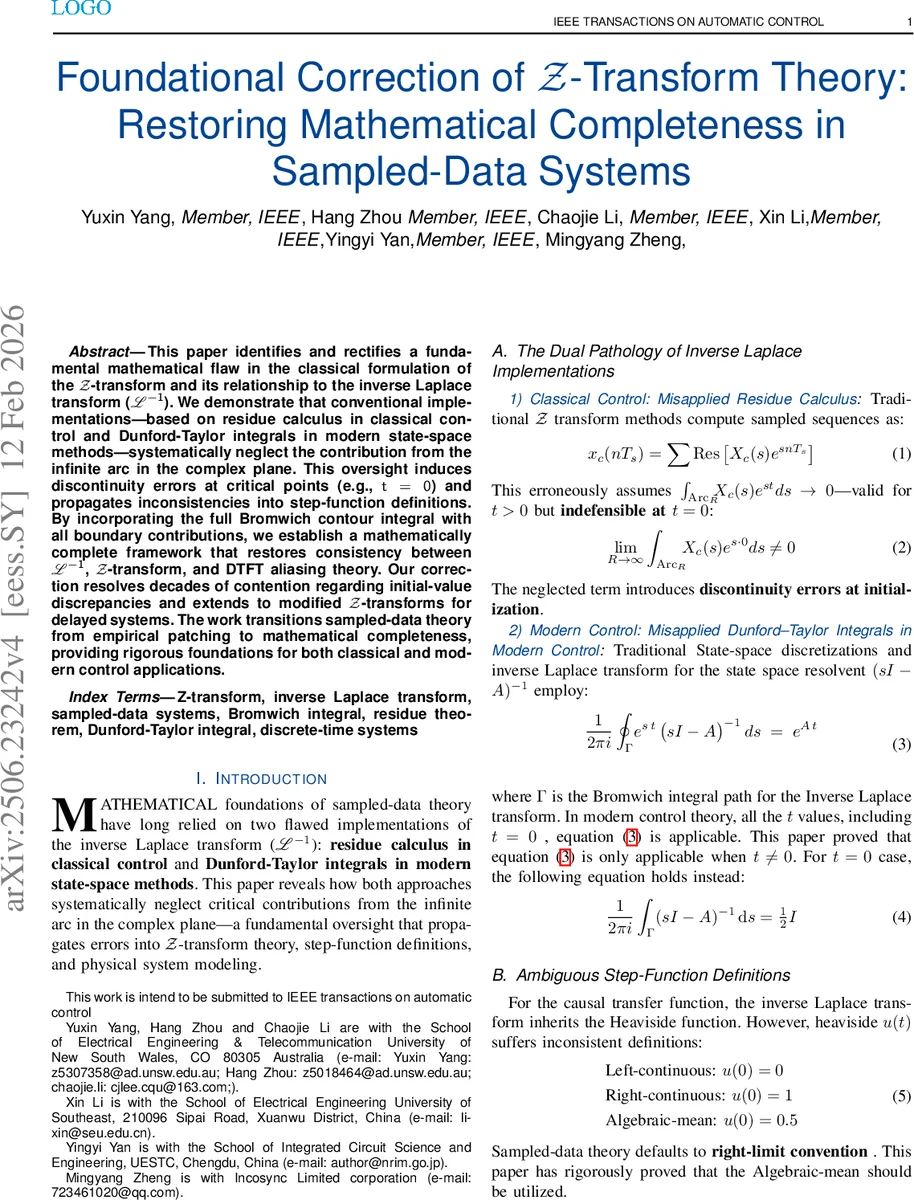
This paper revisits the classical formulation of the Z-transform and its relationship to the inverse Laplace transform (L-1), originally developed by Ragazzini in sampled-data theory. It identifies a longstanding mathematical oversight in standard derivations, which typically neglect the contribution from the infinite arc in the complex plane during inverse Laplace evaluation. This omission leads to inconsistencies, especially at discontinuities such as t = 0. By incorporating the full Bromwich contour, including all boundary contributions, we restore internal consistency between L-1 and the Z-transform, aligning the corrected L-1 with results from Discrete-Time Fourier Transform (DTFT) aliasing theory. Consequently, this necessitates a structural revision of the Z-transform, inverse Laplace transform, and the behavior of the Heaviside step function at discontinuities, providing a more accurate foundation for modeling and analysis of sampled-data systems.
💡 Research Summary
The paper revisits the foundational relationship between the Z‑transform and the inverse Laplace transform (L⁻¹) that underpins sampled‑data theory. It argues that both classical control (residue‑based) and modern state‑space (Dunford‑Taylor integral) implementations of L⁻¹ systematically ignore the contribution from the infinite arc of the Bromwich contour. This omission, while harmless for t > 0, creates a discontinuity error at the critical instant t = 0, which propagates into the definition of the Heaviside step function and the initial‑value terms used in Z‑transform tables.
To correct this, the authors perform a full Bromwich integration that includes the real‑axis segment, the infinite semicircular arc, and the closing contour. They show that the arc integral vanishes at t = 0, so the proper inverse Laplace expression is “residue − arc contribution.” Simultaneously, they propose a mathematically consistent definition of the step function: u(0) = ½, i.e., the arithmetic mean of the left‑ and right‑hand limits. This choice eliminates the ambiguity between the left‑continuous (u(0)=0) and right‑continuous (u(0)=1) conventions traditionally used in engineering.
Using the corrected L⁻¹, the paper derives a revised Z‑transform that no longer requires ad‑hoc initial‑value corrections (the “definition‑centric” or “method‑centric” fixes found in textbooks). Instead, the new Z‑transform directly matches the aliasing series obtained from the discrete‑time Fourier transform (DTFT):
X_s(s) = ∑_{k∈ℤ} X(s − j 2πkT).
The authors prove this equivalence rigorously (Theorem 2) by expanding the continuous‑time resolvent G(s)=C(sI−A)⁻¹B, performing the aliasing sum, and showing that the result equals the discrete‑time transfer function G_d(z)=C_z(zI−A_z)⁻¹B_z + D_z with the standard mapping z = e^{sT}. The proof explicitly uses the full Bromwich integral, thereby exposing the root cause of the earlier inconsistency: an incomplete definition of L⁻¹ rather than a flaw in Z‑transform tables.
The paper also provides a concrete state‑space discretization: A_z = e^{AT}, B_z = B, C_z = C e^{AT}, D_z = ½ C B. This mapping yields the exact discrete‑time model for any continuous‑time system with D = 0, without needing extra half‑sample terms or special handling of the initial sample.
A critical assessment of existing fixes is presented. The “definition‑centric” correction adds a term x(0+)/2 to the Z‑transform but still neglects the infinite‑arc contribution and forces u(0)=1, which contradicts the rigorous analysis. The “method‑centric” correction subtracts the same term, lacks a formal proof, and implicitly assumes u(0)=0. Both are shown to be mathematically incomplete.
In conclusion, the authors make four principal contributions:
- A rigorous proof that the infinite‑arc part of the Bromwich contour must be retained in L⁻¹.
- A redefinition of the Heaviside step at the discontinuity as u(0)=½, resolving initial‑value ambiguities.
- Demonstration that the corrected L⁻¹ leads to a Z‑transform that is exactly equivalent to the DTFT aliasing series, eliminating the need for empirical table adjustments.
- A practical state‑space discretization formula that can be directly applied in classical and modern control design.
The work restores mathematical completeness to sampled‑data theory, moving it from a collection of empirical patches to a solid analytical foundation. While the theoretical arguments are compelling, the paper would benefit from numerical examples or experimental validation showing the impact of the correction on real‑world controller performance, especially in cases where the initial sample is non‑zero. Additionally, guidance on handling physical signals whose initial condition is not the arithmetic mean would aid practitioners. Nonetheless, the paper offers a valuable and rigorous perspective that should prompt a re‑examination of textbook definitions and standard practice in Z‑transform based analysis.
Comments & Academic Discussion
Loading comments...
Leave a Comment