Can An Uncertainty Relation Generate A Plasma?
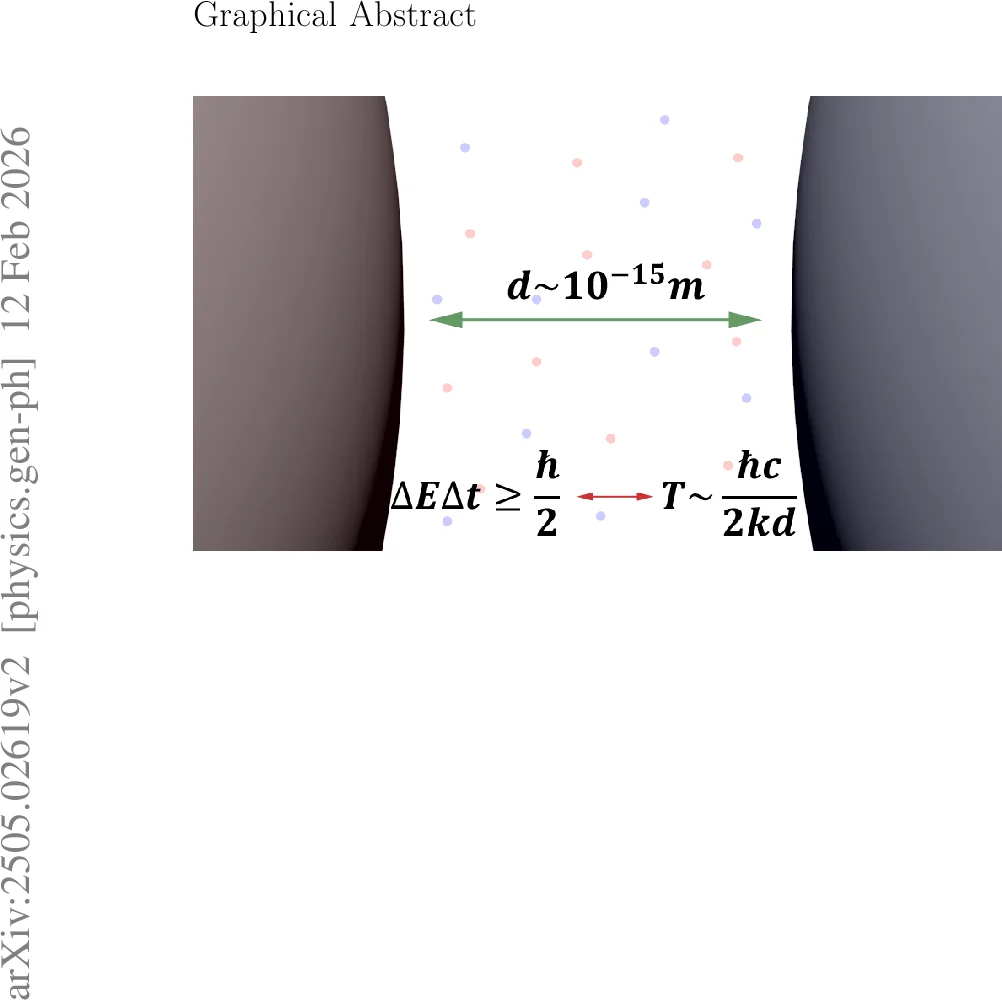
We explore the fundamental idea that there may be a role for the Casimir effect, via an uncertainty relation, in the generation of electron-positron and quark-gluon plasmas. We investigate this concept, reviewing the possible contribution of semi-classical electrodynamics to nuclear interactions, specifically focusing on the Casimir effect at sub-Fermi length scales. The main result is a temperature distance relation, derived from the time-energy uncertainty relation, which can have observable consequences at these extreme scales. From a more general perspective, since the energy-time uncertainty relation appears to be a significant physical quantity, we also provide a brief overview of recent developments in this direction in Sec. 3.2.
💡 Research Summary
The paper investigates whether the uncertainty principle, specifically the time‑energy relation, can be linked to the Casimir effect in order to generate electron‑positron and quark‑gluon plasmas at nuclear (femtometer) scales. The authors begin by reviewing the historical work of Ninham, Parsegian, and collaborators on intermolecular forces and the suggestion that semi‑classical electrodynamics (Maxwell’s equations combined with Planck quantization) may contribute to nuclear binding through screened Casimir‑Yukawa potentials. They then propose a heuristic temperature‑distance relation derived from ΔE·Δt ≥ ℏ/2, where Δt is approximated by the light‑travel time d/c between two nucleons and ΔE is taken as the pion rest energy mπc². This yields kT ≈ ℏc/(2d), implying that sub‑femtometer separations correspond to temperatures of order 10¹² K or higher.
In Section 3.1 the authors critique the common claim that the time‑energy uncertainty directly permits particle creation, emphasizing instead the Mandelstam‑Tamm formulation τ_A ΔH ≥ ℏ/2, which relates observable change times to energy spread but does not by itself generate real pairs. They argue that genuine pair creation in a Casimir geometry arises from the interaction of the quantum vacuum with boundary conditions, not merely from the uncertainty principle.
Section 3.2 revisits Bohr’s proposal of an energy‑temperature uncertainty Δβ ≥ 1/ΔE (β = 1/kT). Building on recent work by Miller and Anders, they generalize this to strongly coupled systems, introducing a non‑negative quantum term Q that tightens the bound: Δβ ≥ 1/√(ΔU² − Q). In the weak‑coupling limit Q→0 the original Bohr relation is recovered. This formalism provides a statistical‑mechanical foundation for linking temperature fluctuations to energy fluctuations in small, possibly non‑equilibrium, nuclear systems.
Section 3.3 combines the temperature‑distance relation with the well‑known high‑temperature expression for an electron‑positron plasma density, ρ ≈ 3ζ(3)k³T³/(π²ℏ³c³). Substituting kT ≈ ℏc/(2d) yields ρ ∝ d⁻³, indicating that as the nucleon separation shrinks, the effective plasma density rises dramatically. The authors claim that at distances ≲1 fm the resulting temperature is sufficient not only for an e⁺e⁻ plasma but also falls within the range required for a quark‑gluon plasma (QGP).
Section 3.4 shows that the same temperature‑distance relation emerges from a low‑temperature expansion of the Casimir free energy between perfect metal plates: G(d,T) ≈ −π²ℏc/(720d³) − ζ(3)k³T³/(2πℏ²c²) + …, where the first term is the zero‑temperature Casimir attraction and the third term represents black‑body radiation. Ninham’s earlier observation that these two terms can cancel at a specific equilibrium distance leads directly to the same kT ≈ ℏc/(2d) condition. The authors note the striking numerical coincidence that the Casimir energy at femtometer separations is of the same order as nuclear binding energies, suggesting a possible semi‑classical contribution to nuclear forces.
Section 3.5 presents a table of numerical estimates for separation distances (1.0–2.0 fm), corresponding meson lifetimes, pion masses, and binding energies. The Casimir contribution (~10 MeV) aligns with experimental binding energies, and the predicted meson masses are close to observed values. The authors acknowledge that modeling nucleons as conducting plates is a crude approximation and propose future work with spherical nuclear geometries and more realistic material properties.
In the discussion (Section 4) the authors reiterate an alternative derivation Δt = ℏ/Δ(kT) and argue that distances around 1 fm correspond to temperatures exceeding 10¹² K, potentially creating QGP. They caution that their conclusions are speculative, emphasizing the need for rigorous QED/QCD calculations, high‑precision Casimir simulations, and experimental validation. They suggest extending the framework to magnetic media and to inter‑molecular distances where Casimir forces are already experimentally accessible.
Overall, the paper presents an intriguing conceptual bridge between quantum uncertainty, Casimir physics, and high‑energy plasma generation at nuclear scales. While the heuristic derivations are mathematically consistent, the physical assumptions—treating nucleons as perfect conductors, neglecting strong interaction dynamics, and interpreting ΔE·Δt as a literal energy source—limit the immediate applicability of the results. The work serves as a provocative starting point for further theoretical and experimental investigations into whether vacuum‑fluctuation forces can play a measurable role in nuclear and sub‑nuclear phenomena.
Comments & Academic Discussion
Loading comments...
Leave a Comment