On strong Euler-homogeneity and Saito-holonomicity for complex hypersurfaces. Applications to a conjecture on free divisors
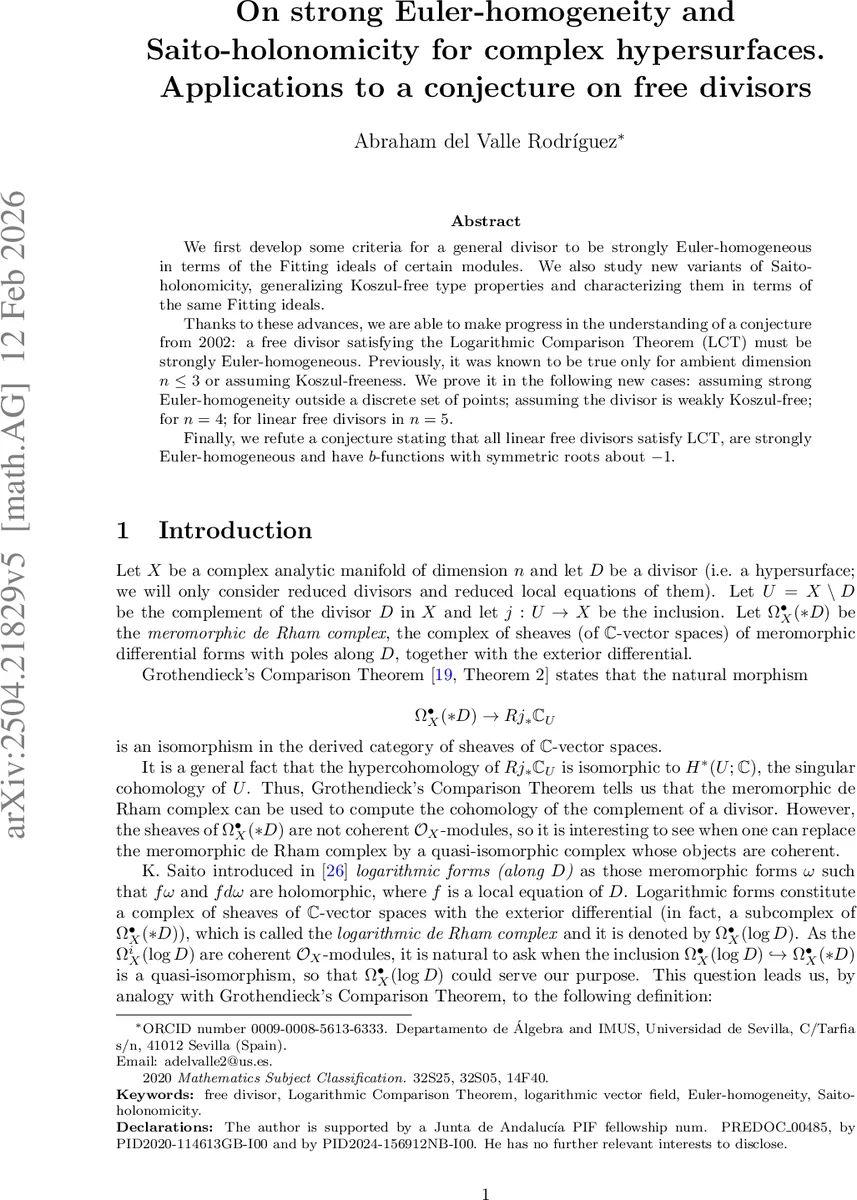
We first develop some criteria for a general divisor to be strongly Euler-homogeneous in terms of the Fitting ideals of certain modules. We also study new variants of Saito-holonomicity, generalizing Koszul-free type properties and characterizing them in terms of the same Fitting ideals. Thanks to these advances, we are able to make progress in the understanding of a conjecture from 2002: a free divisor satisfying the Logarithmic Comparison Theorem (LCT) must be strongly Euler-homogeneous. Previously, it was known to be true only for ambient dimension $n \leq 3$ or assuming Koszul-freeness. We prove it in the following new cases: assuming strong Euler-homogeneity outside a discrete set of points; assuming the divisor is weakly Koszul-free; for $n=4$; for linear free divisors in $n=5$. Finally, we refute a conjecture stating that all linear free divisors satisfy LCT, are strongly Euler-homogeneous and have $b$-functions with symmetric roots about $-1$.
💡 Research Summary
The paper develops new algebraic criteria for strong Euler‑homogeneity and variants of Saito‑holonomicity of complex hypersurfaces, using Fitting ideals of modules associated to logarithmic derivations. After recalling the logarithmic de Rham complex and the Logarithmic Comparison Theorem (LCT), the author introduces the Saito matrix A (built from a generating set of logarithmic vector fields) and its extended version ~A, which records also the coefficients α_i satisfying δ_i(f)=α_i f for a reduced local equation f of the divisor D. The loci D_i (where rank A ≤ i) and ~D_i (where rank ~A ≤ i) are defined as the vanishing sets of appropriate Fitting ideals. The main technical achievement of Sections 3 and 4 is to show that strong Euler‑homogeneity of D at a point p is equivalent to a dimension condition on the sets D_i and ~D_i near p, and that strong Saito‑holonomicity (a new notion extending Saito’s holonomic divisors) is characterized by analogous dimension conditions on the ~D_i.
The paper then introduces weakened and strengthened versions of Koszul‑freeness for free divisors: “weakly Koszul‑free” relaxes the regular sequence condition in the graded ring gr D_X, while “strongly Koszul‑free” requires the regular sequence to generate the whole logarithmic derivation module. These notions are shown to be equivalent to the Fitting‑ideal criteria for strong Saito‑holonomicity. By passing to the formal power‑series completion, the author proves that the same criteria hold in the formal setting, which is crucial for later deformation arguments.
Armed with these tools, the author attacks Conjecture 1.2 (2002): a free divisor satisfying LCT must be strongly Euler‑homogeneous. The conjecture was known only for ambient dimension n ≤ 3 or under Koszul‑freeness. The paper proves several new cases:
-
Punctured‑neighbourhood version (Theorem 6.1, 6.3). If a free divisor is strongly Euler‑homogeneous on a punctured neighbourhood of a point and satisfies LCT, then the existence of a non‑topologically nilpotent logarithmic derivation forces strong Euler‑homogeneity at the point itself. Consequently, any free divisor that is strongly Euler‑homogeneous outside a discrete set of points and satisfies LCT is strongly Euler‑homogeneous everywhere.
-
Weakly Koszul‑free divisors (Theorem 6.5). The same conclusion holds for free divisors that are merely weakly Koszul‑free, without any restriction on the ambient dimension.
-
Four‑dimensional case (Theorem 6.10). Using an intrinsic formal structure theorem (Theorem 6.8) and the strong Saito‑holonomicity criteria, the conjecture is proved for all free divisors in dimension 4.
Finally, the paper addresses two conjectures concerning linear free divisors. Granger, Mond, Nieto and Schulze had conjectured that every linear free divisor satisfies LCT, is strongly Euler‑homogeneous, and has a Bernstein–Sato polynomial whose roots are symmetric about –1. The author constructs an explicit counterexample in dimension 5, showing that while the divisor still satisfies LCT and the strong Euler‑homogeneity part of Conjecture 1.2, its b‑function lacks the claimed symmetry, thereby refuting both conjectures in dimension 5. Nevertheless, the author proves that Conjecture 1.2 remains true for linear free divisors in dimension 5.
Overall, the work provides a unified Fitting‑ideal framework for detecting strong Euler‑homogeneity and Saito‑holonomicity, extends the validity of the LCT ⇒ strong Euler‑homogeneity conjecture to several new families (including all free divisors in dimension 4 and weakly Koszul‑free divisors in any dimension), and clarifies the limits of previously held beliefs about linear free divisors. The results deepen the interplay between logarithmic geometry, D‑module theory, and singularity theory, and open avenues for further exploration of holonomic properties beyond the free case.
Comments & Academic Discussion
Loading comments...
Leave a Comment